What Is a Carpet? Types, Materials, and How It’s Made
What is a carpet, really? Most people use the word every day without knowing what separates a true carpet from a rug, a mat, or carpet tile. That confusion gets expensive fast once you start shopping for new flooring or trying to figure out what’s actually under your feet.
This guide breaks carpet down in plain language: what it’s made of, how it’s built, the different pile types you’ll see in stores, and what actually determines how long it lasts. By the end you’ll know exactly what you’re looking at, what questions to ask before you buy, and how to keep it performing well once it’s installed.
A carpet is a textile floor covering made of fiber strands attached to a backing material. It usually has a layer of cushioned padding underneath and is fastened to the floor, covering part or all of a room. Most modern carpet is tufted from nylon, polyester, polypropylene, or wool.
What Is a Rug, and How Is It Different From Carpet?
So what is a rug, exactly? It’s a smaller, loose-laid floor covering with finished edges, while carpet is fastened down and usually covers an entire room. That’s the simplest answer, but the line between the two blurs more than people expect.
Carpet almost always means wall-to-wall installation. It’s cut to fit a room, stretched over padding, and secured to the floor with tack strips or adhesive. You can’t just pick it up and move it to another room.
A rug sits on top of an existing floor instead of replacing it. It’s woven or tufted with finished, bound edges so it doesn’t fray, and it’s meant to be lifted, rolled up, or swapped out whenever you want a change. Some rugs are even cut from leftover carpet and given finished edges, which is part of why the two words get mixed up so often.
Size is the other practical difference. Rugs are usually a defined size meant to anchor a seating area or hallway. Carpet is sold by the roll and cut to match whatever room it’s going into, so there’s no standard size at all.
Choosing between them usually comes down to flexibility. A rug makes sense if you want to change your look often, layer it over hardwood or tile, or define a specific zone in an open floor plan. Wall-to-wall carpet makes more sense when you want consistent warmth and softness across an entire room, especially bedrooms and family rooms where comfort matters more than the ability to rearrange.
What Is a Carpet Used For?
So what is a carpet actually used for, beyond covering a floor? It cushions every step, absorbs sound, traps heat, and adds color and texture to a room.
Underfoot comfort is the most obvious benefit. Carpet cushions every step, which matters in bedrooms, living rooms, and anywhere people sit or kneel on the floor with kids or pets.
It also blocks noise far better than hard flooring. Carpet fibers absorb sound instead of bouncing it around the room, which is why apartments and multi-story homes often require carpet on at least part of the floor.
Heat retention is another real advantage. Carpet traps a layer of warm air near the floor, so rooms with carpet generally feel warmer than rooms with tile or hardwood, even at the same thermostat setting.
Beyond function, carpet is also a design tool. Color, pattern, and texture let it set the tone of a room in a way that’s harder to achieve with hard flooring alone.
Carpet also makes a room safer in practical terms. It softens falls for kids and older adults, and it provides better grip underfoot than smooth tile or hardwood, which is one reason it’s still common on stairs even in homes that have switched to hard flooring everywhere else.
What Are the Different Parts of a Carpet?
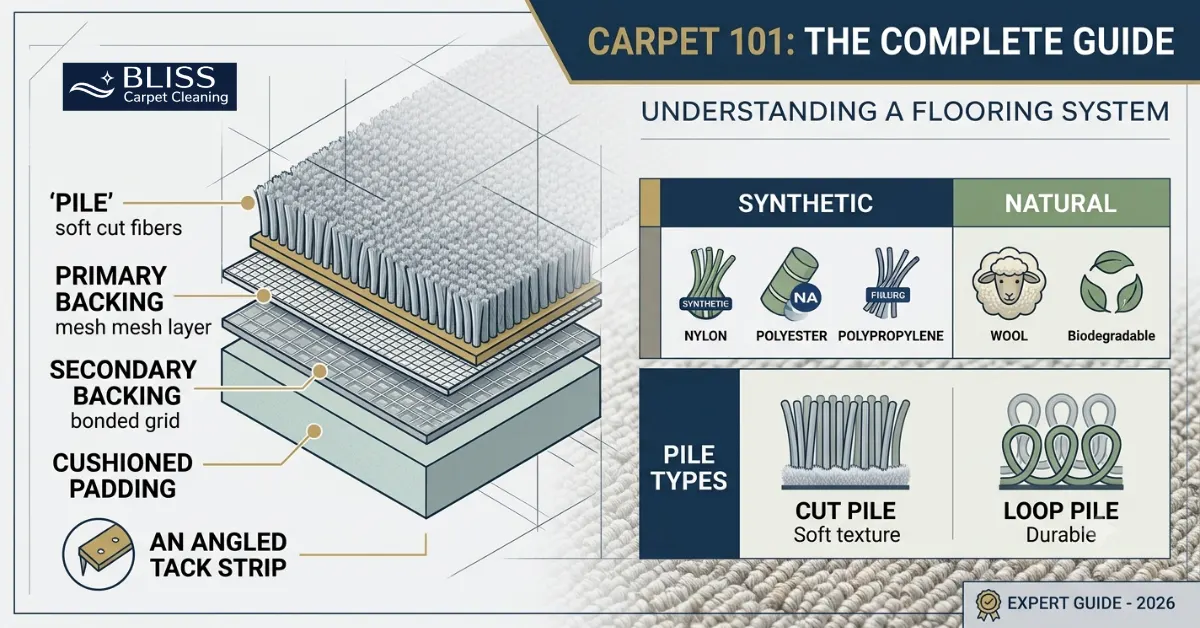
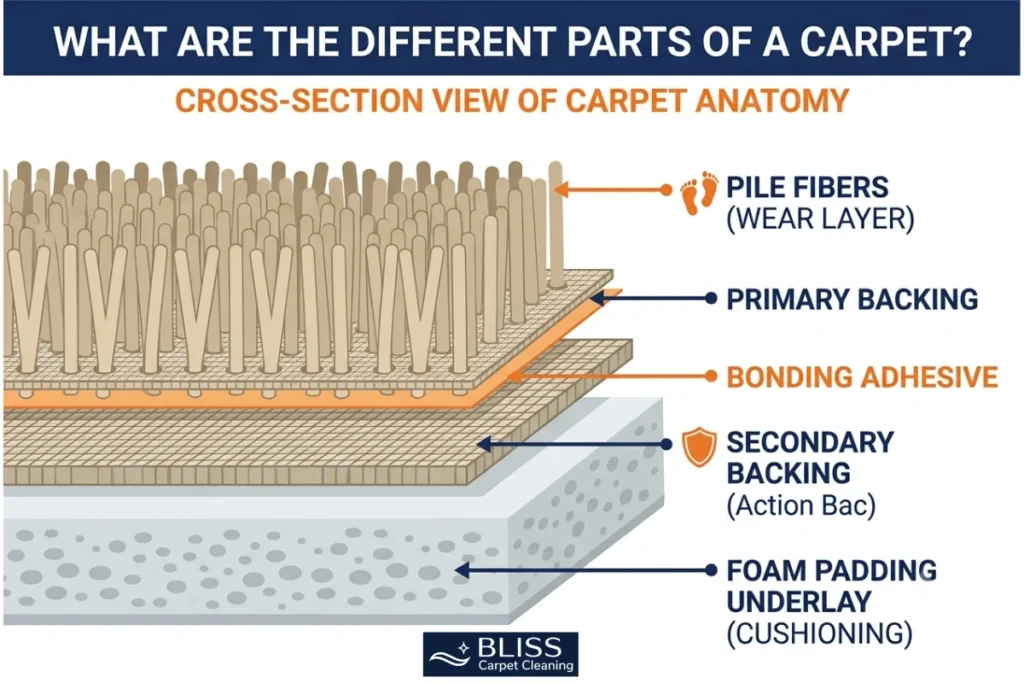
A carpet is made up of four basic parts: the pile, the primary backing, the secondary backing, and the padding underneath. Each layer does a different job.
The pile is the part you see and walk on, the visible fiber on top. It can be cut into individual strands or left as closed loops, and that choice affects how the carpet feels and wears.
Underneath the pile sits the primary backing, a woven mesh that holds the tufted fibers in place. A secondary backing, often a sturdier woven material, gets bonded to the primary backing for extra stability and to keep the carpet from stretching out of shape. Backing material is usually a synthetic mesh, though some carpets still use natural jute for the secondary layer.
Padding, also called underlay, goes between the carpet and the subfloor. It’s usually foam, rubber, or felt, and it adds bounce, comfort, and a longer lifespan to the carpet sitting on top of it.
How Tack Strips Hold Carpet in Place
Tack strips are thin wood or metal strips with angled points, nailed around the edge of a room before installation. The carpet gets stretched across the room and hooked onto these points, which keeps it tight and prevents wrinkles or shifting over time.
How Is Carpet Made?
Most carpet today is made through tufting, where a machine pushes yarn through a backing material using hundreds of needles. The loops are either left intact or sheared, and a second backing is bonded on for strength.
It starts with loose fiber strands called staples. These get heated, lubricated, and twisted into long slivers, which are then spun into spools of yarn ready for the tufting machine.
A tufting machine can run up to 12 feet wide with over a thousand needles working at once. Each needle pushes yarn through the primary backing while a looper holds it in place from underneath, forming the loops that become the pile.
Older and higher-end carpet is still made by weaving, where the pile is created directly on a loom alongside the backing in one process. Hand-knotted rugs use a similar idea but rely on individual knots tied by hand, which is why they take so much longer to produce.
A few less common methods round out the picture. Needle felting bonds synthetic fibers together using barbed needles instead of weaving or tufting them, producing an extremely durable surface often used in hotels and restaurants. Embroidered carpet, now mostly a handcraft, builds its pattern with stitches applied directly to a cloth base rather than through a loom at all.
Tufted vs. Woven Carpet
Tufted carpet is faster and cheaper to produce, which is why it dominates the residential market today. Woven carpet takes longer and costs more, but it tends to hold its pattern and shape better over decades of use, which is why hotels and high-traffic commercial spaces still choose it.
What Are the Main Materials Used to Make Carpet?
So what is carpet made of? Most modern carpet is built from one of four fibers: nylon, polyester, polypropylene, or wool. Around 90 percent of carpet sold today uses a synthetic fiber instead of wool.
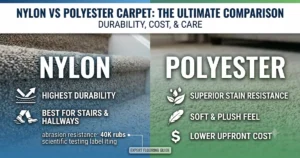
Nylon is the most common choice and the toughest of the synthetics. It resists wear well, holds its shape under heavy traffic, and takes dye easily, though it can stain if the dye sites aren’t treated. Most nylon sold today comes solution-dyed or stain-treated specifically to address that weakness.
Polyester, often labeled PET, is valued for its soft feel and color richness. It resists water-based stains naturally, but it tends to flatten under heavy furniture or foot traffic faster than nylon.
Polypropylene, also called olefin, resists moisture and fading exceptionally well, which makes it a common choice for basements and outdoor-style carpet. It’s harder to dye and softer underfoot than nylon, but it holds up against oil-based stains less effectively. This is also the fiber most commonly used in Berber-style loop carpet, since its lower cost suits the looser, coarser weave.
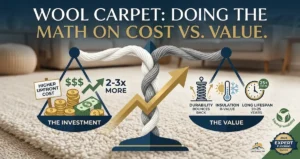
Wool is the main natural fiber still used in carpet. It’s durable, naturally stain-resistant, and biodegradable, but the cost puts it out of reach for a lot of budgets. Many wool carpets are blended with synthetic fiber, commonly an 80 percent wool to 20 percent synthetic mix, to balance cost and durability.
Triexta is a newer synthetic fiber that’s gained ground in recent years. It’s partly made from renewable corn-based material, resists staining without added chemical treatment, and holds up to crushing about as well as nylon, which has made it a popular middle-ground choice between performance and price.
What Are the Main Types of Carpet Pile?
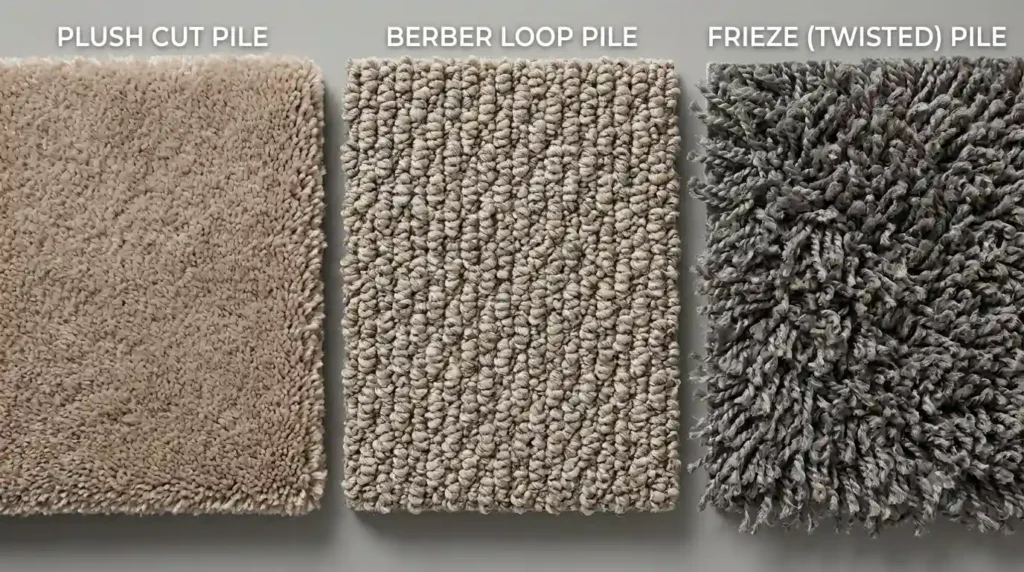
Carpet pile falls into two basic categories: cut pile and loop pile. Everything else, plush, Berber, frieze, shag, is a variation of one of these two.
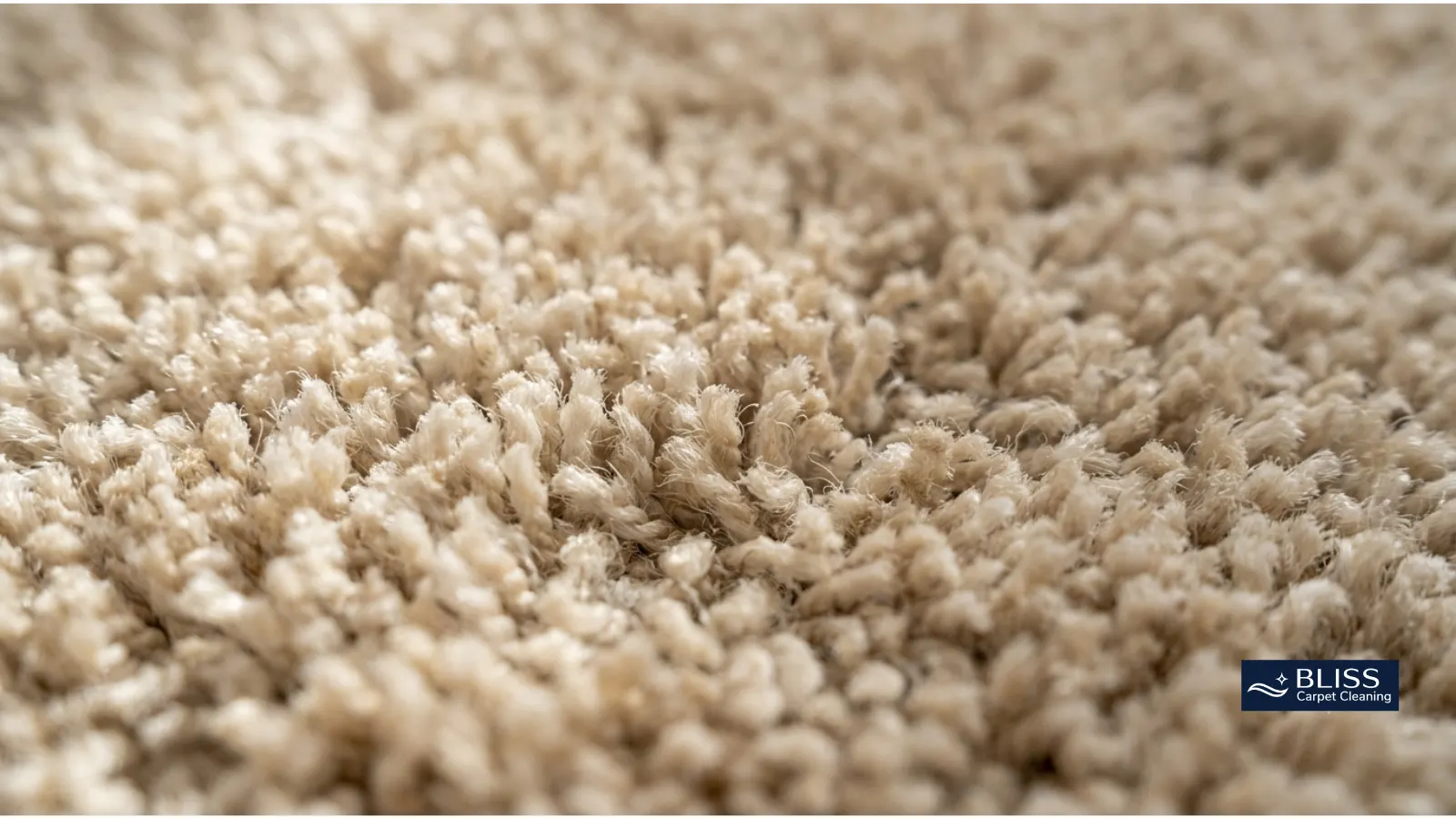
Cut pile carpet has its fiber loops sheared off at the top, leaving individual strands standing upright. This creates a soft, dense feel that most people picture when they think of carpet, and it covers styles like plush and Saxony.
Loop pile leaves the fiber loops uncut. Berber carpet is the most familiar loop pile style, known for its durability and its tendency to hide footprints and vacuum marks better than cut pile.
Frieze carpet uses long, twisted strands that curl in different directions, which hides footprints and vacuum lines even better than Berber. Shag carpet is an older loop style with longer fibers, popular for its texture but harder to keep clean since dirt settles deeper into the pile.
Pile height adds another layer to the decision. High pile carpet, where the fiber stands taller, feels softer and more plush underfoot. Low pile carpet is cut shorter and packed tighter, which makes it firmer, easier to clean, and generally better for households dealing with allergies since there’s less room for dust to settle into the fibers.
How Long Does Carpet Last, and What Affects Its Durability?
Carpet typically lasts between 5 and 15 years, depending on the fiber, the density, and how well it’s maintained. No single number applies to every carpet.
Fiber choice plays a major role. Nylon generally outlasts polyester and polypropylene under heavy foot traffic, while wool can last decades if it’s properly cared for.
Density matters just as much as fiber type. According to the Carpet and Rug Institute, residential carpet should have a density rating of 3,000 or higher, with commercial-grade carpet rated at 5,000 or above. Higher density means the fibers are packed more tightly, which resists crushing and matting.
Foot traffic and maintenance finish the equation. A carpet in a busy hallway wears out faster than the same carpet in a guest bedroom, and skipping regular vacuuming or professional cleaning shortens its life regardless of how well it was made. Dirt and grit act like sandpaper on carpet fibers, so the longer they sit, the more damage they cause every time someone walks across the room.
Why Carpet Care and Indoor Air Quality Matter
Carpet acts like a filter, trapping dust, pollen, and other particles in its fibers until they’re removed. Left uncleaned, that same carpet can work against the air quality it normally helps protect.
According to the EPA, more than 4 billion pounds of carpet enter the U.S. solid waste stream every year. Most of that ends up in landfills rather than being recycled. In the most recent year measured, only about 9 percent of discarded carpet was recycled, while nearly three-quarters went straight to a landfill.
That waste problem connects directly to how carpet gets treated while it’s still in use. The Carpet and Rug Institute reports that regular vacuuming removes 90 to 95 percent of the dry soil trapped in carpet fibers, keeping those particles from recirculating into the air. CRI also recommends professional deep cleaning every 12 to 18 months to remove the soil vacuuming alone can’t reach.
Because most people spend close to 90 percent of their time indoors, what’s trapped in carpet fiber matters more than it might seem. CRI’s Green Label Plus program, recognized by the EPA, LEED, and the American Lung Association’s Healthy Home program, tests carpet, padding, and adhesives for low chemical emissions before they reach store shelves.
The World Floor Covering Association notes that more than 90 percent of today’s carpet is made from synthetic fiber. That’s worth knowing when comparing maintenance needs, since synthetic and natural fibers respond differently to cleaning products and moisture, and using the wrong approach can shorten the life of either type.
Common Questions About Carpet, Answered
Who invented carpet, and how old is the craft?
Carpet weaving dates back thousands of years, with the oldest surviving example, the Pazyryk carpet, dated to around the 5th century BC and discovered frozen in a burial site in Siberia. No single person invented it. The craft developed independently across multiple ancient cultures, including Persia, the Caucasus, and Central Asia.
When did wall-to-wall carpet become popular in American homes?
Wall-to-wall carpet took off in the 1950s, once tufting made production fast and affordable. By the late 1960s, tufted carpet sales had grown from roughly 6 million yards a year to about 400 million yards a year.
What does “broadloom” carpet mean?
Broadloom simply means carpet woven on a wide loom and sold in large rolls, instead of carpet tiles or narrow strips sewn together. It’s the standard format for most wall-to-wall residential carpet today, and the term is sometimes used as shorthand for traditional roll carpet in general.
What’s the difference between carpet and carpet tile?
Carpet comes in large rolls and is installed wall-to-wall in one continuous piece. Carpet tile is cut into individual squares that can be installed, removed, and replaced one at a time, which is why it’s common in offices and commercial spaces.
Is carpet bad for allergies?
Carpet isn’t automatically bad for allergies. Research cited by the Carpet and Rug Institute shows no clear evidence that removing carpet reduces indoor allergens, since hard floors let particles settle on the surface and become airborne again with every step. Regular vacuuming and professional cleaning are what actually keep allergens under control, regardless of which flooring type is installed.
How wide does carpet typically come?
Most carpet sold in the United States comes in widths of 12 or 15 feet. That width is one reason large rooms sometimes need carpet seamed together to cover the whole floor.
What is carpet density, and why does it matter?
Carpet density measures how tightly the fibers are packed into the backing, usually expressed as a number rather than a percentage. Higher density generally means better resistance to crushing, matting, and visible wear over time, which is why it matters more in high-traffic rooms than in spaces people barely walk through.
Is wool carpet better than synthetic carpet?
Wool is more durable and naturally stain-resistant, but it costs significantly more than synthetic fiber. Synthetic carpet, especially nylon, gets close to wool’s durability at a fraction of the price, which is why it dominates the market.
Can old carpet be recycled?
Yes, but it’s not common yet. Carpet fiber, backing, and padding can be broken down and reused in new products, though only a small percentage of discarded carpet is actually recycled each year rather than landfilled or burned for energy recovery.
What is Berber carpet, in simple terms?
Berber is a loop pile carpet originally associated with the Berber people of North Africa. It’s known for its durability and its ability to hide footprints, vacuum lines, and everyday wear better than most cut pile styles.
The real takeaway is that carpet isn’t just one product. It’s a system of fiber, pile, backing, and padding working together, and changing any one piece changes how it performs in your home and how long it actually lasts. So the next time you ask what is a carpet, the honest answer is: it depends on what’s underneath the surface you can see, and on how well that system gets cared for once it’s down.
If you are in the Las Cruces NM area and need professional carpet cleaning, our team is ready to help.