


Blog · Carpet Materials
What Is Berber Carpet? Loops, Cost, and Durability
What is Berber carpet, and why does it show up in nearly every budget flooring recommendation? Berber gets recommended constantly, but most explanations stop at "it's the looped one" without explaining what that loop construction actually means for your wallet, your pets, or how long the floor will last.
Published September 28, 20268 min read
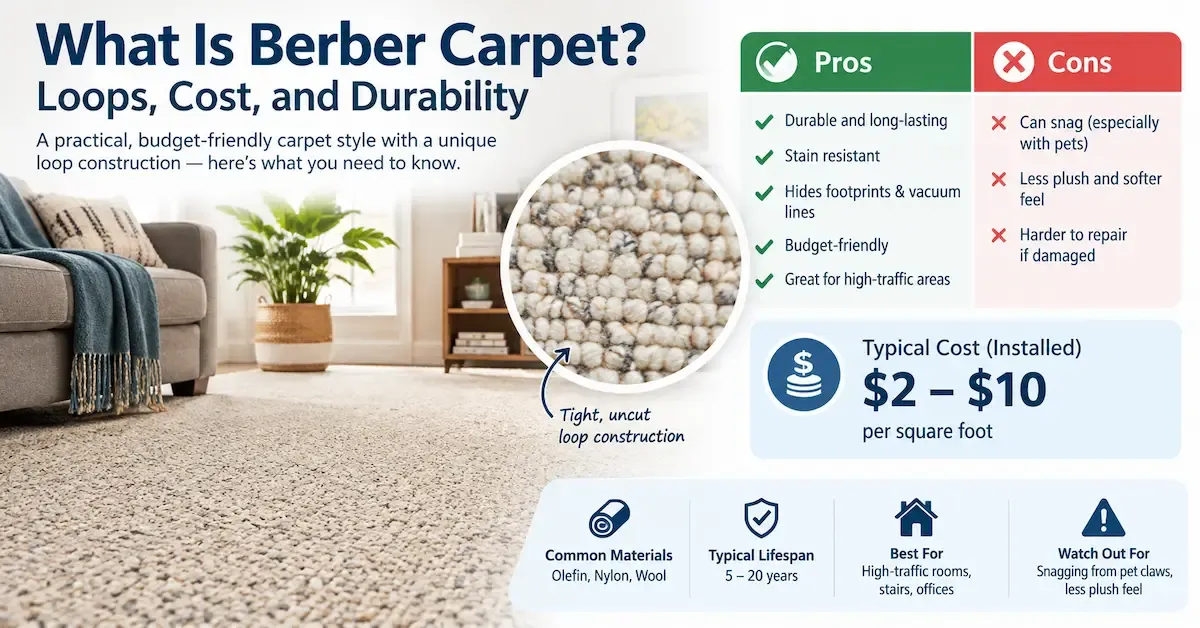
This guide breaks down what Berber carpet actually is, the real berber carpet pros and cons, what it costs in actual numbers, and where it performs best in a home. No vague pros-and-cons list, just the details that actually change your decision.
The Short Answer: Berber carpet is a style of carpet defined by its tight, uncut loop construction, originally inspired by handwoven North African textiles. Modern Berber is usually made from nylon or olefin, costs $2 to $10 per square foot installed, and is known for durability and stain resistance over plush comfort.
Berber Carpet at a Glance
| Feature | Detail |
|---|---|
| Construction | Tight, uncut loop pile |
| Common Materials | Olefin (most affordable), nylon, wool (premium) |
| Cost Installed | $2 to $10 per square foot |
| Typical Lifespan | 5 to 20 years, depending on fiber and density |
| Best For | High-traffic rooms, stairs, offices |
| Watch Out For | Snagging from pet claws, less plush feel |
What Is Berber Carpet, Exactly?
Berber carpet is a loop-pile carpet style named after the handwoven textiles of North Africa's Berber people, who have made similar knotted, flecked fabrics for thousands of years.
Modern Berber is mass-produced rather than handwoven, but it keeps the look: a light background color flecked with small, darker specks, built from continuous loops of yarn instead of cut fibers. That loop construction is what actually defines the style, not the color or the price point.
Traditional, handwoven Berber carpets still exist and use a knot rather than a loop, made almost exclusively from wool. In Tunisia specifically, authorities still regulate the craft directly, requiring genuine Berber rugs to use only wool with no synthetic material, then sealing each piece with an official wax mark to certify it. The carpet sold as "Berber" in most home stores today is the modern, machine-tufted version, a different product wearing the same name.
What Makes Berber Loop Carpet Different?
Berber loop carpet keeps every fiber uncut, looping the yarn through the backing and back up again instead of shearing it into individual strands. That's the entire mechanical difference between Berber and most other carpet styles.
Cut-pile carpets like plush or Saxony are made the same way, then the loops get sheared off, leaving exposed fiber ends that feel soft but flatten and shed more easily. Berber skips that step, so the loops stay intact and resist crushing.
Here's where it gets confusing: the word "Berber" actually gets used two different ways in the flooring industry. Most often it describes the loop construction itself. But it's also used to describe the fleck-of-color pattern, even when that pattern shows up on a different construction, like textured or frieze carpet. If a salesperson says "Berber," it's worth asking whether they mean the loop or just the look.
What Are the Pros of Berber Carpet?
Berber's biggest strengths are durability and stain resistance. The tight loop construction resists crushing under heavy traffic and keeps spills sitting on the surface instead of soaking in immediately.
Because the loops hold their shape better than cut fiber, Berber tends to hide footprints and vacuum lines that show up clearly on plush carpet. That makes it a practical pick for living rooms, hallways, and home offices that see daily use.
Berber is also one of the more budget-friendly carpet styles, especially in olefin. The flecked coloring helps disguise dirt and minor wear between cleanings, stretching the time between deep cleans without the carpet looking neglected.
What Are the Cons of Berber Carpet?
Berber's biggest weakness is the loop itself. A single snagged loop can unravel into a visible run, and the construction isn't especially soft compared to plush or shag styles.
Pet claws are the most common cause of snags, since a dog or cat scratching or playing can catch a loop and pull a thread loose. Furniture legs dragged across the floor cause the same problem. Once a loop runs, repair is difficult and sometimes impossible without replacing a section.
Comfort is the other tradeoff. Berber's tight, low-profile construction doesn't compress underfoot the way plush carpet does, so it can feel firmer to walk or sit on, especially without a quality pad underneath.
How Much Does Berber Carpet Cost?
Berber carpet typically costs $2 to $10 per square foot installed, with most full room projects landing around $1,250 on average, according to cost data from HomeGuide, Angi, and HomeAdvisor.
Material alone runs $1 to $5 per square foot for synthetic fiber, while wool or wool-blend Berber costs close to double that. Installation labor adds $1 to $4 per square foot on top, and putting Berber on stairs adds another $3 to $15 per step due to the extra cutting and seaming involved.
For a standard 200 square foot room, that puts most synthetic Berber projects between $400 and $1,800 fully installed, with wool versions running higher. Heavier face weight, meaning more fiber packed per square yard, also pushes the price up but typically delivers a longer-lasting carpet in return.
| Material | Cost Per Sq Ft (Material Only) | Notes |
|---|---|---|
| Olefin / Polypropylene | $1 to $4 | Most affordable, moisture-resistant |
| Nylon | $2 to $5 | Best durability for the price |
| Wool | $4 to $8+ | Premium, softest, costs nearly double |
What Is Berber Carpet Made Of?
Despite its handwoven, natural-fiber origins, most Berber carpet sold today is synthetic. Olefin, also called polypropylene, is the most common and affordable material, according to Wikipedia's documented history of the style.
Nylon is the second most common choice, offering better durability and stain resistance than olefin at a moderate price increase. Wool Berber still exists and delivers the softest feel and closest link to the original handwoven textiles, but it sits at the top of the price range.
Some manufacturers also blend fibers, mixing wool with nylon or adding Triexta for extra stain resistance. The fiber matters more than the Berber label itself when it comes to how the carpet performs day to day. Major brands like Mohawk, Shaw, and Stainmaster all sell Berber lines across multiple fiber types, so the brand name says less about performance than the material listed on the label.
Where Does Berber Carpet Work Best?
Berber performs best in high-traffic areas without pets: living rooms, hallways, home offices, and stairs, where its durability and low profile matter more than plush comfort.
Stairs in particular benefit from Berber's resistance to crushing, since stair treads take more concentrated wear than flat flooring. Basements and home offices are also good fits, especially with olefin Berber, since it resists moisture better than most fiber options.
Bedrooms are a tougher call. Berber's firmer feel underfoot makes it less ideal for a room meant for bare feet and lounging, though a wool or nylon Berber with a quality pad can still work if durability matters more than plushness in that space.
Common Questions, Answered
Is Berber carpet comfortable or soft underfoot?
+
Less so than plush or shag carpet, but a quality pad underneath makes a real difference. Wool and nylon Berber tend to feel softer than olefin, which can feel rougher against bare feet.
Is Berber carpet good for pets?
+
It depends on the pet. Berber holds up fine against general foot traffic and minor accidents, but cat claws and untrimmed dog nails can snag the loops and cause runs over time.
Is Berber carpet good for allergies?
+
Yes, particularly wool or tightly woven synthetic versions, since the dense loop structure traps allergens until vacuuming removes them. Regular professional cleaning helps remove what regular vacuuming misses.
Is Berber carpet still in style?
+
Yes, Berber has made a comeback in recent years after a period of being seen as dated. Modern color and pattern options have moved it away from the flat, neutral look it was known for in past decades.
How long does Berber carpet last?
+
Anywhere from 5 to 20 years, depending heavily on fiber and density. Entry-level olefin in heavy traffic wears out fastest, while dense wool or solution-dyed nylon Berber can last close to two decades with proper care.
Is Berber carpet good for stairs?
+
Yes, it's one of the better choices for stairs. The low, tight loop resists the concentrated wear that stair treads create better than plush or shag styles do.
Can a snagged loop in Berber carpet be repaired?
+
Sometimes, if caught early. A professional can often re-secure a single snagged loop, but a run that's spread across multiple loops usually requires patching or replacing that section.
What's the difference between Berber and regular loop carpet?
+
Technically, Berber is a type of loop carpet, not a separate category. The name specifically refers to loop carpet with the light background and dark fleck pattern; loop carpet without that flecked look is usually just called loop or textured loop.
What colors does Berber carpet come in?
+
Most Berber comes in neutral tones like tan, beige, gray, charcoal, and brown, though some lines offer blue, green, or black accents within the flecked pattern. Multi-color flecked patterns are the most common look across nearly every brand.
Can Berber carpet be used outdoors or on covered patios?
+
Olefin Berber specifically can hold up in covered, low-moisture outdoor spaces since the fiber resists water and mildew better than nylon or wool. It's not a fit for fully exposed outdoor areas regardless of fiber.
So, what is Berber carpet really? It's a loop-built, budget-friendly workhorse, not a luxury comfort carpet, and that's exactly why it's stuck around this long. The right call comes down to where it's going and what's going to walk across it.
If you are in the Las Cruces NM area and want help choosing or maintaining Berber carpet in your home, our team is ready to help.

Michael Sanders
Michael Sanders is a home care and cleaning industry writer covering carpet maintenance, flooring care, and household cleaning practices across the United States. His work focuses on practical, research-backed guidance — from stain and odor removal to deep extraction methods and indoor allergen prevention. Michael collaborates with cleaning professionals to ensure accuracy, and his writing reflects a genuine interest in helping homeowners make informed decisions about caring for their homes.
Have Berber Carpet That Needs Care?
We know how to clean loop-pile Berber carpet the right way, without pulling or snagging the fibers. Serving Las Cruces, NM and the surrounding areas.
Call Now — Free Quote