


Blog · Carpet Materials
Cut Pile vs Loop Pile Carpet: Which One Is Right for You?
Cut pile vs loop pile carpet is one of those decisions that sounds simple until you're standing in a flooring store holding two samples that look almost identical. The construction underneath is what determines how the carpet performs, how long it lasts, and which rooms it belongs in.
Published September 29, 20269 min read
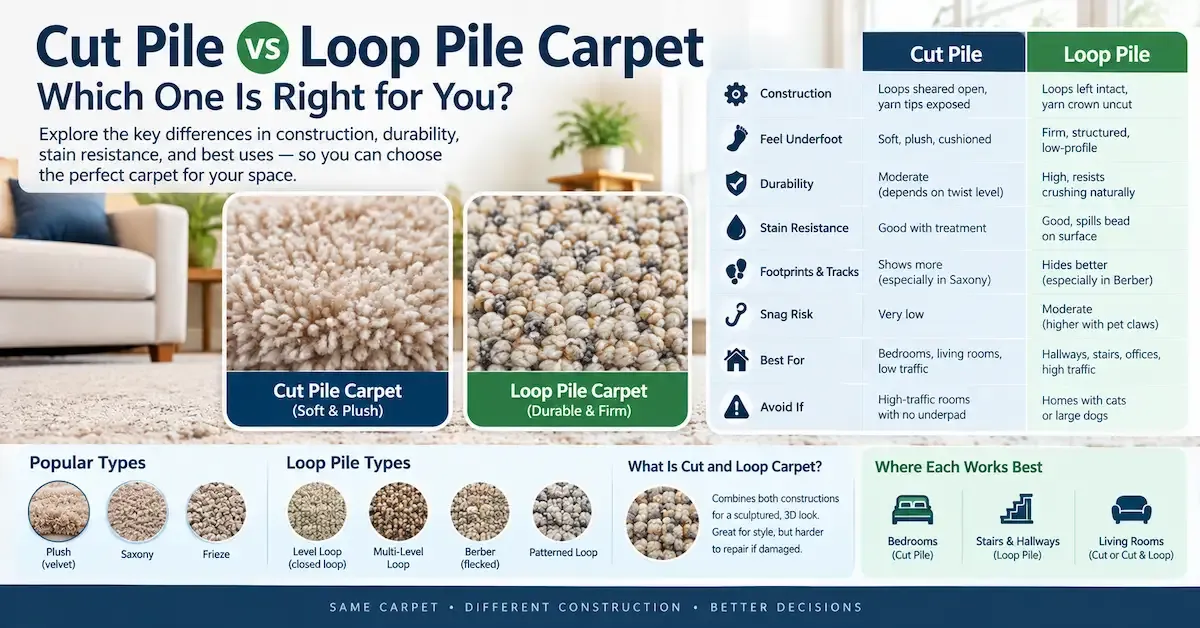
This guide explains how each construction works, what the sub-types look like, where cut and loop carpet fits in, and what the specs on the label actually mean. Tables do the heavy lifting so you get the comparison fast.
Cut pile carpet has yarn loops that are sheared open, creating a soft surface that feels plush underfoot. Loop pile carpet leaves those loops intact, creating a firmer, more durable surface. Cut pile wins on comfort, loop pile wins on durability, and cut and loop carpet sits in between with pattern-making capability neither alone can achieve.
Cut Pile vs Loop Pile at a Glance
| Factor | Cut Pile | Loop Pile |
|---|---|---|
| Construction | Loops sheared open, yarn tips exposed | Loops left intact, yarn crown uncut |
| Feel Underfoot | Soft, plush, cushioned | Firm, structured, low-profile |
| Durability | Moderate, depends on twist level | High, resists crushing naturally |
| Stain Resistance | Good with treatment | Good, spills bead on surface |
| Footprints and Tracks | Shows more, especially in Saxony | Hides better, especially in Berber |
| Snag Risk | Very low | Moderate, higher with pet claws |
| Best For | Bedrooms, living rooms, low traffic | Hallways, stairs, offices, high traffic |
| Avoid If | High-traffic rooms with no underpad | Homes with cats or large dogs |
How Cut Pile and Loop Pile Carpet Are Actually Built
Both constructions start the same way. A tufting machine pushes yarn through a backing material in continuous loops. Loop pile carpet stops there, leaving the loops intact. Cut pile carpet goes one step further, shearing the tops off those loops so each yarn strand stands as an individual tuft with an exposed tip. That one step changes everything about how the carpet feels, wears, and performs.
Types of Cut Pile Carpet
| Style | What It Is | Best For | Watch Out For |
|---|---|---|---|
| Plush / Velvet | Dense, uniform tips cut to same height | Formal rooms, low traffic | Shows every footprint and vacuum mark |
| Saxony | Slightly twisted tips, smooth finish | Bedrooms, formal living rooms | Pile reversal and shading under light |
| Textured Cut Pile | Tips cut at varying angles, casual look | Family rooms, living rooms | Less formal appearance |
| Frieze | Tightly twisted, curled tips | High-traffic rooms, hallways | Less plush feel underfoot |
Types of Loop Pile Carpet
| Style | What It Is | Best For | Watch Out For |
|---|---|---|---|
| Level Loop (Closed Loop) | All loops same height, smooth surface | Offices, basements, commercial | Firmer feel, less comfortable barefoot |
| Multi-Level Loop | Loops at two or three heights, creates pattern | Living rooms, family rooms | Harder to repair if damaged |
| Berber | Level loop with flecked yarn, tight construction | Stairs, hallways, high traffic | Snag risk with pet claws |
| Patterned Loop | Varying loop heights create visual design | Statement rooms, low traffic | Pattern hides wear but limits style flexibility |
What Is Cut and Loop Carpet?
Cut and loop carpet combines both constructions in a single piece, with some loops left intact and others sheared in a deliberate pattern. That mix creates sculptured, three-dimensional surface designs that neither pure cut pile nor pure loop pile can produce alone.
The raised cut pile sections feel softer while the intact loops hold their shape around them, giving the carpet visual depth. This is the construction behind most patterned carpets sold in home stores today. The tradeoff is repairability. If a loop snags or a cut section mats, the two-construction surface is harder to patch invisibly than either a purely cut or purely looped carpet.
Cut Pile vs Loop Pile Carpet: Durability, Stain Resistance, and Pets
The loop stays intact in loop pile carpet, so foot traffic compresses the crown of the loop rather than the exposed tip of a sheared fiber. That's why loop pile holds its shape longer under heavy use.
For cut pile, the Carpet and Rug Institute recommends a twist level of 3.5 or higher to resist matting. Below that, exposed fiber tips flatten permanently under repeated traffic.
| Factor | Cut Pile | Loop Pile |
|---|---|---|
| Crush Resistance | Lower, depends on twist level | Higher, loop crown resists compression |
| Stain Risk | Spills absorb into open fiber tips | Spills bead on loop surface longer |
| Snag Risk | Very low, no loops to catch | Moderate to high with sharp claws |
| Footprint Visibility | High in plush and Saxony, low in frieze | Low in level loop and Berber |
| Pet Suitability | Better, no snag risk | Riskier with cats and large dogs |
| Vacuuming | Standard vacuum with beater bar fine | Suction-only vacuum recommended |
| Repair Difficulty | Moderate | Moderate to difficult |
Which Pile Works Best in Each Room?
| Room | Best Pile | Best Style | Why |
|---|---|---|---|
| Bedrooms | Cut pile | Plush or Saxony | Comfort and softness matter more than durability |
| Living rooms | Cut pile | Textured or frieze | Hides daily marks, softer than loop |
| Hallways | Loop pile | Level loop or Berber | Resists crushing from constant foot traffic |
| Stairs | Loop pile or dense cut | Berber or frieze | Tight construction handles concentrated wear |
| Home offices | Loop pile | Level loop | Durable, hides marks, easy to vacuum |
| Basements | Loop pile | Level loop with olefin fiber | Moisture-resistant fiber suits below-grade rooms |
| Kids and pet rooms | Cut pile | Textured or frieze | No snag risk, easier spot cleaning |
What Face Weight, Twist Level, and Pile Height Actually Mean
These three numbers appear on every carpet label and predict performance more reliably than the style name or brand.
| Spec | What It Measures | What to Look For |
|---|---|---|
| Face Weight | Ounces of fiber per square yard | 35 to 40 oz for residential, 40+ for heavy traffic, 28 oz or less is budget grade |
| Twist Level | How many times yarn is twisted per inch | 3.5 or higher for cut pile to resist matting |
| Pile Height | How tall fiber stands above the backing | 0.25 to 0.5 inch lasts longer in traffic, 0.5 to 0.75 inch+ feels softer |
A carpet with low face weight and low twist will mat regardless of whether it is cut or looped. A dense, high-twist cut pile will outperform a low-density loop pile every time. Construction type sets the baseline, the numbers determine the actual result.
Common Questions, Answered
What does rug pile mean?
+
Rug pile refers to the fiber surface of a rug or carpet, the part you walk on and see. It's made of yarn loops tufted into a backing, either left intact as loops or cut into individual fiber strands.
What are the different types of rug pile?
+
The main types are cut pile, loop pile, and cut and loop pile. Sub-types include plush, Saxony, frieze, textured, level loop, multi-level loop, and Berber, each with different height, twist, and construction characteristics.
What are the main disadvantages of loop pile carpet?
+
The biggest are snag risk from pet claws and a firmer feel compared to cut pile. Repairs are harder too, since re-securing one snagged loop without affecting adjacent ones takes professional skill.
Is loop pile carpet good for allergies?
+
Yes. The tight loop surface traps dust and allergens in the fiber rather than releasing them into the air. Regular suction-only vacuuming removes what gets trapped, and the IICRC recommends professional cleaning every 12 to 18 months to fully clear embedded particles.
Can cut pile carpet be used in high-humidity rooms?
+
It can, but fiber choice matters more than pile type. Nylon or solution-dyed polyester handles humidity better than wool. Avoid plush or Saxony in bathrooms since open fiber tips hold moisture longer than loop constructions.
How often should carpet be professionally cleaned regardless of pile type?
+
The IICRC S100 standard recommends professional cleaning every 12 to 18 months for most residential carpet. High-traffic rooms or homes with pets may need cleaning every 6 to 12 months.
Does pile height affect durability?
+
Yes, directly. Lower pile height means less exposed fiber above the backing, so there is less material to compress or wear down under traffic. Higher pile feels softer but flattens faster in busy rooms.
What is a closed loop carpet?
+
Closed loop is another name for level loop carpet, where all loops stay the same height with no shearing. It is the most durable loop style and is common in offices and commercial spaces.
Is textured cut pile carpet good for living rooms?
+
Yes, it's one of the best choices. The yarn tips are cut at slightly varying angles, which breaks up light reflection and hides footprints and vacuum marks far better than smooth plush or Saxony.
What is multi-level loop carpet used for?
+
Multi-level loop uses loops at two or three different heights to create built-in pattern and visual texture. It works well in living rooms where you want more decoration than flat level loop without giving up loop durability.
The real decision in cut pile vs loop pile carpet comes down to one question: do you need the floor to feel good or hold up? Cut pile gives you the feel. Loop pile gives you the endurance. Cut and loop gives you pattern. Once you know which matters most in the room you're carpeting, the choice is straightforward.
If you are in the Las Cruces NM area and need help choosing or maintaining the right carpet for your home,our team is ready to help.

Michael Sanders
Michael Sanders is a home care and cleaning industry writer covering carpet maintenance, flooring care, and household cleaning practices across the United States. His work focuses on practical, research-backed guidance — from stain and odor removal to deep extraction methods and indoor allergen prevention. Michael collaborates with cleaning professionals to ensure accuracy, and his writing reflects a genuine interest in helping homeowners make informed decisions about caring for their homes.
Not Sure Which Carpet Pile Is Right for You?
We clean and maintain every pile type the right way, from plush cut pile to tight Berber loop. Serving Las Cruces, NM and the surrounding areas.
Call Now — Free Quote