

Blog · Carpet Education
Best Carpet for Bedrooms: Softness, Specs, and Color Picks
Choosing the best carpet for bedrooms is different from every other flooring decision in the house. Traffic is low. Durability is less critical. What matters most is how the carpet feels underfoot at 6 a.m., how it performs in a room where you spend roughly one-third of your life, and whether it works with the light and color of the space.
Published October 13, 202612 min read
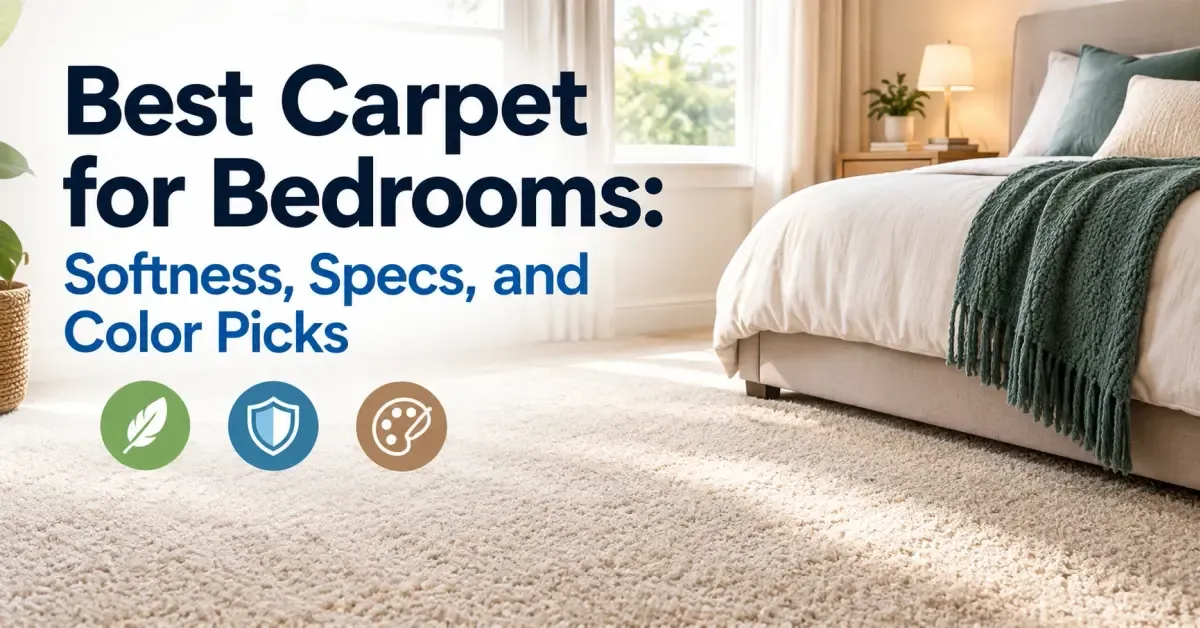
Most buyers pick bedroom carpet based on showroom feel alone. That feel tells you nothing about whether the softness lasts, how the carpet handles allergens during sleep, or how the color holds up under different lighting conditions throughout the day.
This article covers the specs, fiber picks, color guidance, and one angle no competitor touches — what bedroom carpet does to your sleep environment.
For bedrooms, choose a soft cut pile carpet — plush, Saxony, or frieze — in polyester or triexta fiber at 32 to 40 oz face weight. Pair with a thicker, softer pad than you would use elsewhere in the home. Choose a mid-tone neutral color. Prioritize Green Label Plus certification for the room where you sleep.
What Face Weight and Pile Height Work Best in a Bedroom?
The best carpet for bedrooms does not need the heavy-duty specs required in hallways or family rooms. Bedroom traffic is light and directional stress on fiber is minimal compared to main living areas.
Bedroom Carpet Specs — Recommended Ranges
| Spec | Bedroom Recommendation | Why It Matters Here |
|---|---|---|
| Face Weight | 32 to 40 oz per square yard | Light traffic means lower weight still performs well — budget goes toward softness instead |
| Pile Height | 1/2 inch to 3/4 inch | Higher pile delivers the soft underfoot feel bedrooms are chosen for |
| Twist Level | 4 to 5 turns per inch minimum | Lower traffic means twist demands are reduced vs high-traffic areas |
| Padding Thickness | Up to 1/2 inch | Bedrooms allow thicker, softer padding — adds luxury feel without durability risk |
| Padding Density | 6 lb per cubic foot | Standard density is fine — firm padding is less critical than in high-traffic rooms |
The bedroom is the one room where face weight can drop to 32 oz without performance compromise. That freed budget is better spent on fiber softness, a thicker pad, or a higher pile height — all of which contribute more to bedroom comfort than extra ounces of face weight.
A pile height of 1/2 to 3/4 inch hits the sweet spot between the luxurious softness bedroom buyers want and the practical maintenance reality of keeping that carpet looking clean. Anything above 3/4 inch starts trapping more debris and becomes harder to vacuum effectively.
Should You Choose Low Pile or High Pile Bedroom Carpet?
Pile height in a bedroom is a trade-off between softness and maintenance. Neither choice is wrong — they suit different priorities.
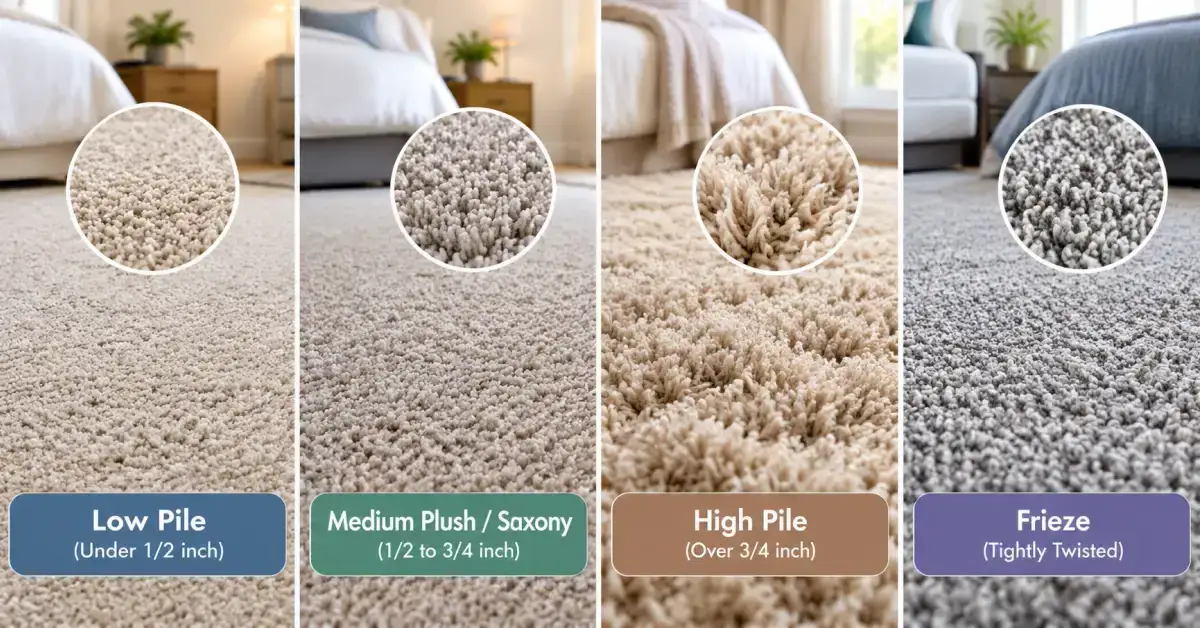
Pile Type Comparison for Bedrooms
| Pile Type | Softness | Maintenance | Allergy Performance | Best Bedroom Use |
|---|---|---|---|---|
| Low Cut Pile (under 1/2 inch) | Moderate | Easy | Best — vacuums to fiber base | Allergy sufferers, pet owners |
| Medium Plush/Saxony (1/2 to 3/4 inch) | High | Moderate | Good with regular vacuuming | Most bedroom applications |
| High Pile (over 3/4 inch) | Highest | Harder | Poorest — traps more allergens | Low-use guest rooms only |
| Frieze (tightly twisted) | Medium-high | Easy | Good — twisted fiber resists matting | Master bedrooms with regular use |
Soft carpet for bedroom use lands most naturally in the medium plush and Saxony range. These constructions deliver the barefoot comfort bedroom buyers want without the maintenance burden of true high pile or shag.
Frieze carpet is an underrated bedroom choice. Its tightly twisted fiber resists matting better than smooth plush, hides footprints and vacuum marks, and still feels soft underfoot. For a master bedroom that sees daily use from two people, frieze in a triexta or nylon fiber outperforms smooth Saxony at the five-year mark.
Low pile carpet belongs in bedrooms where allergy performance or pet management is the priority. The shorter the fiber, the more effectively a vacuum reaches the base and removes trapped particulates.
Which Carpet Fiber Feels Softest and Lasts Longest in a Bedroom?
Bedrooms are the one room where polyester earns its place at the top of the fiber ranking. Low traffic means polyester's main weakness — poor crush resistance under heavy use — is largely irrelevant.
Carpet Fiber Comparison for Bedrooms
| Fiber | Softness | Durability in Bedroom | Allergy Notes | Cost Range | Bedroom Verdict |
|---|---|---|---|---|---|
| Polyester (PET) | Highest | Good (low traffic) | Neutral | $1 to $4/sqft | Best value soft choice |
| Triexta (PTT) | Very high | Very good | Neutral | $2.29 to $4.48/sqft | Best overall bedroom fiber |
| Nylon | Medium-high | Excellent | Neutral | $2.50 to $7.50/sqft | Best for master bedrooms with pets |
| Wool | High | Excellent | Naturally resistant to dust mites | $5 to $15/sqft | Best luxury bedroom choice |
| Wool Blend | High | Very good | Good | $3 to $8/sqft | Best mid-range luxury option |
Polyester in a bedroom plush construction feels genuinely luxurious underfoot and costs significantly less than nylon or triexta. The trade-off is that it will mat faster than either alternative if the bedroom sees more than light daily use — two people with pets pushing furniture around regularly will see polyester show wear faster than triexta would.
Triexta is the strongest all-around bedroom fiber. Its built-in stain resistance, genuine softness, and better crush resistance than polyester make it the pick for most households. A homeowner who chose an inexpensive 28 oz polyester plush for their master bedroom found it looking flat and dull within 18 months of daily use. The same budget spent on a 35 oz triexta in a medium pile would have held its appearance several years longer.
Wool and wool blends remain the luxury benchmark. Natural resistance to dust mites, genuine softness, and exceptional longevity make wool worth the cost in a bedroom where comfort and indoor environment quality are the priority.
Is Carpet Good or Bad for Bedroom Allergies?
The allergy question around bedroom carpet is more nuanced than most people assume. The answer depends on fiber choice, pile height, maintenance habits, and certification.
The American Lung Association notes that carpet traps common allergens including dust mites, pet dander, and pollen, keeping them out of the breathing zone at sleeping height. A hard floor allows those same particles to remain airborne and circulate continuously. Maintained carpet can actually reduce airborne allergen concentration compared to bare hard flooring.
The critical word is maintained. Carpet that is not vacuumed frequently enough becomes a reservoir rather than a trap — allergens accumulate past the point where normal air disturbance keeps them settled.
New carpet installation in a bedroom introduces VOC off-gassing into the room where you sleep. The Carpet and Rug Institute's Green Label Plus certification identifies products with the lowest verified VOC emission levels. For a bedroom installation, Green Label Plus certification is more important than in any other room in the home. Ventilate the bedroom thoroughly for 48 to 72 hours after installation before sleeping in the space.
For allergy sufferers, practical guidance is: choose low pile carpet to maximize vacuum effectiveness, vacuum three or more times per week, schedule professional cleaning every 12 months, and select Green Label Plus certified product.
What Carpet Color Works Best in a Bedroom?
Bedroom carpet color affects mood, perceived room size, and how the space feels at different times of day. It is also a maintenance decision.
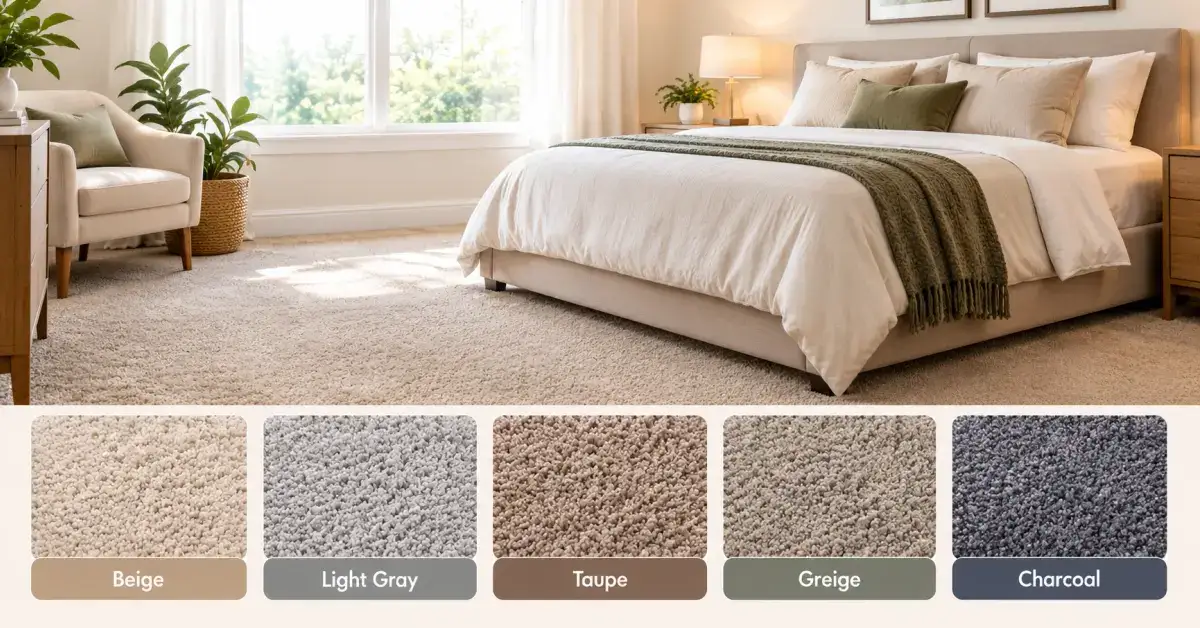
Bedroom Carpet Color Guide
| Color Range | Bedroom Mood | Room Size Effect | Maintenance Reality | Best For |
|---|---|---|---|---|
| Light (cream, pale gray, soft white) | Airy, calm, spacious | Makes room feel larger | Shows dust, footprints quickly | Small bedrooms, low-use guest rooms |
| Mid-tone neutral (greige, warm gray, tan, taupe) | Warm, restful, versatile | Neutral impact | Hides everyday dust and pet hair best | Most bedrooms, any size |
| Deep tone (charcoal, navy, slate) | Dramatic, cozy, intimate | Makes room feel smaller | Shows light dust and pet hair | Large master bedrooms as accent |
| Warm earthy (terracotta, sage, soft gold) | Grounding, natural | Slight warming effect | Moderate — depends on shade depth | Bedrooms with natural material decor |
Mid-tone neutrals dominate bedroom carpet choices for good reason. Greige, warm gray, taupe, and tan work with almost any wall color, furniture finish, and natural light condition. They hide the everyday dust and pet hair a bedroom accumulates without showing every footprint the way light carpet does.
Natural light matters more in bedroom carpet selection than in any other room. Carpet looks different under morning light, afternoon sun, and evening artificial light. Always place a sample in the actual bedroom and observe it at multiple times of day before committing. A carpet that looks like a warm greige in the showroom can read as pink or yellow under certain lighting conditions.
For small bedrooms, light to mid-tone carpet creates the most spacious feeling. Dark carpet in a small bedroom absorbs light and can make the space feel compressed.
Does Carpet Affect Sleep Quality?
This is the angle no competitor covers — and the data is real.
Carpet provides measurable thermal insulation. According to the World Floor Covering Association, a carpeted floor feels up to 10 to 12 degrees warmer underfoot than hard flooring at the same room temperature. In bedrooms, a warmer floor surface contributes to overall thermal comfort during sleep, particularly in colder climates or homes without radiant heating.
Carpet also absorbs impact noise and reduces echo. A carpeted bedroom is meaningfully quieter than the same room with hard flooring — both for sound entering from adjacent rooms and for movement within the room itself. Reduced noise disturbance during sleep is a real benefit, particularly in multi-story homes where foot traffic on an upper floor transfers sound to rooms below.
The VOC consideration cuts the other way. New carpet off-gasses volatile organic compounds most heavily in the first 24 to 72 hours after installation. In a bedroom — a closed environment where you breathe the air for 7 to 8 hours nightly — this window matters more than anywhere else in the home. Choose Green Label Plus certified carpet and ventilate aggressively after installation.
What Bedroom Carpet Tells You About Indoor Comfort
These facts ground the bedroom carpet decision in real data.
The EPA reports that indoor air can be two to five times more polluted than outdoor air. Bedrooms represent the longest continuous single-room exposure in any home — roughly one-third of a person's life spent in that space. Carpet choice and certification directly affect the air quality of that environment.
The American Lung Association notes that properly maintained carpet reduces airborne allergen concentration by keeping particles trapped at floor level rather than circulating in the breathing zone. Maintenance frequency is the variable that determines whether carpet helps or hurts allergy performance.
The Carpet and Rug Institute's Green Label Plus program sets the lowest verified VOC emission standard for carpet products. For bedroom installations specifically, this certification is the single most important label to look for beyond fiber and pile specs.
The IICRC reports that vacuuming three or more times per week in bedroom carpet areas reduces dust mite allergen levels significantly compared to once-weekly vacuuming. Frequency matters more than vacuum quality up to a point.
According to the World Floor Covering Association, carpet's thermal insulation properties contribute measurably to room comfort — particularly relevant in bedrooms where floor temperature affects the overall sleep environment.
Common Questions About Bedroom Carpet, Answered
What is the softest carpet material for a bedroom?
+
Polyester and triexta produce the softest feel underfoot of any carpet fiber. Between the two, polyester has a slight edge in raw softness for the price but triexta holds that softness longer under use. Wool feels luxurious in a different way — more resilient and springy than synthetic softness. For pure barefoot softness at a reasonable price, triexta in a medium plush construction is the strongest choice.
What carpet padding is best for bedrooms?
+
Bedrooms allow more padding flexibility than high-traffic areas. A memory foam or prime urethane pad at 1/2 inch thickness with 6 lb density delivers excellent comfort underfoot. Unlike hallways and stairs where firm, thin padding is required, bedrooms can support a softer, thicker pad that adds to the luxury feel without compromising carpet performance.
Is wool carpet good for bedrooms?
+
Wool is excellent for bedrooms. It is naturally soft, provides genuine thermal insulation, resists dust mites inherently, and lasts exceptionally long under light bedroom traffic. The trade-offs are cost and moisture sensitivity. Wool costs significantly more than synthetic options and should not be used in bedrooms prone to humidity or moisture. For the right home and budget, wool in a bedroom is the long-term best value.
What is the best carpet for a master bedroom?
+
Triexta or nylon in a medium plush or frieze construction at 35 to 40 oz face weight with a thicker comfort pad. Master bedrooms see more daily use than guest rooms — two people moving around daily, pets, and regular foot traffic from bathroom to closet. Triexta handles this comfortably while delivering genuine softness. For a luxury master suite, a wool blend is worth the investment.
What carpet color makes a bedroom look bigger?
+
Light to mid-tone carpet makes a bedroom feel larger and more open. Pale gray, soft cream, and warm greige all expand the perceived size of a room by reflecting light rather than absorbing it. Avoid very dark carpet in small bedrooms — it compresses the space visually and makes the room feel enclosed.
How do I choose carpet for a small bedroom?
+
Prioritize light to mid-tone colors to maximize perceived space. Choose a low to medium pile height — high pile in a small room can feel overwhelming and traps more debris in a space that is harder to maneuver a vacuum around. Keep the color consistent with adjacent hallway carpet if possible to create visual flow that makes both spaces feel larger.
What is the most popular carpet color for bedrooms?
+
Warm neutrals dominate bedroom carpet sales — greige, taupe, warm gray, and soft tan consistently rank as the most chosen bedroom colors. These shades work across the widest range of wall colors, furniture finishes, and natural light conditions. They also offer the best balance of visual warmth and practical maintenance performance.
Is plush carpet good for bedrooms?
+
Yes. Plush and Saxony carpet are among the best pile styles for bedrooms. The smooth, even cut pile surface delivers genuine softness underfoot and creates a clean, uniform look. The trade-off is that plush shows footprints and vacuum marks more than textured or frieze constructions. In a bedroom this is a minor concern — most homeowners find the softness worth the occasional visible footprint.
What carpet fiber is best for bedrooms with pets?
+
Triexta or solution-dyed nylon. Both offer strong stain resistance — triexta through built-in fiber chemistry, nylon through durable topical treatment. Choose a low to medium pile construction rather than high pile, which traps pet hair deeply and requires more aggressive vacuuming. A mid-tone or flecked color hides pet hair between vacuuming sessions far better than very light or very dark solid colors.
How long does bedroom carpet typically last?
+
With light traffic and proper care, bedroom carpet outlasts carpet in any other room. Quality polyester in a bedroom lasts 10 to 15 years. Triexta runs 15 to 20 years. Nylon can reach 20 to 25 years. Wool lasts 25 years or more with proper care. The limiting factor in most bedroom carpet replacements is style preference, not wear — bedroom carpet simply does not face the mechanical stress that shortens carpet life in high-traffic areas.
The buying priority for bedroom carpet flips compared to every other room in the house. Durability drops down the list. Softness, indoor air quality, and how the carpet performs in a sleeping environment move to the top. That means the best carpet for bedrooms is not necessarily the most durable fiber or the highest face weight — it is the fiber and construction that delivers lasting softness, holds allergens at floor level when properly maintained, and carries a Green Label Plus certification for the room where your air quality matters most.
If you are in the Las Cruces NM area and need professional carpet cleaning to keep your bedroom carpet performing at its best, our team at Bliss Carpet Cleaning is ready to help.

Michael Sanders
Michael Sanders is a home care and cleaning industry writer covering carpet maintenance, flooring care, and household cleaning practices across the United States. His work focuses on practical, research-backed guidance — from stain and odor removal to deep extraction methods and indoor allergen prevention. Michael collaborates with cleaning professionals to ensure accuracy, and his writing reflects a genuine interest in helping homeowners make informed decisions about caring for their homes.


Want Your Bedroom Carpet to Stay Soft and Fresh?
Professional cleaning keeps bedroom carpet soft, allergen-free, and smelling clean. Serving Las Cruces, NM and the surrounding areas.
Call Now — Free Quote