


Blog · Carpet Education
Best Carpet for Stairs: Specs, Safety, and What to Avoid
Stairs are the hardest working surface in any carpeted home. Every step concentrates foot traffic on a narrow band of fiber at the stair nose, and that same location is where most household fall injuries happen. Yet most homeowners choose stair carpet the same way they choose bedroom carpet — based on how it feels in the showroom and whether the color works with the hallway.
Published October 14, 202612 min read
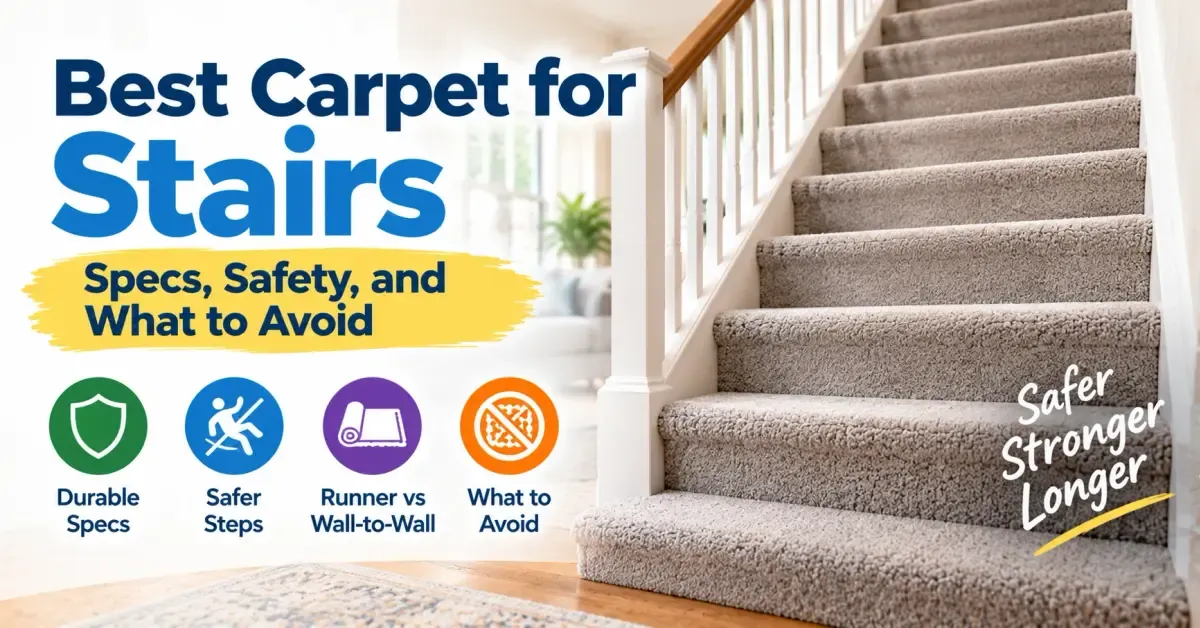
The best carpet for stairs is not the softest or the most stylish. It is the one built to handle concentrated wear, maintain traction, and hold its construction at the stair nose for years.
This article covers the exact specs, what to avoid, how installation method affects longevity, and the safety data most flooring guides never mention.
For stairs, choose nylon or wool in a low cut pile construction with a face weight of 50 oz minimum, a twist level of 6 or more turns per inch, and a pile height under 3/4 inch. Avoid loop pile, high pile, and silk or viscose blends entirely. Use thin, dense padding only. Professional installation with the French cap method extends stair carpet life significantly.
What Specs Does Stair Carpet Actually Need?
The best carpet for stairs requires higher specs than carpet in any other room in the home. The stair nose — the front edge of each tread — receives the full force of every footstep and bends the carpet fiber at a sharp angle with each use.
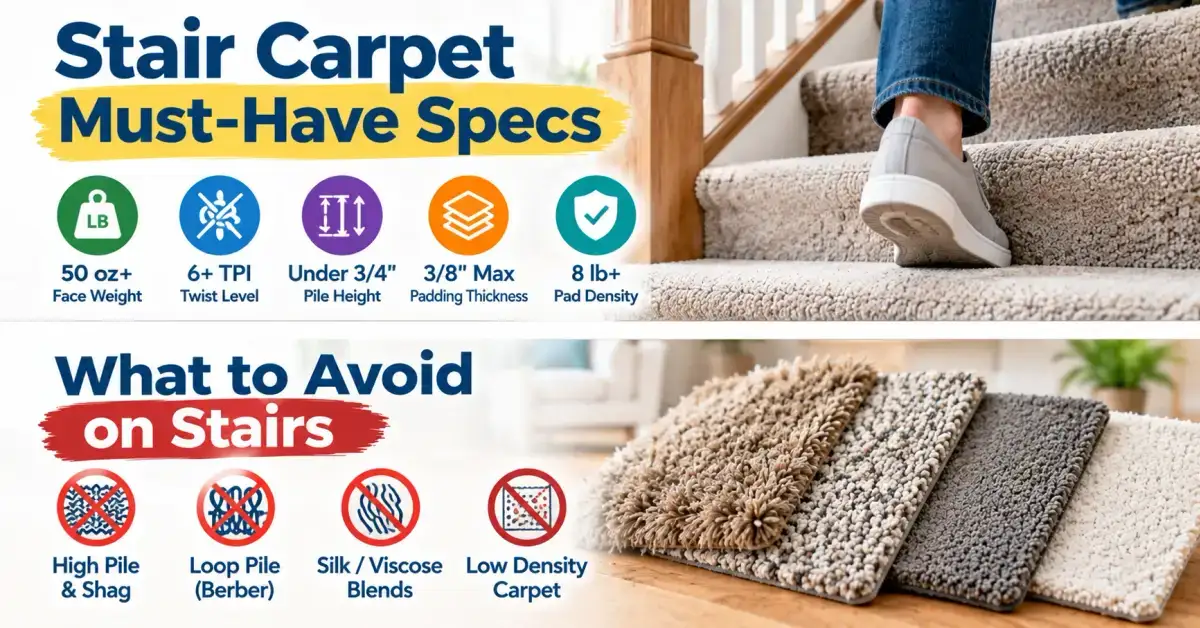
Stair Carpet Minimum Specs
| Spec | Minimum for Stairs | Why It Matters on Stairs |
|---|---|---|
| Face Weight | 50 oz per square yard minimum | More fiber at the nose means more material before backing shows through |
| Twist Level | 6 turns per inch minimum | Tight twist resists unraveling under repeated nose bend stress |
| Pile Height | Under 3/4 inch | Short fiber maintains traction and resists crushing at the nose |
| Density | 3,500 or above | Tightly packed fiber recovers faster between steps |
| Padding Thickness | 3/8 inch maximum | Thick padding creates instability at the nose — thin and dense only |
| Padding Density | 8 lb per cubic foot | Firm pad absorbs subfloor flex stress without compressing unevenly |
Face weight alone does not protect the stair nose. A 60 oz carpet with loose twist will unravel at the nose within two years. A 52 oz carpet with 7 turns per inch and heat-set fiber will outlast it by a decade. Twist level and heat-setting are the specs that determine stair carpet longevity more than any other single measurement.
Padding on stairs requires the opposite approach from bedrooms. Thicker, softer padding that adds luxury underfoot in a bedroom creates dangerous instability at a stair nose. Use thin, dense padding — 3/8 inch at 8 lb density — and never exceed that thickness on stairs.
What Carpet Should You Never Put on Stairs?
Knowing what to avoid on stairs is as important as knowing what to choose. Several carpet types that perform acceptably in other rooms fail specifically because of how stairs stress fiber and construction.
High pile and shag carpet — pile height above 3/4 inch — creates two problems on stairs. First, the long fibers compress under foot traffic and lose traction, increasing slip risk. Second, the toe of a shoe or the paw of a pet can catch in the pile at the stair nose, creating a trip hazard. High pile belongs in bedrooms. It does not belong on stairs under any circumstances.
Large loop Berber is one of the most common stair carpet mistakes. The loop construction that resists crushing so well on flat surfaces becomes a liability on stairs. A shoe edge or pet claw catching a loop at the stair nose can unravel an entire row across the width of the step. Standard Berber loop pile on stairs is a snag risk that compounds with every year of use.
Silk and viscose blends feel luxurious in the showroom and fail quickly under stair stress. Neither fiber has the tensile strength to handle the repeated bend and compression at the stair nose. Viscose in particular breaks down rapidly under foot traffic and is nearly impossible to clean effectively once soiled.
Low density constructions — carpets where you can see backing through the fibers when bent — will show through at the stair nose within months. The nose bend exposes backing faster than any other wear mechanism in residential carpet use.
A homeowner who installs a 32 oz loop pile carpet on their main staircase to match the adjacent hallway will see snagged loops, exposed backing at every nose, and visible wear lanes within 18 months. The hallway carpet may last ten years. The same product on the stairs will not last three.
Runner vs Wall-to-Wall: Which Is Better for Stairs?
Both runner and wall-to-wall stair carpet work well when installed correctly. The right choice depends on the staircase type, budget, and how the home is used.
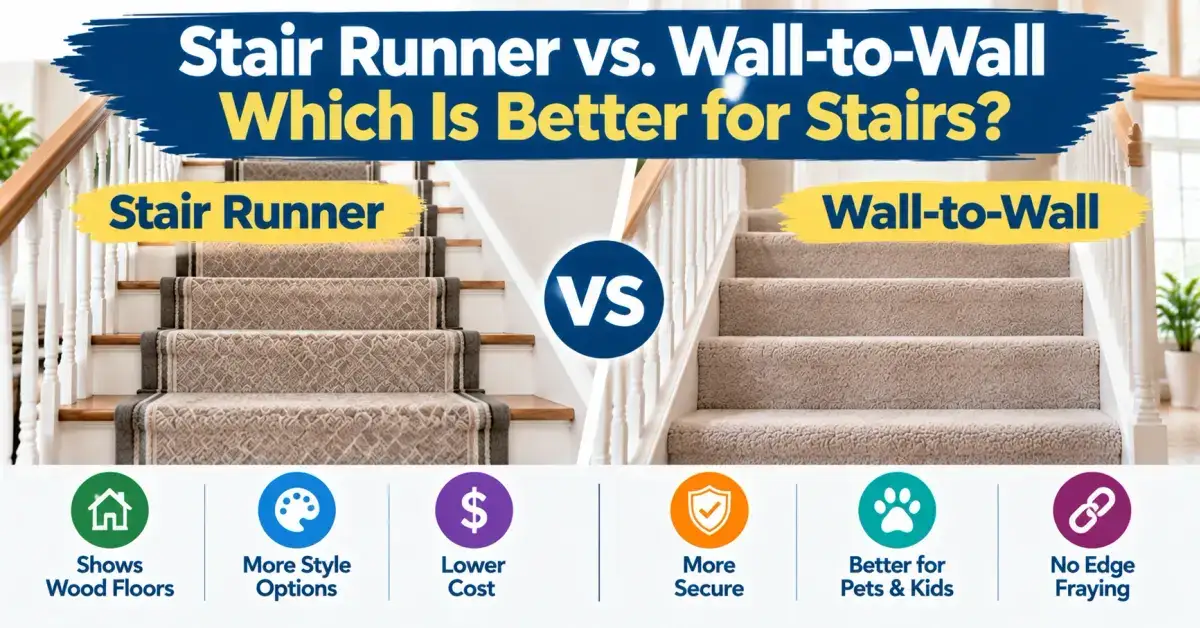
Stair Runner vs Wall-to-Wall Comparison
| Factor | Stair Runner | Wall-to-Wall |
|---|---|---|
| Installation security | Good with proper fastening | Better — no exposed edges |
| Edge fraying risk | Present at both sides | None |
| Hardwood exposure | Yes — visible on both sides | None |
| Replacement cost | Lower — less material | Higher — full stair coverage |
| Style flexibility | Higher — pattern and border options | Moderate |
| Best for | Showcasing hardwood, formal staircases | Family homes, high-traffic stairs, pet households |
A stair runner leaves hardwood exposed on both sides of each tread. This looks intentional and attractive on a formal staircase with quality hardwood in good condition. It requires secure fastening at every tread — either gripper rods or tackless strips — and the exposed edges need monitoring for fraying over time.
Wall-to-wall stair carpet eliminates the edge fraying risk and provides complete tread coverage. In homes with children, pets, or high daily traffic, full coverage is the more practical and safer long-term choice. There are no exposed runner edges for pets to scratch or children to catch a foot on.
For staircases where the hardwood underneath is damaged or unfinished, wall-to-wall is the only sensible option.
Is Patterned Carpet a Good Choice for Stairs?
Patterned carpet for stairs is not just an aesthetic choice — it is a functional one. Pattern on stairs serves three practical purposes that solid color carpet cannot match.
First, pattern hides wear at the stair nose. Solid color carpet shows the lighter, compressed fiber at the nose point clearly once wear begins. A geometric or tone-on-tone pattern breaks up the visual uniformity enough that early nose wear is far less visible.
Second, pattern disguises soil and debris between cleanings. Stairs accumulate dirt, pet hair, and tracked-in debris more than any other surface. A multi-toned or textured pattern absorbs visual noise from everyday soiling in a way that a solid color plush never does.
Third, non-directional pattern eliminates the seam and direction matching problems that complicate solid carpet stair installations. A non-directional geometric or all-over pattern can be cut and fitted at each tread without visible direction inconsistency.
What to watch for: geometric patterns with large repeats require careful matching at each tread, which increases material waste and installation labor cost. A pattern with a repeat over 18 inches can add 15 to 20% to material cost on a full staircase. Choose patterns with smaller repeats or non-directional designs to minimize waste.
Tone-on-tone textures — subtle pattern woven into a single color — give the functional benefits of pattern without the matching complexity. For most residential staircases this is the best balance of performance and installation efficiency.
What Do Stairs Actually Do to Carpet Over Time?
Understanding the wear mechanism on stairs explains why stair carpet requires different specs than any other location in the home.
According to industry flooring data from major manufacturers including Shaw Floors, stair carpet wears at two to three times the rate of the same carpet installed on flat flooring. The stair nose concentrates the entire force of every footstep onto a narrow band of fiber that also bends sharply with each use. No other residential carpet location produces this combination of compression and directional stress simultaneously.
The CDC reports that falls are the leading cause of injury-related deaths among adults 65 and older in the United States, and stairs are among the most common fall locations in the home. Carpet with appropriate pile height and traction directly reduces slip risk compared to hard stair surfaces. Low pile carpet on stairs provides grip that bare hardwood, tile, or laminate cannot replicate.
The Carpet and Rug Institute notes that carpet on stairs reduces impact noise transmission between floors by absorbing footfall sound. In a multi-story home this is a meaningful daily benefit beyond safety and appearance.
The IICRC recommends professional installation for stair carpet specifically because improper tackless strip placement and inadequate stretching on stairs creates bunching and uneven surfaces that become trip hazards over time.
According to the World Floor Covering Association, stair carpet installed over improper or absent padding fails up to 40% faster than properly padded installations. The padding absorbs subfloor flex stress at the nose bend point — without it that stress transfers directly to fiber roots and backing.
Waterfall vs French Cap: Which Stair Installation Method Lasts Longer?
The installation method affects how long stair carpet holds up at the nose — the highest wear point on every step. Most homeowners never know to ask which method their installer uses.
Stair Carpet Installation Methods
| Method | How It Works | Nose Durability | Appearance | Cost | DIY Feasibility |
|---|---|---|---|---|---|
| Waterfall | Carpet flows straight over nose, tucks at base | Moderate — nose exposed to full bend stress | Clean, simple | Lower | Possible but difficult |
| French Cap | Carpet wraps under nose, secured at back of tread | Best — nose stress distributed across wrap | Tailored, fitted | Higher | Difficult — professional recommended |
| Open Riser | Carpet on tread only, riser left open or painted | Moderate | Modern, architectural | Moderate | Possible on simple stairs |
The waterfall method is the most common installation approach. Carpet flows over the stair nose and tucks into the angle between tread and riser at the base. It is faster to install and costs less in labor. The trade-off is that the full bend stress of every footstep concentrates at the nose point where the carpet makes its sharpest turn.
The French cap method — also called cap and band — wraps the carpet under the stair nose and secures it at the back of the tread. This distributes the nose bend stress across a longer section of carpet rather than concentrating it at one point. Stair carpet installed with the French cap method consistently outlasts waterfall installations at the nose, often by several years. The labor cost is higher but the extended carpet life makes it the better long-term investment on a main staircase.
Most homeowners who replace stair carpet prematurely due to nose wear had it installed with the waterfall method. Asking specifically for French cap installation on a primary staircase is one of the highest-value decisions a homeowner can make when replacing stair carpet.
Common Questions About Stair Carpet, Answered
What carpet pile is safest for stairs?
+
Low cut pile under 3/4 inch is the safest option for stairs. Short fibers maintain traction underfoot and reduce the risk of toe-catching at the stair nose. Anything above 3/4 inch pile height increases slip risk and trip hazard at the nose. Loop pile introduces snag risk and should be avoided on stairs regardless of pile height.
What carpet padding should I use on stairs?
+
Use thin, dense padding only — 3/8 inch thickness at 8 lb per cubic foot density. Never exceed 7/16 inch on stairs. Thicker padding creates instability at the stair nose where carpet must bend sharply. Firm padding absorbs subfloor flex stress without compressing unevenly under foot traffic. The wrong padding choice accelerates stair carpet failure faster than almost any other single factor.
How much does it cost to carpet stairs?
+
Professional stair carpet installation typically runs $75 to $150 per step for material and labor combined, depending on fiber choice, pile style, and installation method. A standard 13-step staircase runs $975 to $1,950 fully installed with mid-grade nylon carpet. French cap installation adds $10 to $20 per step in labor over the waterfall method. Runner installation costs less in material but requires additional fastening hardware.
What color carpet is best for stairs?
+
Mid-tone and patterned carpet hides stair-specific soiling — tracked dirt, pet hair, and nose wear — better than any solid light or dark color. Warm grays, taupes, and greige tones in a textured or patterned construction give the best combination of appearance longevity and practical maintenance performance on stairs.
Is Berber carpet safe for stairs?
+
Standard large-loop Berber is not recommended for stairs. The loop construction creates a snag risk at the stair nose that compounds over time — a caught loop can unravel across the full width of a tread. Tightly woven, small-loop commercial-grade Berber with a very tight loop construction performs better but still carries more risk than low cut pile. For most residential staircases, low cut pile nylon is the safer choice.
How long does stair carpet last?
+
Quality nylon stair carpet installed with proper specs, correct padding, and French cap installation lasts 10 to 15 years on a primary staircase with daily family use. Polyester stair carpet typically lasts 5 to 8 years under the same conditions. Wool stair runners in quality construction can last 20 years or more with proper care. The installation method and padding are as influential as fiber choice in determining actual lifespan.
Can I install stair carpet myself or do I need a professional?
+
Stair carpet installation is significantly more difficult than flat floor installation. Proper tackless strip placement, accurate tread and riser cutting, and correct stretching at each step require experience and specialized tools. The IICRC recommends professional installation for stairs specifically because DIY installation errors create bunching and uneven surfaces that become trip hazards. For a primary staircase, professional installation is the right choice.
What carpet is best for stairs with pets?
+
Solution-dyed nylon or triexta in a low cut pile construction at 50 oz or above. Both fibers resist pet stains effectively. Avoid loop pile entirely — pet claws catch loops at the stair nose and can unravel rows across the full tread width. A mid-tone or patterned color in a tight cut pile handles pet hair, tracked soil, and occasional accidents better than any other stair carpet combination.
What is the best carpet for basement stairs?
+
Olefin or solution-dyed nylon in a low cut pile construction. Basement stairs face moisture risk that above-grade stairs do not. Olefin is naturally moisture-resistant and does not support mold growth. Solution-dyed nylon holds color and resists moisture better than standard nylon. Avoid wool on basement stairs — moisture sensitivity makes it a poor choice below grade. Use a moisture-resistant pad, not standard urethane.
What is the waterfall method vs French cap method?
+
The waterfall method flows carpet straight over the stair nose and tucks it at the base of each riser. It is faster and less expensive to install but concentrates bend stress at the nose point. The French cap method wraps carpet under the nose and secures it at the back of the tread, distributing nose stress across a longer carpet section. French cap installation extends stair carpet life at the nose meaningfully and is worth the additional labor cost on a primary staircase.
Most homeowners focus on fiber and color when replacing stair carpet and overlook the detail that matters most — installation method. The best carpet for stairs with the wrong installation approach will wear at the nose faster than a moderately specified carpet installed with the French cap method. Asking your installer specifically for French cap installation on your primary staircase, paired with a 50 oz minimum nylon or wool in a low cut pile, is the combination that delivers the longest service life and the safest stair surface in your home.
If you are in the Las Cruces NM area and need professional carpet cleaning to extend the life of your stair carpet investment, our team at Bliss Carpet Cleaning is ready to help.

Michael Sanders
Michael Sanders is a home care and cleaning industry writer covering carpet maintenance, flooring care, and household cleaning practices across the United States. His work focuses on practical, research-backed guidance — from stain and odor removal to deep extraction methods and indoor allergen prevention. Michael collaborates with cleaning professionals to ensure accuracy, and his writing reflects a genuine interest in helping homeowners make informed decisions about caring for their homes.


Keep Your Stair Carpet Looking New
Regular professional cleaning protects the investment in your stair carpet's specs and installation. Serving Las Cruces, NM and the surrounding areas.
Call Now — Free Quote