

Blog · Carpet Education
Best Carpet for Pets: Dogs, Cats, and Stain-Proofing
Most pet carpet advice treats dogs and cats as the same problem. They are not. A dog's accidents soak into fiber and penetrate toward the backing. A cat's claws catch and pull at loop construction during normal scratching behavior. The best carpet for pets depends on which animal — or which combination — actually lives in your home.
Published October 16, 202611 min read
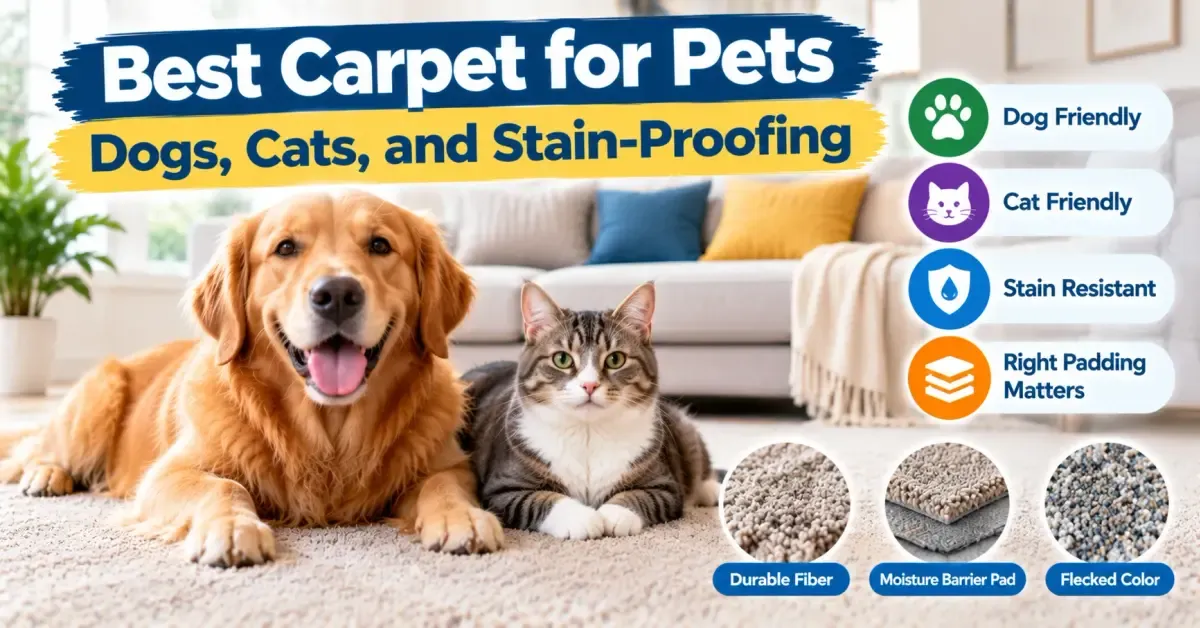
This article separates dog-specific guidance from cat-specific guidance, explains the urine chemistry that determines whether odor becomes permanent, and covers the padding decision that matters as much as carpet fiber but almost nobody talks about.
The Short Answer: For pet households, choose solution-dyed nylon or triexta in a cut pile construction with a moisture barrier pad underneath. Avoid loop pile if you have cats. Choose a flecked or multi-tonal mid-tone color. Clean accidents immediately with an enzyme-based product, not standard detergent.
What Carpet Works Best for Dogs vs Cats?
Pet-friendly carpet is not one category. Dogs and cats create genuinely different stress on carpet, and the right product differs accordingly.
Dog vs Cat Carpet Priorities
| Concern | Dog Priority | Cat Priority | Recommended Approach |
|---|---|---|---|
| Claws/Scratching | Low — paw nails rarely snag fiber | High — claws catch loops during play and scratching | Cut pile only for cat households |
| Accidents | High — urine volume can be significant | Moderate — litter box reduces carpet accidents | Solution-dyed fiber, moisture barrier pad |
| Shedding | High for double-coated breeds | Moderate to high | Low to medium pile for easy vacuum removal |
| Tracked Debris | Moderate — mud, outdoor dirt | High — litter tracking from box | Textured or flecked color hides both types |
| Odor Source | Urine, wet fur, paw oils | Urine, litter dust | Both need solution-dyed fiber and proper padding |
Dog households face higher accident volume risk, particularly with puppies or senior dogs, and benefit most from solution-dyed fiber paired with a true moisture barrier pad. Cat households face a different primary risk — claw snag on loop pile construction — and benefit most from steering toward cut pile regardless of fiber choice.
Households with both animals need to prioritize cut pile construction first (protecting against cat claws) and solution-dyed fiber second (protecting against dog accidents). This combination covers both risk profiles without compromising on either.
Is Loop Pile Carpet Safe for Cats With Claws?
Loop pile — including Berber and level loop constructions — carries meaningfully higher snag risk in cat households than cut pile.
The mechanism is straightforward. A cat's claw catching a single loop during normal scratching, kneading, or play behavior can pull that loop, and the pull travels across the connected row of loops in the construction. One snag event can unravel a visible section of carpet across multiple inches or more, depending on how tightly the loops are woven.
This risk exists even in cats that do not scratch furniture aggressively. Normal play, kneading before settling down, and routine claw maintenance all create moments where a claw can catch a loop. The risk compounds over a cat's lifetime in the home.
Cut pile carpet eliminates this specific risk entirely. There are no connected loops for a claw to catch — each fiber tuft stands independently. For households with cats, cut pile in any style (plush, Saxony, textured, frieze) is the safer construction choice regardless of which fiber or face weight you select.
If a loop pile look is genuinely important aesthetically, a tightly woven, small-loop commercial-grade Berber reduces but does not eliminate the snag risk. For most cat households, the safer choice is simply a textured cut pile that delivers a similar visual texture without the structural vulnerability.
What Carpet Fiber Actually Resists Pet Urine and Stains?
Stain resistance in pet households comes down to how color is applied to the fiber, not just a marketing label.
Solution-dyed fiber has color built into the polymer itself during manufacturing, before the fiber is even extruded into strands. Standard dyed fiber applies color to the surface of the fiber after it is formed. This distinction matters enormously for pet stains: solution-dyed fiber cannot be bleached or discolored by pet urine, because the color exists throughout the entire fiber structure, not just on the surface where urine contacts it.
Fiber Performance for Pet Urine and Stains
| Fiber | Stain Resistance Mechanism | Urine Performance | Cost Range |
|---|---|---|---|
| Triexta (solution-dyed) | Built-in, permanent | Excellent | $2.29 to $4.48/sqft |
| Solution-dyed Nylon | Built-in, permanent | Excellent | $2.50 to $7.50/sqft |
| Standard Nylon (topical) | Surface treatment, wears off | Good initially, declines over time | $2.50 to $7/sqft |
| Polyester (PET) | Often solution-dyed, moisture resistant | Good | $1 to $4/sqft |
| Wool | Natural lanolin offers some resistance | Moderate — absorbs odor more readily | $5 to $15/sqft |
Triexta and solution-dyed nylon both perform excellently against pet urine specifically because the color cannot be chemically altered by the acidic compounds in urine. Standard nylon with a topical stain treatment will perform well initially but the protection wears down with repeated cleaning over years, eventually leaving fiber vulnerable to permanent discoloration.
A household with a new puppy that chose standard topically-treated nylon found visible yellowing at accident sites within two years, even with prompt cleaning each time. The topical treatment had worn thin from the repeated cleaning required during house-training. The same household with solution-dyed nylon would not see this discoloration regardless of cleaning frequency, because the color resistance does not depend on a coating that wears away.
Does Carpet Padding Matter More Than the Carpet Itself for Pet Odor?
This is the gap almost no pet carpet guide addresses, and it may be the single most important decision for households dealing with pet accidents.
Carpet fiber is only the top layer. Beneath it sits the backing, then the padding, then the subfloor. When a pet accident is not cleaned immediately, or when the volume is significant, urine penetrates through the carpet fiber and backing into the padding underneath.
Standard carpet padding is absorbent by design — it is meant to provide cushioning, not block liquid. Once urine reaches a standard pad, it saturates and the odor becomes extremely difficult to remove through surface cleaning alone. In many cases, professional cleaning can address the visible carpet surface while odor persists, because the source has moved past the reachable layer.
A moisture barrier pad — built with a waterproof membrane layer — prevents this penetration. Liquid is stopped at the pad surface, keeping accidents contained to the carpet and backing where they can be cleaned effectively. For pet households, particularly those with puppies, senior pets, or multiple animals, a moisture barrier pad is not an optional upgrade. It is the single change most likely to prevent a permanent odor problem.
When urine has already penetrated to an untreated pad, the IICRC notes that pad replacement is often the only way to permanently eliminate odor — surface treatments and even professional extraction cannot reliably reach saturated padding beneath an intact carpet installation.
What Carpet Color Hides Pet Hair and Stains Best?
Solid colors at either extreme — very light or very dark — perform poorly in pet households. Light carpet shows every accident and dark carpet shows light-colored shedding hair constantly.
Flecked and multi-tonal carpet construction is the strongest performer for pet households specifically. The visual variation in the fiber breaks up the appearance of both pet hair and minor soiling between cleanings, regardless of whether the pet sheds light or dark fur.
For dog households dealing with shedding, a mid-tone flecked carpet hides loose fur far more effectively than any solid color. For cat households dealing with litter tracking, the same flecked construction disguises litter dust and granules that settle into carpet fiber near litter box areas.
Mid-tone warm grays, tans, and greige work as a base color across most pet households. Avoid pure white or cream (shows everything) and avoid solid black or very dark colors (shows light-colored hair and dust constantly).
What Pet Households Should Know About Carpet and Odor Chemistry
These facts explain why some cleaning approaches succeed and others fail in pet households.
The Carpet and Rug Institute confirms that solution-dyed fiber carries color through the entire strand structure, which is why pet urine and accidents cannot bleach or visibly discolor this type of fiber the way they can with surface-treated alternatives.
The IICRC specifically recommends enzyme-based cleaning products for pet urine and other organic stains. Standard detergent-based cleaners can actually lock in odor rather than eliminate it, because they fail to break down the uric acid crystals responsible for the lingering smell. Enzyme cleaners use biological processes to break those crystals down at the molecular level, which detergents cannot replicate.
According to IICRC guidance, urine that penetrates through carpet backing into padding and subfloor becomes significantly harder to remediate, and full pad replacement is frequently the only permanent solution once saturation occurs at that level.
Industry manufacturer data confirms that loop pile construction carries meaningfully higher snag risk in cat households compared to cut pile, due to the mechanical vulnerability of connected loops to claw contact during normal feline behavior.
The EPA notes that carpet certified under Green Label Plus carries the lowest verified VOC emissions — particularly relevant in pet households, which typically use cleaning products and enzyme treatments more frequently than the average household.
Common Questions About Pet-Friendly Carpet, Answered
Is wool carpet good for pet households?
+
Wool is a mixed choice for pet households. It offers natural durability and some inherent stain resistance through lanolin content, but it absorbs odor more readily than synthetic fiber and is significantly more expensive to replace if accidents cause permanent damage. For households prioritizing budget-friendly stain resistance, solution-dyed nylon or triexta outperforms wool for pet-specific concerns.
Can pet odor be permanently removed from carpet?
+
Yes, if addressed before the urine penetrates to the padding. Prompt cleaning with an enzyme-based product on the carpet surface typically eliminates odor completely. Once urine reaches an untreated, absorbent pad, removal becomes much harder, and pad replacement is often necessary for a permanent fix. Acting quickly after any accident is the single most important factor in preventing permanent odor.
What is the best pet-proof carpet backing?
+
A backing paired with a moisture barrier pad underneath is the strongest combination for pet households. The backing itself slows initial penetration, while the moisture barrier pad stops liquid from reaching the subfloor entirely. This combination is more important for odor prevention than carpet fiber choice alone.
Is carpet or hard flooring better for pets?
+
Both have trade-offs. Hard flooring is easier to clean immediately after an accident but offers no traction for pets, which can be a real concern for older dogs or active cats. Carpet provides better footing and comfort but requires the right fiber, backing, and padding combination to handle accidents without permanent odor. For most pet households, properly specified carpet with a moisture barrier pad performs well.
What carpet pile is best for shedding dogs?
+
Low to medium cut pile makes vacuum removal of shed fur most effective. Longer pile traps fur deeper in the fiber and requires more aggressive, frequent vacuuming. A textured low to medium cut pile in a flecked color handles shedding dog households better than high pile or loop construction.
Does pet urine ruin carpet padding?
+
It can, if not addressed quickly. Standard padding is absorbent and will saturate with urine if accidents are not cleaned promptly or if volume is significant. Saturated padding often cannot be fully restored through cleaning and may need replacement. A moisture barrier pad prevents this outcome by stopping liquid penetration at the pad surface.
What carpet is best for multiple pets?
+
Cut pile construction in solution-dyed nylon or triexta with a moisture barrier pad handles multiple-pet households best. Multiple animals increase both claw-snag risk (if cats are present) and accident frequency (regardless of species), making the combination of cut pile and solution-dyed fiber with proper padding the most protective choice available.
Is solution-dyed carpet worth it for pet owners?
+
Yes. Solution-dyed fiber costs only marginally more than standard dyed alternatives in most cases, and the permanent stain and discoloration resistance it provides specifically protects against the most common and costly pet carpet damage. For any household with dogs or cats, solution-dyed nylon or triexta is worth the modest cost difference.
What carpet face weight is best for pet households?
+
A face weight of 40 to 50 oz per square yard balances durability against pet traffic and scratching with reasonable cost. Higher face weight alone does not prevent claw snag risk or urine penetration — fiber type, pile construction, and backing matter more than face weight for pet-specific concerns.
How often should pet households professionally clean carpet?
+
The IICRC recommends professional cleaning every 6 to 12 months for pet households, compared to 12 to 18 months for households without pets. More frequent professional extraction removes embedded dander, odor-causing residue, and tracked debris that regular vacuuming cannot fully address.
The detail most pet carpet guides skip entirely is padding and backing. Fiber choice gets all the attention because it is visible and easy to compare in a showroom. But the moisture barrier pad underneath determines whether a pet accident stays a quick cleanup or becomes a permanent odor problem that requires tearing up the installation. Choosing solution-dyed fiber in cut pile construction, paired with proper moisture barrier padding, addresses both the dog-specific and cat-specific risks that the best carpet for pets actually needs to solve.
If you are in the Las Cruces NM area and need professional carpet cleaning to address pet stains or odor,our team at Bliss Carpet Cleaning is ready to help.

Michael Sanders
Michael Sanders is a home care and cleaning industry writer covering carpet maintenance, flooring care, and household cleaning practices across the United States. His work focuses on practical, research-backed guidance — from stain and odor removal to deep extraction methods and indoor allergen prevention. Michael collaborates with cleaning professionals to ensure accuracy, and his writing reflects a genuine interest in helping homeowners make informed decisions about caring for their homes.
Dealing With Pet Stains or Odor?
Our team knows how to treat pet accidents at the source, not just mask them. Serving Las Cruces, NM and the surrounding areas.
Call Now — Free Quote