
Blog · Carpet Cleaning Guide
Carpet Installation Tools: What to Buy, Rent, and Skip
The core carpet installation tools for stretch-in carpet are a knee kicker, a power stretcher, a carpet knife, a wall trimmer, and a stair tool. Add a seaming iron, seam roller, and seam tape if your room has a seam.
Published November 17, 202614 min read
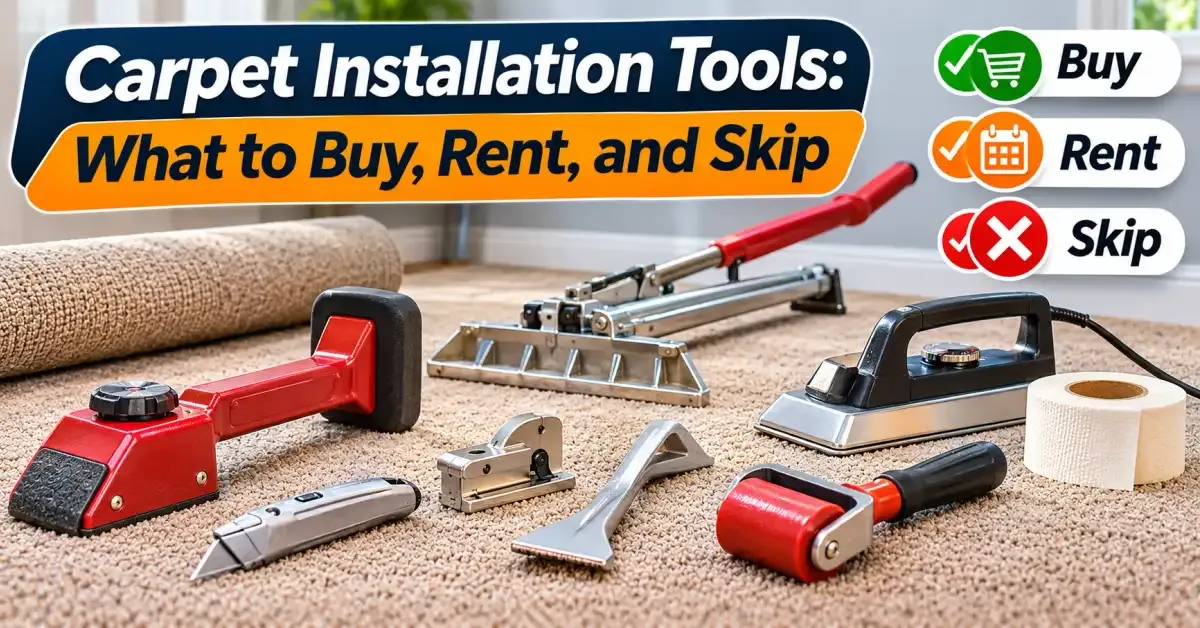
Most people buy the cheap hand tools and rent the power stretcher and iron. Most carpet tool kits leave those two out, yet the Carpet and Rug Institute (CRI) says power stretching is mandatory. This guide covers the full list by job stage, current prices, kit contents, supplies, and knee safety.
Tools Needed to Install Carpet: The Short List
These carpet laying tools cover most stretch-in jobs. The table shows which ones to buy and which to rent.
| Tool | What it does | Get it how |
|---|---|---|
| Knee kicker | Hooks carpet onto the tack strip and positions it | Buy |
| Power stretcher | Stretches carpet tight across the room | Rent |
| Carpet knife | Cuts carpet and trims seams | Buy |
| Wall trimmer | Trims carpet edges at walls | Buy |
| Stair tool | Tucks carpet into stair and wall gaps | Buy |
| Seaming iron, tape, and roller | Joins two pieces at a seam | Rent the iron, buy the tape and roller |
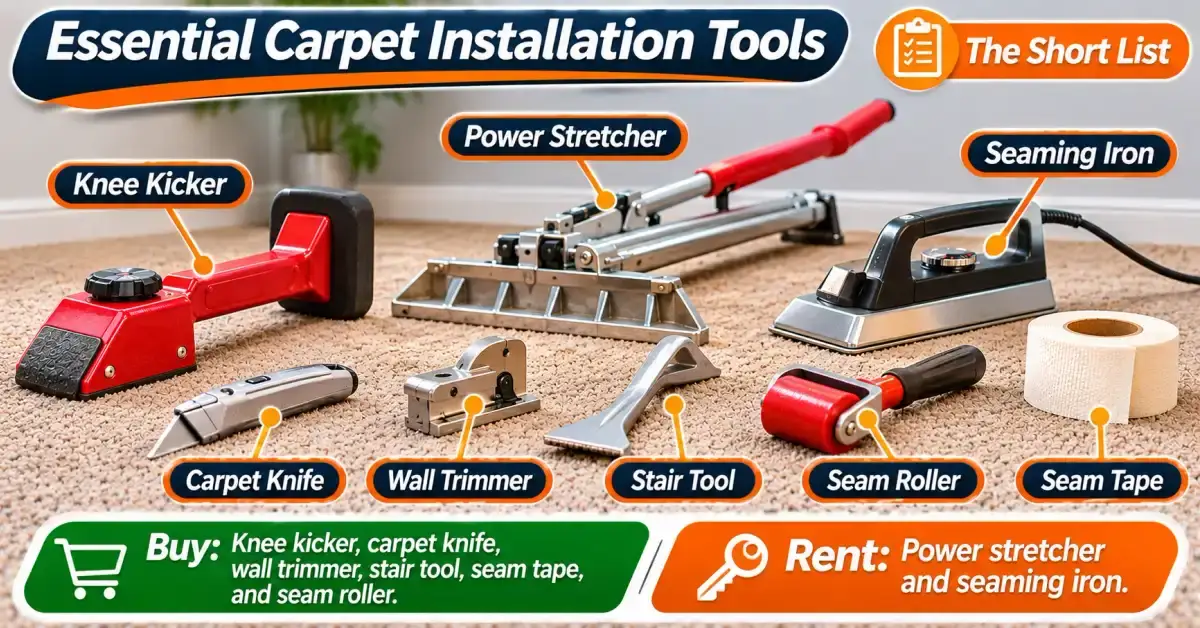
The sections below explain each tool, what it costs, and the mistakes beginners make with it. If the room has no seam, you can skip the iron entirely. A small closet may need nothing more than the kicker, knife, and stair tool.
Knee Kicker vs Power Stretcher: Which Tool Does What
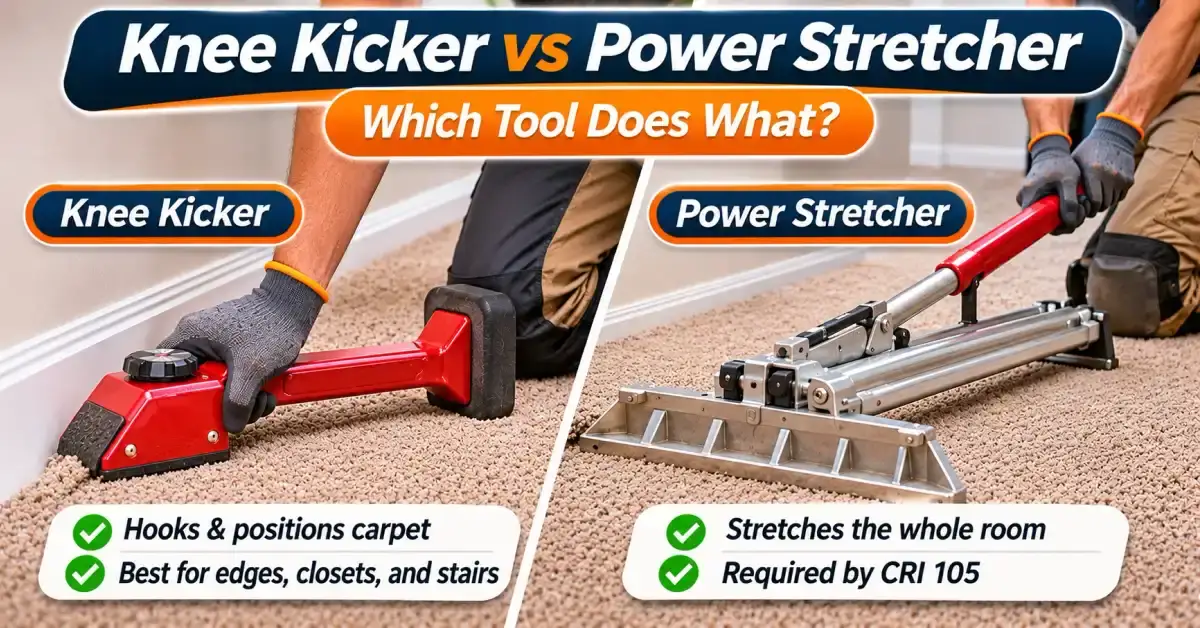
People often treat these two tools as interchangeable. They are not, and the difference decides whether your carpet stays tight.
Knee Kicker vs Power Stretcher at a Glance
| Knee kicker | Power stretcher | |
|---|---|---|
| Main job | Hooks and positions carpet | Stretches the whole room |
| How it works | Short kicks with your knee | Long lever pull, set at about a 15 degree angle |
| Best for | Edges, closets, stairs | Whole rooms |
| Standard | Not for stretching (CRI, Shaw) | Mandatory (CRI 105) |
Do You Need a Power Stretcher, or Is a Knee Kicker Enough?
For a whole room, you need a power stretcher. A knee kicker is enough only for small areas such as closets, stairs, and touch-ups.
CRI 105, the residential installation standard, makes power stretching mandatory and rejects devices that penetrate the carpet backing. Without manufacturer instructions, it calls for stretching tufted carpet with synthetic backing at least 1% in length and width. Shaw Industries asks for 1% to 1.5% in both directions and does not recommend stretcher hooks, stingers, or spikes. This Old House puts the line at rooms of 10 by 10 feet or larger. CRI sets no size exemption, so treat that figure as a rule of thumb.
Key Takeaway: A knee kicker positions carpet and a power stretcher stretches it. CRI requires the power stretcher for a stretch-in room.
The two tools work in sequence. The installer first hooks the carpet onto the tack strip along each wall with the kicker. The power stretcher then pulls the carpet tight at about a 15 degree angle from the wall, and the installer trims and tucks the edge. The kicker never replaces that stretching step. Rent the stretcher for a day, and plan the room so you can finish the whole stretch in one session.
Carpet Installation Tools by Job Stage
Measuring and Marking Tools
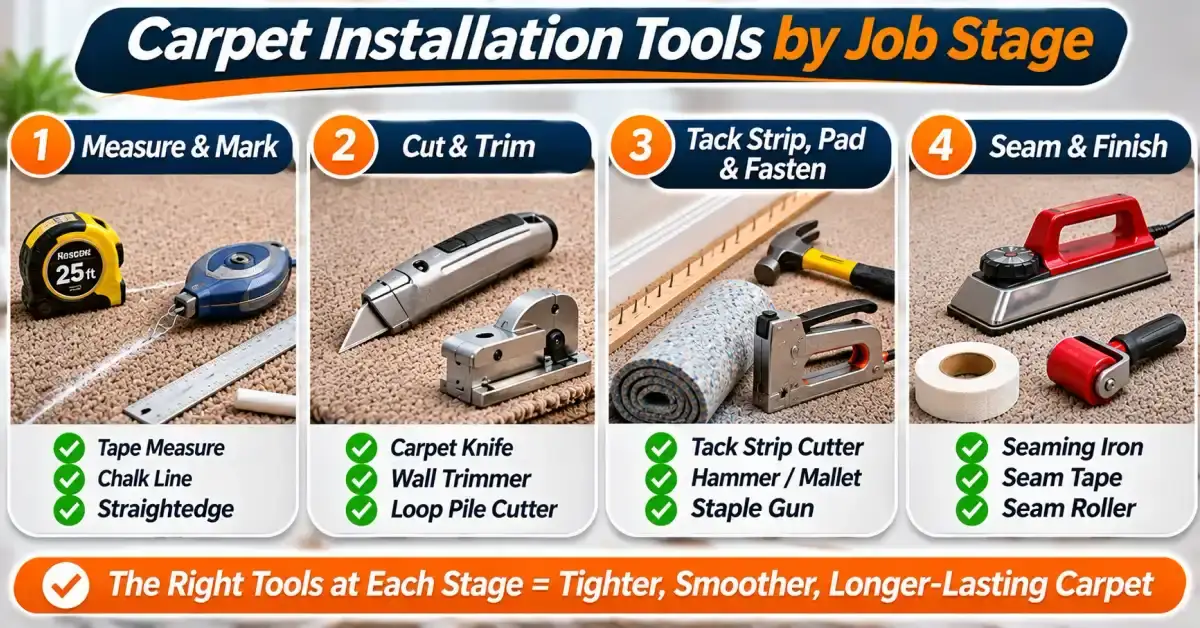
A steel tape measure, chalk line, and straightedge handle layout. Snap chalk lines to mark cut lines and seam locations before you touch the carpet. A straightedge also guides the knife for long, clean cuts. Beginners often measure once. Measure twice, and leave extra carpet at every wall for trimming. A cut you cannot undo costs far more than a minute with the tape.
Cutting and Trimming Tools
A carpet knife handles most carpet cuts, while a utility knife covers general cuts. A wall trimmer cleans up edges along baseboards. A cushion-back cutter slices pad-backed carpet cleanly, and a loop pile cutter trims loop carpet at seams. A row finder opens the tuft rows so a seam cutter shears fewer yarns. Dull blades tear fibers and slip off the line, so swap them often. Keep a small container for used blades, because loose ones end up in the pad and in bare feet.
Tack Strip, Pad, and Fastening Tools
You need a hammer or mallet, a tack strip cutter, and a staple gun or hammer tacker for the pad. A pry bar and molding lifter remove baseboards and old strips. CRI says the gap between strip and wall should be slightly less than the carpet thickness and never more than 3/8 inch. A wider gap lets the carpet pull loose. Cut strips to length with the tack strip cutter, and keep the pins angled toward the wall. Strips should not cross door openings.
Seaming Tools
A seaming iron with a heat shield melts the tape that joins two pieces. A seam roller presses the carpet into the melted adhesive. CRI requires a wood or non-conductive weight on the iron, not a metal one. Most homeowners rent the iron because only seam jobs need it. A seam roller costs little and works better than pressing by hand. Seams are also where the rented iron earns its fee, since a poor seam shows every day.
Edge and Stair Tools
A stair tool pushes carpet into the tight crease at each riser and drives it into the gap along a wall. Napping shears trim stray fibers along cut edges, and a nail-driving bar helps place tacks in tight spots. Stairs reward the right tool, because a dull or wrong-size blade leaves visible gaps at every riser. Names overlap between brands, so read the product description before you buy:
- Stair tool and carpet tucker: often the same steel tool. Roberts sells one 4-inch model as a "carpet tucker and stair tool," while other brands make blades near 3 inches wide.
- Bent stair tool: an angled blade for tucking under toe spaces and heat registers.
- Bolster chisel: a wide flat blade some sellers list as a stair tool.
- Edging tool: a loose label for any of the above, so check the blade width.
Safety Gear and Knee Protection
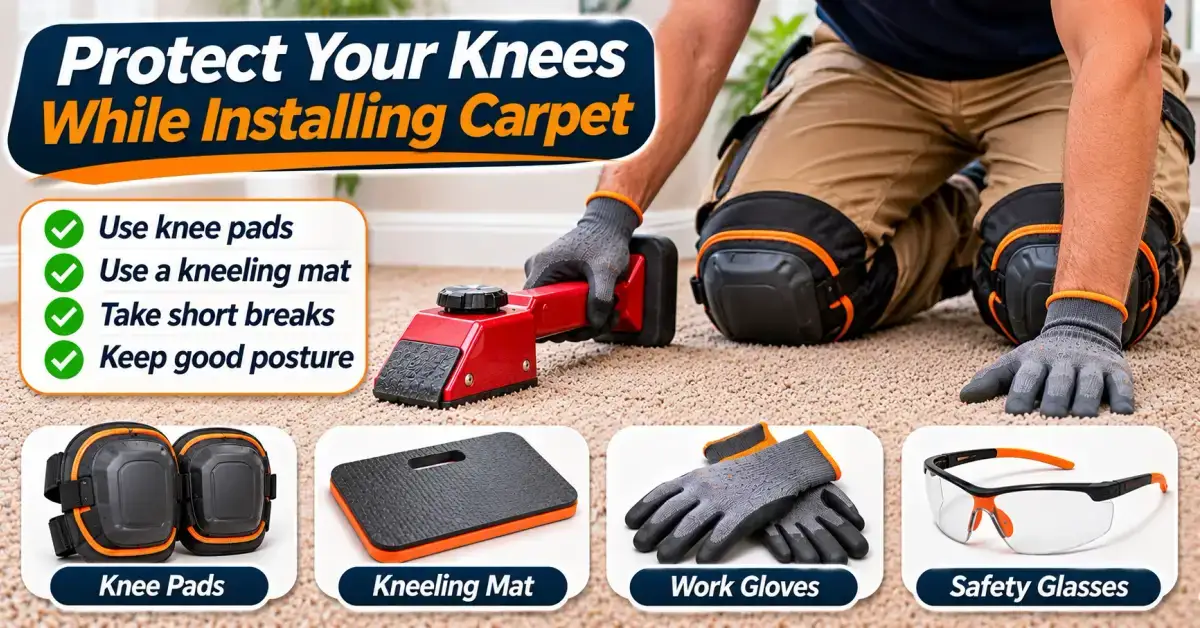
Do you need knee pads for carpet installation? Yes. The National Institute for Occupational Safety and Health (NIOSH) issued Alert 90-104 in May 1990 after finding serious knee injuries among carpet layers, who spend about 75% of their time kneeling. NIOSH recommends knee pads and the power stretcher. It also notes that mild kicks are enough to engage carpet on the tack strip, while hard kicks come from stretching a room.
Add gloves and safety glasses, and wear cut-resistant gloves during knife work. Always cut away from your body. Kneeling for hours also strains the back, so take breaks and switch tasks. Wearing pads for every kneeling job costs little compared with a knee injury.
Key Takeaway: Wear knee pads for every kneeling job, and use the power stretcher, as NIOSH recommends.
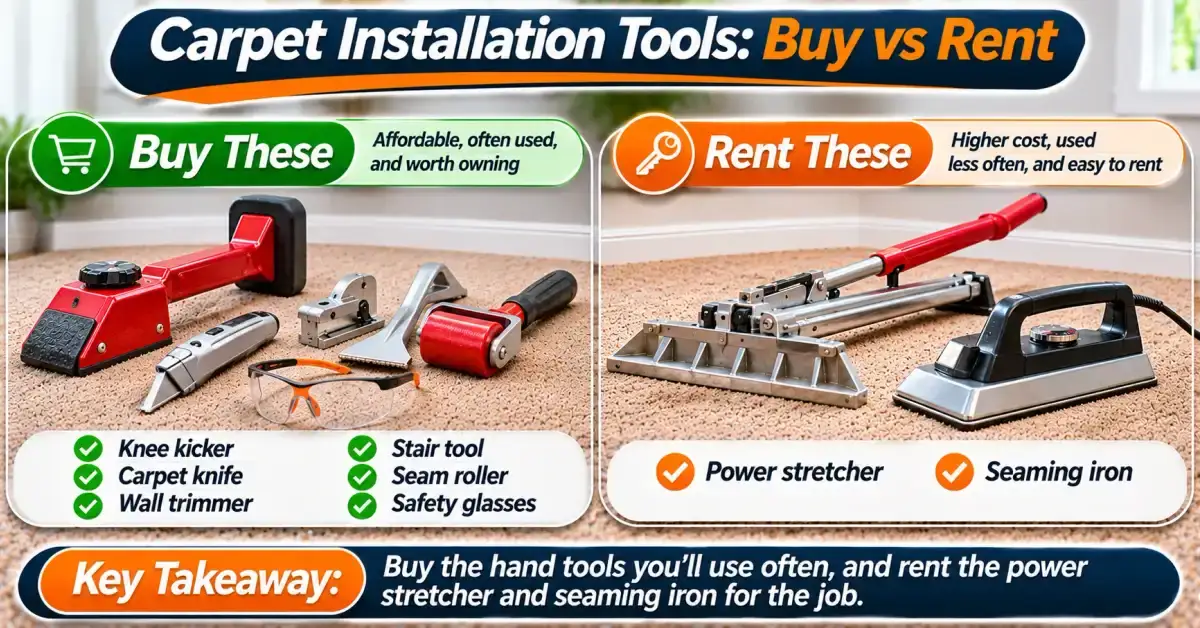
Carpet Installation Tools to Rent vs Buy
Buy the cheap hand tools you will use again. Rent the power stretcher and iron, because they cost the most and see the least use. Before you rent, ask how long the rental period runs, whether a deposit applies, and what the late fee is. Inspect the tool when you pick it up, and check that the stretcher's head and teeth move freely. Return it clean to avoid extra charges.
How Much Do Carpet Installation Tools Cost?
These prices are retailer listings seen on November 11, 2026, and they change often. Rental rates vary by store, deposits may apply, and some rental listings show no posted price, so call ahead.
| Tool | Typical new price | Verdict |
|---|---|---|
| Knee kicker | $27 to $144 | Buy |
| Stair tool | About $8 | Buy |
| Wall trimmer | About $58 | Buy |
| Cushion-back cutter | About $27 | Buy |
| Seaming iron (heat-bond) | About $129 | Rent or buy |
| Power stretcher | Several hundred to about $900 | Rent |
| Carpet puller | About $26 | Buy only for removal |
Tools and Shortcuts to Skip
- A carpet puller, unless you are removing old carpet.
- Stretcher hooks, stingers, and spikes, which Shaw does not recommend.
- Homemade substitutes for a power stretcher, which CRI does not accept.
- A 22-tool kit for one small room.
- Secondhand tools with dull or rusted blades.
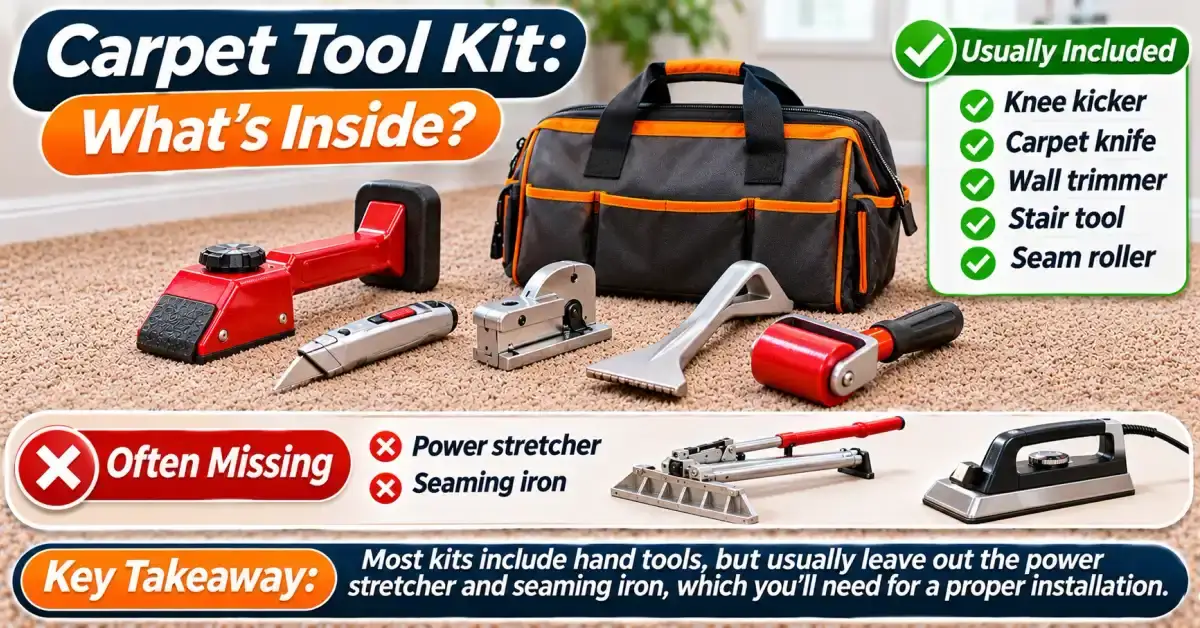
Carpet Tool Kits: What Is Inside and What Is Missing
What Common Kits Include
| Kit | Listed contents | Listed price | Not included |
|---|---|---|---|
| Roberts 10-752 Deluxe | 22 tools in a 24-inch steel box, including knee kicker, trimmer, loop pile cutter, cushion-back cutter, stair tool, tucker, 6-inch seam roller, knives, shears, chalk reel | $509 to $529 | Power stretcher, seaming iron |
| Crain 950 Installers Tool Kit | Installer hand tools per the retailer list | About $632 | Power stretcher, seaming iron |
| Menards rental kit | Wall trimmer, stair seam roller, stair tool, carpet knife with sheath | Listed at $8 for 4 hours; out of stock when checked | Power stretcher, knee kicker, iron |
| Economy 3-piece kit | Knee kicker, tucker, knife | Low | Nearly everything else |
When a Kit Is Worth It
A kit pays off on multi-room or repeat jobs. Home centers and online tool shops list carpet tool kits for sale, so compare before you buy. For one bedroom, the individual pieces you need cost far less. Using the prices above, a kicker, trimmer, stair tool, and cushion-back cutter total roughly $120 at the low end, against more than $500 for the Roberts kit. You would still rent the stretcher either way. When you read any kit list, look for a knee kicker, trimmer, stair tool, seam roller, and cutters. Anything missing from that set, you add yourself.
Key Takeaway: Kits cover hand tools, not the power stretcher or seaming iron. Compare the kit total with buying only what you need and renting the rest.
Supplies to Buy Alongside Your Carpet Tools
Carpet tools and supplies are two separate shopping lists. Tools last for years, while supplies run out.
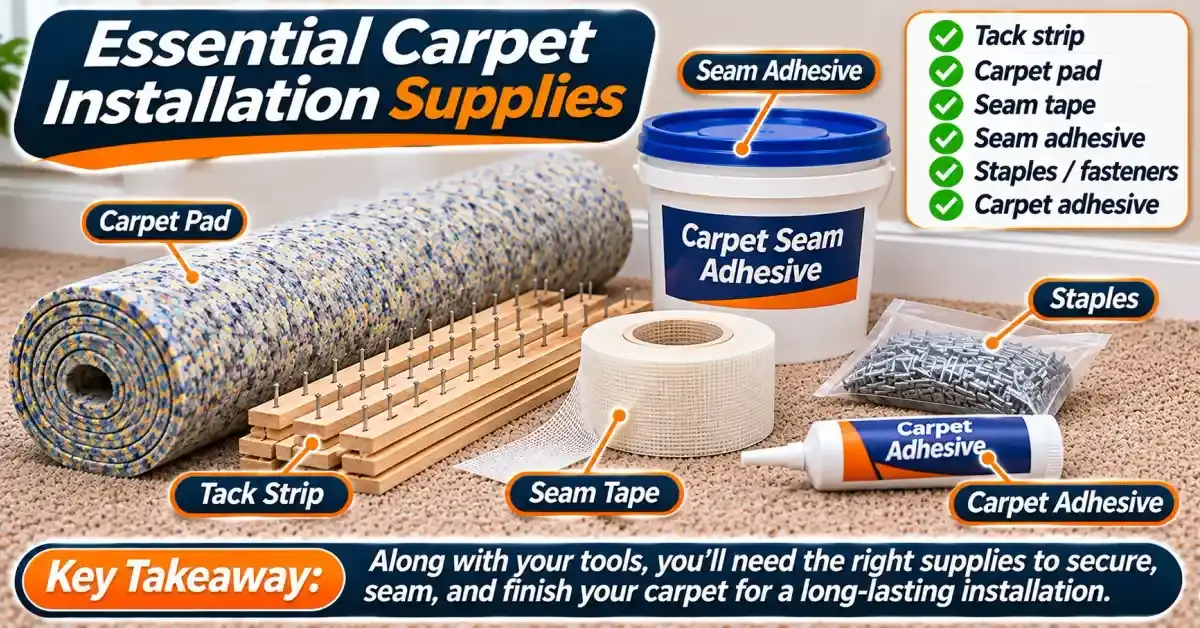
Plan on tack strips (at least 1 inch wide and 1/4 inch thick per CRI), pad, staples, seam tape, transition strips, and spare blades. Blades are the item you will replace most, so buy a pack of spare knife blades before you start. Seam tape matches the seam length, with a little extra for trimming. Transition strips finish the carpet edge at doorways, and you should measure the doorway before you buy them. Buy extra staples if you are fastening pad across a large room.
Staples fasten the pad, and the pad maker's instructions decide the size. Arrow sells T50 staples with legs from 1/4 to 9/16 inch. Glue-down jobs also need adhesive. Wipe knife blades and trimmers dry after use, and store them in a box so edges stay sharp.
Tools for Glue-Down Carpet, Carpet Tile, and Removal
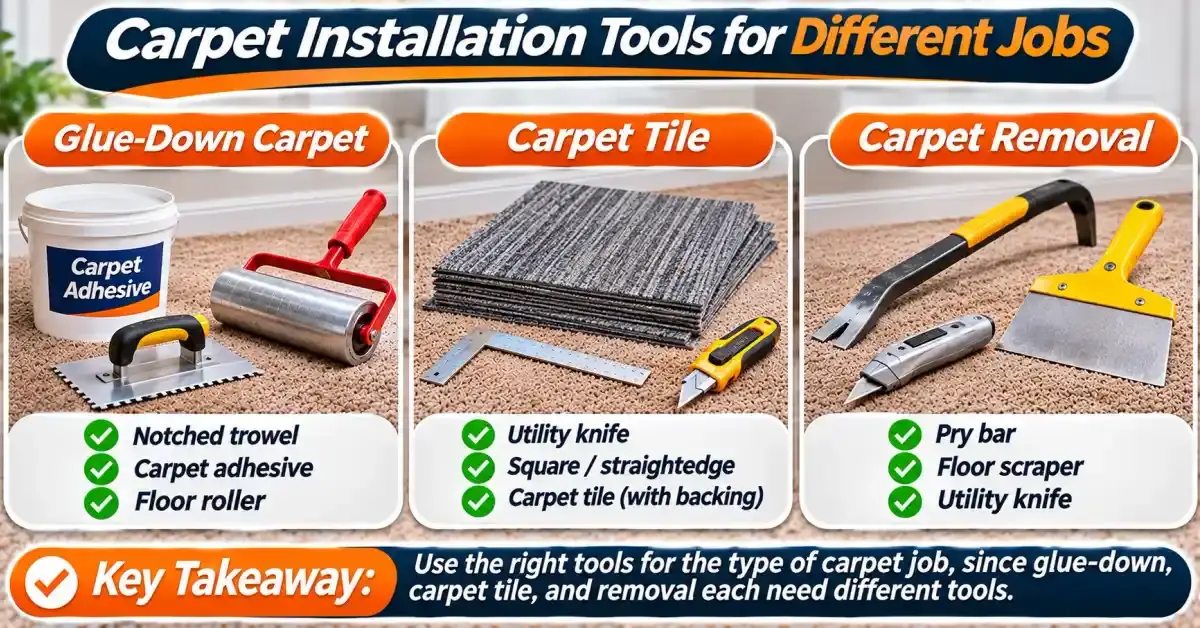
Glue-down carpet needs a notched trowel sized to CRI 105 Table II or the adhesive maker's directions, plus a 35, 50, or 75 pound roller. Do not exceed 75 pounds unless the manufacturer says so.
Carpet tile needs a tape measure, chalk line, straightedge, and knife. Only glue-down tile also needs a roller and trowel, and peel-and-stick tile needs neither.
Removal calls for a carpet puller, pry bar, pliers, and utility knife. The stretch-in tools above do not apply to tile. Always check the carpet or adhesive maker's instructions first, since they override general guidance. Trowel notch and roller weight can differ by product.
Key Takeaway: Glue-down carpet needs a correctly notched trowel and a 35 to 75 pound roller. Tile needs only measuring tools and a knife, unless it is glue-down tile.
Which Tools You Need for Your Project
- Small bedroom, no seam: knee kicker, rented power stretcher, carpet knife, wall trimmer, stair tool, hammer, tack strip cutter, tape measure, chalk line.
- Large room with a seam: add a rented seaming iron, seam tape, seam roller, cushion-back cutter, and a wood seam weight.
- Stairs: stair tool, tucker, knee kicker, staple gun or hammer tacker, carpet knife.
- Small repair or re-hooked edge: knee kicker, tucker, hammer, pry bar.
Use these lists as a starting point and adjust for your carpet. Patterned carpet may need extra stretch to match, and heavier carpet may need stronger knife blades. Read the carpet maker's installation sheet before you buy or rent anything.
FAQs About Carpet Installation Tools
Can You Install Carpet Yourself?
+
Yes, in a simple rectangular room with the right tools and a rented power stretcher. Seams, stairs, and patterned carpet are harder, because patterns may need extra stretch to match.
Can You Lay Carpet Without a Knee Kicker?
+
Not for a standard stretch-in job. The CRI 105 procedure uses the kicker to hook carpet onto the tack strip before power stretching. Glue-down and carpet tile installs do not use one.
Where Can You Rent Carpet Installation Tools?
+
Home improvement stores and equipment rental companies rent them. Home Depot, Menards, Sunbelt Rentals, and United Rentals list rental carpet tools. Stock and prices vary, so call ahead and ask about deposits.
What Tools Do Carpet Installers Use?
+
A professional installer typically carries a knee kicker, power stretcher, knives, trimmers, a stair tool, a seaming iron, and a roller. Many keep them in a steel tool box. You do not need all of them for one room, so start with the short list above and add tools as the job requires.
Buy the Basics, Rent the Rest
Carpet installation tools split cleanly. Buy the knee kicker, knives, trimmer, and stair tool. Rent the power stretcher and seaming iron. Since CRI requires power stretching for stretch-in rooms, skip any kit or shortcut that leaves it out.
Need a carpet cleaning company you can trust? We handle residential and commercial carpet cleaning, rug cleaning, upholstery cleaning, and pet stain and odor removal —our team is ready to help.

Michael Sanders
Michael Sanders is a home care and cleaning industry writer covering carpet maintenance, flooring care, and household cleaning practices across the United States. His work focuses on practical, research-backed guidance — from stain and odor removal to deep extraction methods and indoor allergen prevention. Michael collaborates with cleaning professionals to ensure accuracy, and his writing reflects a genuine interest in helping homeowners make informed decisions about caring for their homes.