
Blog · Carpet Cleaning Guide
How to Install Carpet on Stairs: Step-by-Step for Waterfall and Cap and Band
To install carpet on stairs, you fix tack strips and pad to every tread and riser, then stretch the carpet over them and staple it in place. Choose waterfall for an easier job or cap and band for a tailored look that takes more skill. Angi rates the job as challenging and estimates about five hours, though a weekend is safer for a first try. Plan on roughly 10% extra carpet for mistakes.
Published November 22, 202615 min read
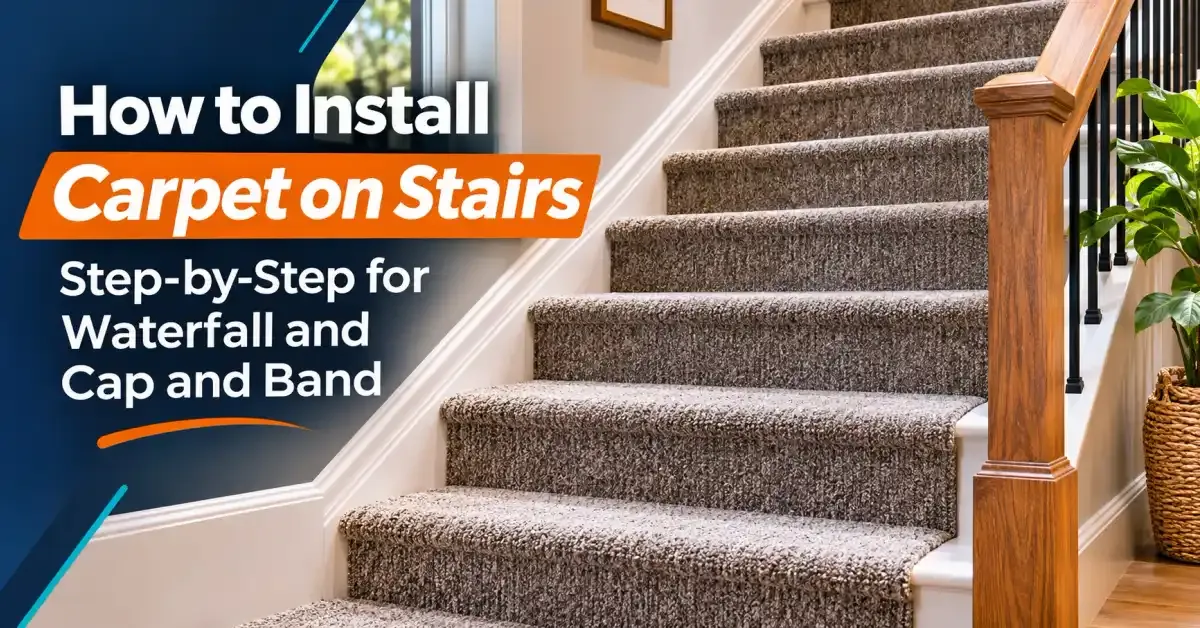
This guide covers measuring, materials, both methods, special cases, costs and common errors.
Waterfall vs Cap and Band: Which Method Should You Use?
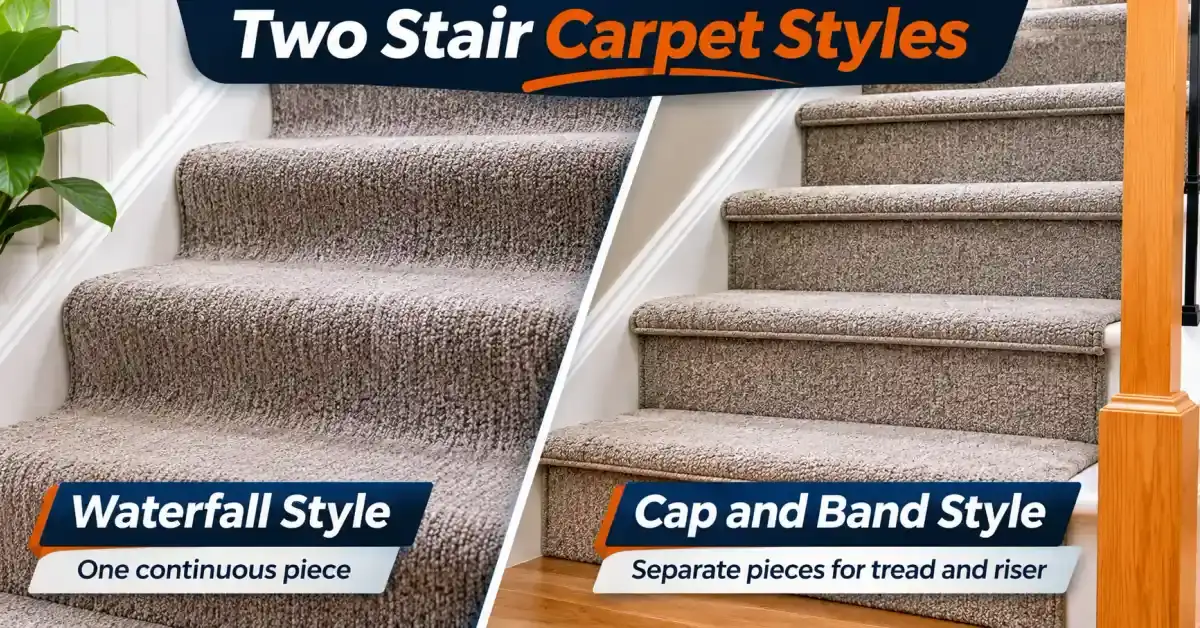
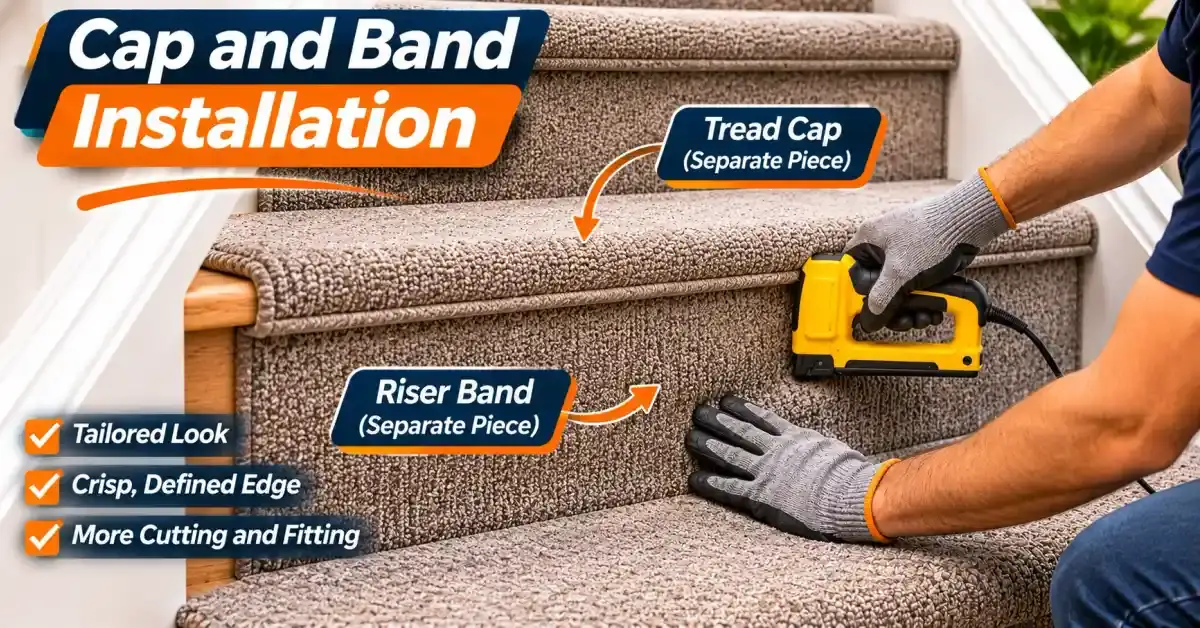
Waterfall uses one continuous piece of carpet that drops over each nosing and runs down the riser to the next tread. Cap and band uses separate pieces, so each tread and each riser gets its own cut. The Journal of Light Construction (JLC) says both methods need a rounded nosing, which reduces wear on the carpet backing.
| Waterfall | Cap and Band | |
|---|---|---|
| Look | Soft, continuous edge over the nosing | Crisp, tailored edge |
| Difficulty | Easier for first-timers | Harder, more cutting and fitting |
| Carpet needed | About 18 to 19 in. per stair (D and G Flooring); JLC notes it can use more | About 19 to 21 in. per stair (D and G Flooring) |
| Time (D and G Flooring) | 3 to 5 hours | 5 to 8 hours |
| Best for | Beginners, patterned carpet | Stairs with a defined nosing, a formal look |
Sources disagree on how much carpet each method uses, so confirm the allowance with your supplier and follow your carpet maker's instructions.
Key Takeaway: Pick waterfall if this is your first stair project. Pick cap and band if you want a tailored edge and can handle more cutting.
What "Cap and Band" and "Hollywood" Mean
JLC defines cap and band as separate pieces: a cap covers each tread and wraps its nosing, and a band covers each riser. Bob Vila and Angi use "Hollywood," "upholstered" or "French cap" for a one-piece style that wraps the nosing and staples underneath. Some sellers treat all of these names as the same thing. When you order carpet or hire an installer, describe the look you want instead of relying on a single name.
How to Measure Stairs for Carpet
If you wonder how to carpet stairs without wasting a roll, start with the measuring. Measure the tread depth, the riser height and the stair width on each step. Then use this formula.
- Add tread depth and riser height to get the length per stair.
- Multiply by the number of stairs.
- Add about 10% for waste, or up to 15% for patterned carpet.
- Convert inches to feet or yards and round up.
- Measure landings separately.
Carpet rolls come 12 feet wide, so one roll covers any standard stair width. Check that your stairs meet the International Residential Code (IRC): treads at least 10 in. deep and risers no taller than 7-3/4 in., with no more than 3/8 in. variation (confirmed through local building-department guides, so check your local code).
Worked Example for a 13-Step Staircase
This example uses 13 stairs, an 11 in. tread, a 7.5 in. riser and a 36 in. width, for the waterfall method.
| Step | Calculation | Result |
|---|---|---|
| Length per stair | 11 + 7.5 | 18.5 in. |
| Total length | 18.5 x 13 | 240.5 in. (20.04 ft) |
| Add 10% waste | 240.5 x 1.10 | 264.55 in. (22.05 ft, 7.35 linear yards) |
| Area before waste | 240.5 x 36 | 60.1 sq ft (6.68 sq yd) |
| Area with 10% waste | 66.1 sq ft / 7.35 sq yd |
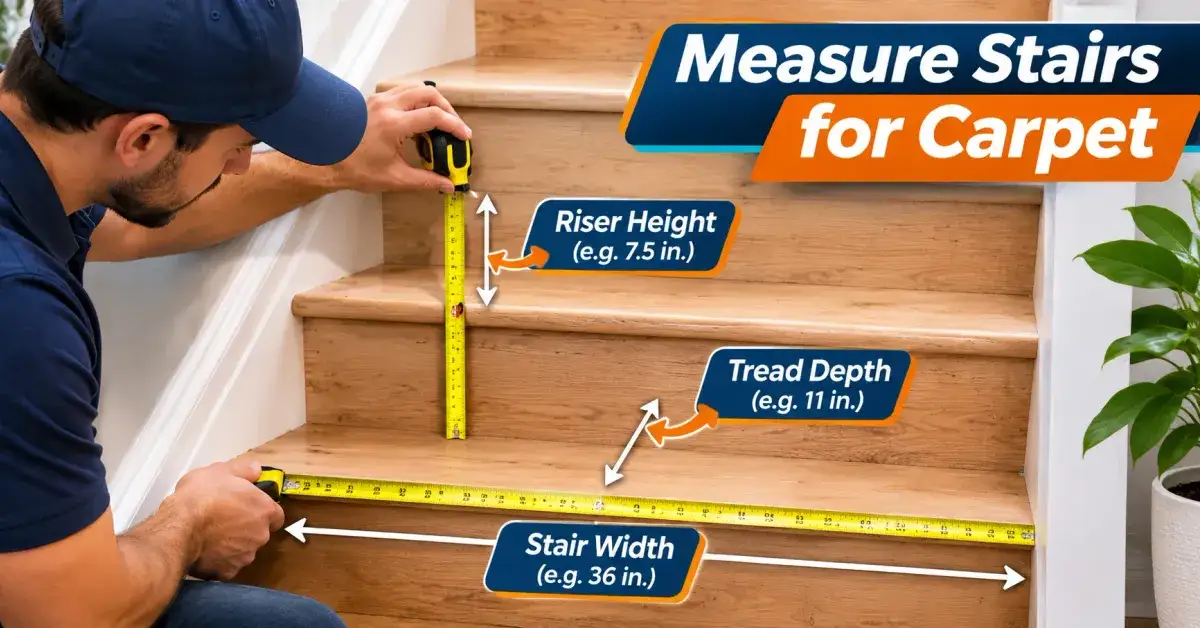
D and G Flooring reaches a similar figure of about 22 linear feet for the same staircase. For wrapped styles, add a wrap allowance (Bob Vila suggests about an inch per nosing for the Hollywood style) and ask your supplier to confirm.
Key Takeaway: Length per stair is tread plus riser. Multiply by the stair count, add 10%, and round up. For this 13-step example, buy about 22 feet.
Tools and Materials to Install Carpet on Stairs
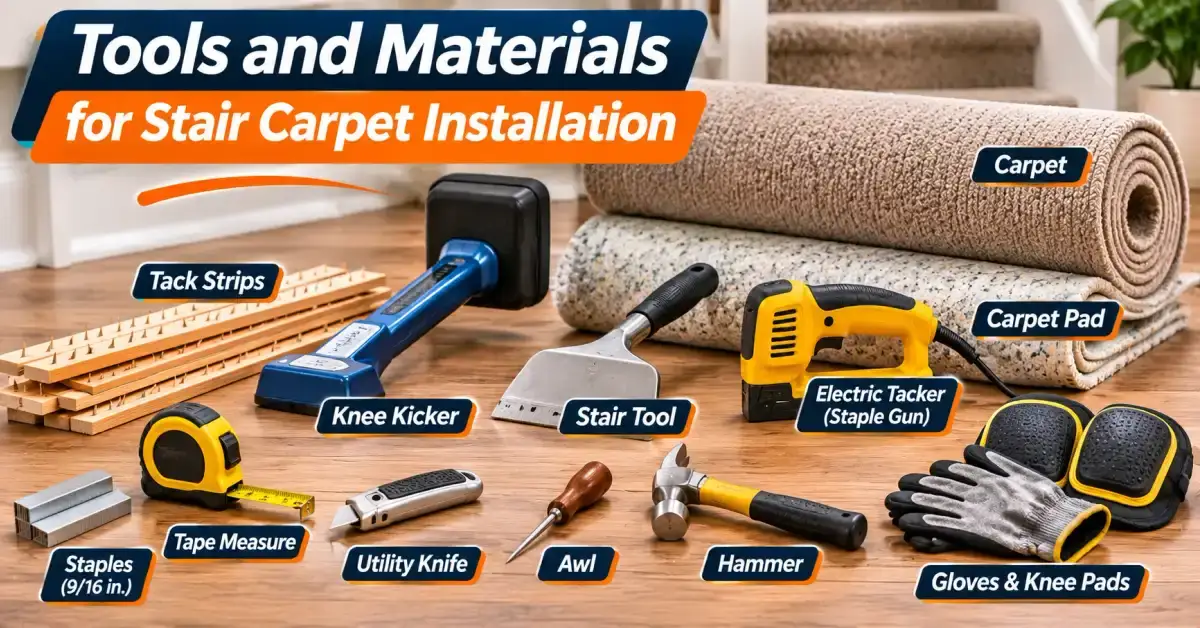
Gather these before you cut anything:
- Carpet, with the pad if you buy it separately
- Tack strips and a tack strip cutter or tin snips
- Knee kicker and stair tool
- Electric tacker, hammer tacker or staple gun
- Utility knife with spare blades, awl, tape measure and chalk
- Gloves, knee pads and a hammer
For staples, Angi recommends 9/16 in. upholstery staples. Electric carpet tackers commonly drive 20-gauge staples with a 3/16 in. crown and 9/16 in. leg, such as the Powernail 54E.
Tack Strips vs Carpet Tacks vs Staples
Carpet tacks for stairs are small nails that hold edges, runners and trim by hand, but they do not replace tack strips on stretch-in installs. Tack strips are thin wood strips with angled pins that grip the carpet backing. Staples then fix the carpet at the nose and at the bottom of each riser.
| Item | What it is | Where it goes |
|---|---|---|
| Tack strip | Wood strip with angled pins | Back of each tread and bottom of each riser |
| Carpet tack | Small nail | Edges, runner ends, trim |
| Staple | Metal fastener from a tacker | Under the nosing and at the riser base |
The Carpet and Rug Institute (CRI) sets clear rules for tack strips. The pins must angle toward the vertical surface and must not poke through the carpet. Each strip needs at least two fasteners. The gap between strip and wall or riser should be slightly less than the carpet thickness and never more than 3/8 in. Some guides give different gaps, so follow your carpet maker. CRI also says not to staple carpet to the tack strip itself.
Key Takeaway: Tack strips hold the carpet, staples finish the edges, and loose carpet tacks only help with trim and runners.
What Pad Works on Stairs
Stairs need a thinner, firmer cushion than living rooms, according to CRI. CRI gives no stair-specific number. For berber and other low-profile carpet, it limits the pad to 3/8 in. thick and 8 lb density. General residential guidance runs 1/4 to 7/16 in. at 6 lb. Avoid carpet with built-in padding on stairs, as Better Homes and Gardens advises. Check the carpet maker's pad requirement before you buy.
Prepare the Stairs Before You Install
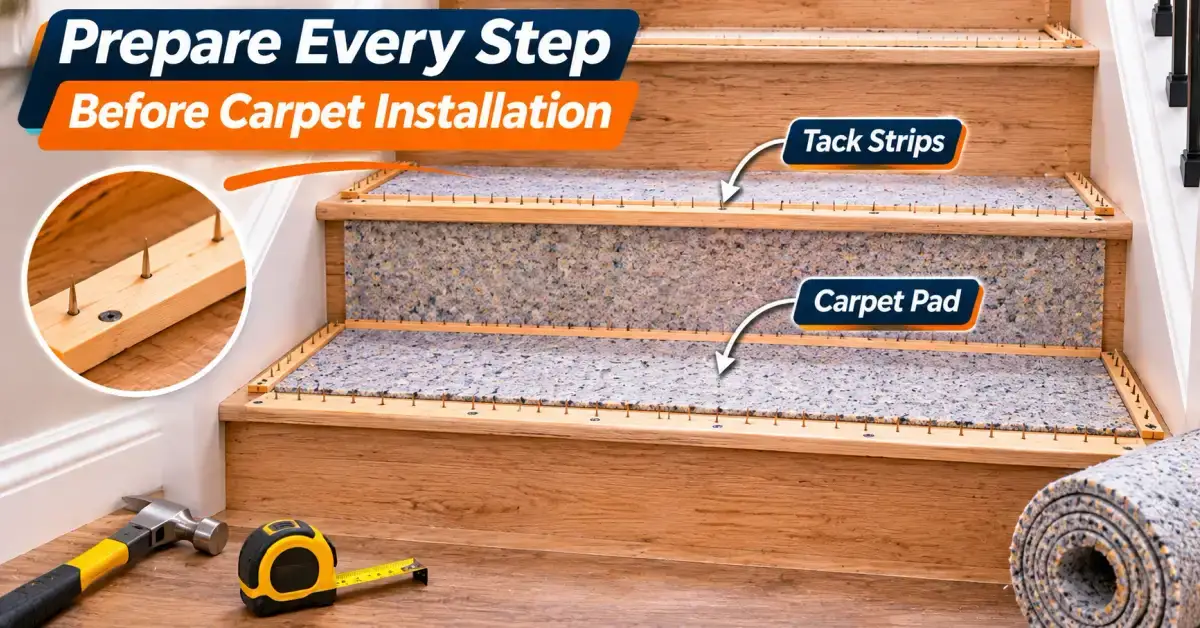
Remove old carpet, pad and every staple or nail. Pull old tack strips and scrape off glue. Tighten squeaky treads, and check that each nosing is rounded and sound. Sweep the stairs clean.
Wear gloves and knee pads. Tack strip points are sharp, so keep removed strips and offcuts away from walking surfaces. Fitting stair carpet goes much faster once the wood is smooth, dry and quiet.
Cut tack strips to fit the stair width. Nail one strip at the back of each tread and one at the bottom of each riser. Leave the gap CRI describes, and point the pins toward the riser. Cut pad to fit each tread, then staple it down so it stays flat. Angi pads only the tread for wrapped styles and staples pad along the riser for waterfall.
How to Install Carpet on Stairs Step by Step
Most DIY guides, including Angi and Bob Vila, work from the bottom stair up because the knee kicker pushes carpet upward. D and G Flooring starts its waterfall at the top. Choose one direction and keep it for the whole flight.
Waterfall Method
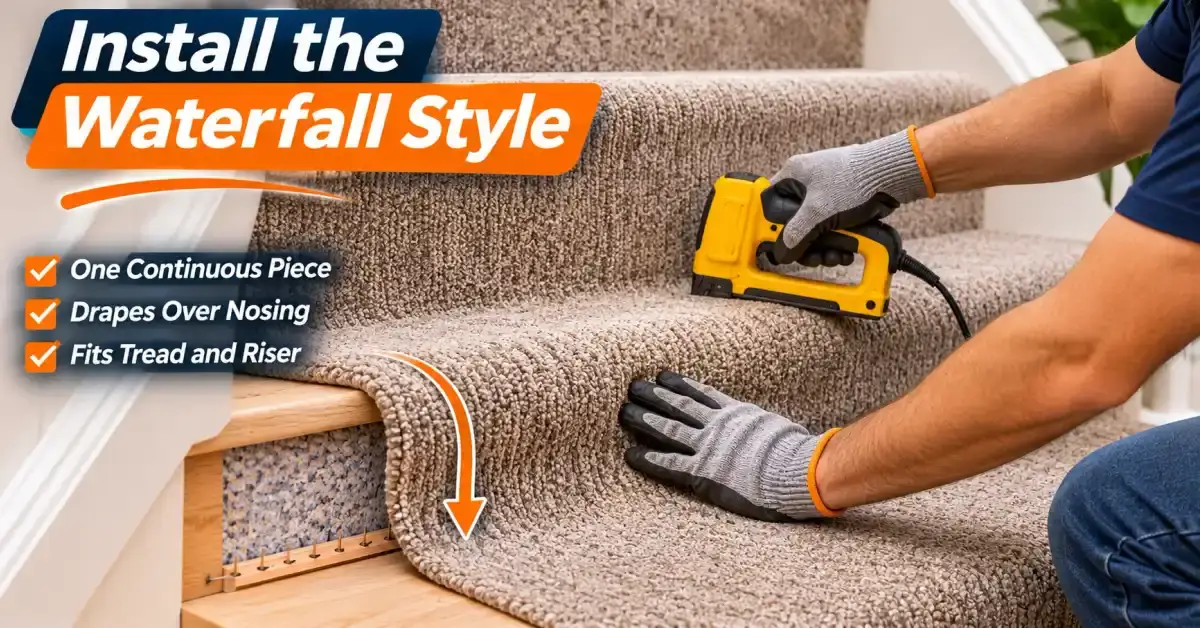
- Trim about 1 in. of selvage (the woven factory edge) from the carpet, as Angi advises.
- Cut a piece long enough for the tread, the riser and the tuck at the back of the tread.
- Hook the carpet on the tack strip at the back of the tread. Rubbing a hammer face along the strip helps the pins bite.
- Pull it forward over the nosing and down the riser.
- Use the knee kicker to stretch it toward the bottom of the riser. Work from the center outward to remove ripples.
- Crease the carpet where riser meets tread with the stair tool, then staple it close to the bottom of the riser.
- Repeat on the next stair, keeping the pile direction consistent, and trim the edges neatly against the wall.
Cap and Band Method
Cap and band stairs take more time, because each tread and each riser gets its own cut. JLC installs the caps first and glues the bands to the risers on the return trip. Direct Carpet starts with the riser piece. Follow the order your carpet maker recommends.
- Cut a cap for each tread, long enough to reach the tack strip and wrap the nosing.
- Hook the cap on the tack strip, stretch it over the nosing and staple it underneath.
- Cut a band for each riser and fasten it the way your carpet maker specifies. JLC glues bands to the risers.
- Tuck each band into the gap at the bottom of the riser with the stair tool.
- Trim the edges so the seam along the nosing stays tidy.
How to Staple Carpet on Stairs
Here is how to staple carpet to stairs without leaving visible tufts. Place the tacker between the carpet fibers, press it flat to the wood and drive the staple. Keep staples close to the nosing underside and the riser base. For runners, Home Depot suggests stapling from the center out about every 3 inches. Never drive staples through the face of the pile.
Landings, Winders, Open Sides, Runners and Pile Direction
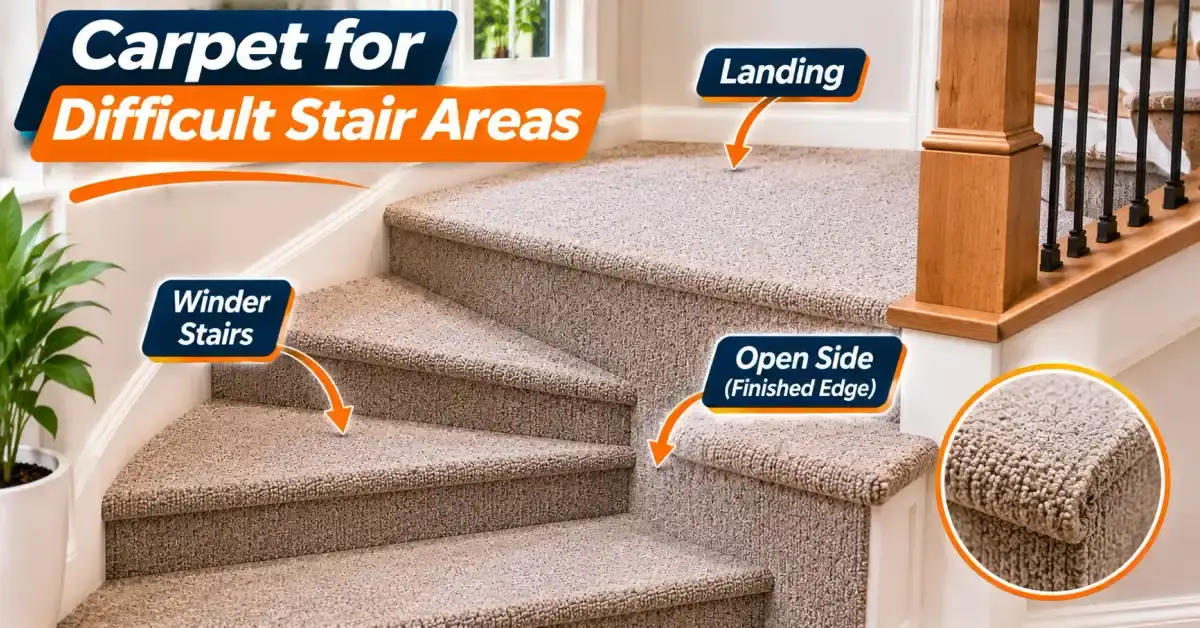
Measure landings separately and treat them as flat floors. Winders are the wedge-shaped steps on a curve, so learning how to fit stair carpet around them takes extra care. HowStuffWorks says to measure each wedge at its widest point and cut a paper pattern first. Open sides, where spindles replace a wall, need the carpet edge bound or wrapped.
Run the pile so it leans down the stairs. HowStuffWorks and D and G Flooring both give this advice, though no standard confirms it. Runners use pre-hemmed carpet, and Angi and Bob Vila keep the tack strips a few inches narrower than the runner so the edges show. The methods above apply to full coverage and runners alike.
Common Mistakes When Laying Carpet on Stairs
Laying carpet on stairs goes wrong in familiar ways:
- Cutting before double-checking measurements: measure twice and add the waste allowance.
- Using thick pad: choose the thin, firm cushion CRI recommends.
- Leaving the selvage on: trim it, because it causes bumps.
- Setting the tack strip gap too wide or too narrow: match it to the carpet thickness.
- Under-stretching: kick from the center outward until the carpet is tight.
- Stapling through the pile: place staples between the fibers.
- Using the wrong staples: match the staple length to your pad and carpet.
- Placing tack strips where bare feet can reach them: keep them at the back of treads and base of risers.
Catch these early, because errors repeat from stair to stair.
How Much Does It Cost to Carpet Stairs?
Costs vary by region, carpet grade and job size. Treat these published figures as ranges, because the pages are undated or labeled 2026.
| Source | Figure |
|---|---|
| HomeGuide | $15 to $55 per step installed; $180 to $880 for 12 to 16 steps, averaging $530 |
| Angi cost page | $14 to $36 per step; typical total $300 to $650 |
| Angi how-to guide | $400 to $1,200 for a flight |
| D and G Flooring | $175 to $525 DIY; $300 to $1,000 with a pro |
HomeGuide lists open sides and curved stairs as cost drivers. Costs differ because each source counts different work, so ask for a written quote that names the stair count and the method.
DIY or Hire a Pro?
Installing carpet on stairs is a realistic DIY project if you own a knee kicker and tacker and have a free weekend. Hire a pro for curved stairs, open sides, patterned carpet or cap and band work. A flawed DIY install may void a carpet warranty, according to Direct Carpet.
Carpet on Stairs FAQs
Can You Install Carpet on Stairs Without Tack Strips?
+
Staples alone can hold a runner, but wall-to-wall stair carpet grips better with tack strips. Loose carpet tacks work only as a limited fallback for runners.
Can You Install Stair Carpet Without Padding?
+
You can, but pad supports the carpet and reduces wear. Follow CRI's advice and choose a thin, firm cushion.
Can You Glue Carpet to Stairs?
+
Adhesive suits bands, edges and runner ends, while stretch-in installs rely on tack strips. Follow your carpet maker's instructions.
Do You Need a Knee Kicker?
+
Yes. A knee kicker gives the stretch that prevents ripples, and HowStuffWorks notes you can rent one.
How Do You Hide Staples on Stair Carpet?
+
Place staples between the fibers and under the nosing, then brush the pile over them.
Quick Recap: How to Install Carpet on Stairs
To install carpet on stairs, choose waterfall or cap and band, measure with tread plus riser, and add 10% waste. Fit tack strips and thin pad, stretch the carpet with a knee kicker, and staple between the fibers. Check the costs and your skill level before you start.
Need a carpet cleaning company you can trust? We handle residential and commercial carpet cleaning, rug cleaning, upholstery cleaning, and pet stain and odor removal —our team is ready to help.

Michael Sanders
Michael Sanders is a home care and cleaning industry writer covering carpet maintenance, flooring care, and household cleaning practices across the United States. His work focuses on practical, research-backed guidance — from stain and odor removal to deep extraction methods and indoor allergen prevention. Michael collaborates with cleaning professionals to ensure accuracy, and his writing reflects a genuine interest in helping homeowners make informed decisions about caring for their homes.