
Blog · Carpet Cleaning Guide
Stair Carpet Runner Guide: How to Choose the Right Size, Fiber and Pad
A stair carpet runner is a strip of carpet that covers the center of each step and leaves bare stair on both sides. On a standard 36 in. stair, a runner about 27 to 32 in. wide usually looks right. Measure tread depth and riser height, add a little waste, then choose a dense, low pile over a thin, firm pad.
Published November 20, 202614 min read
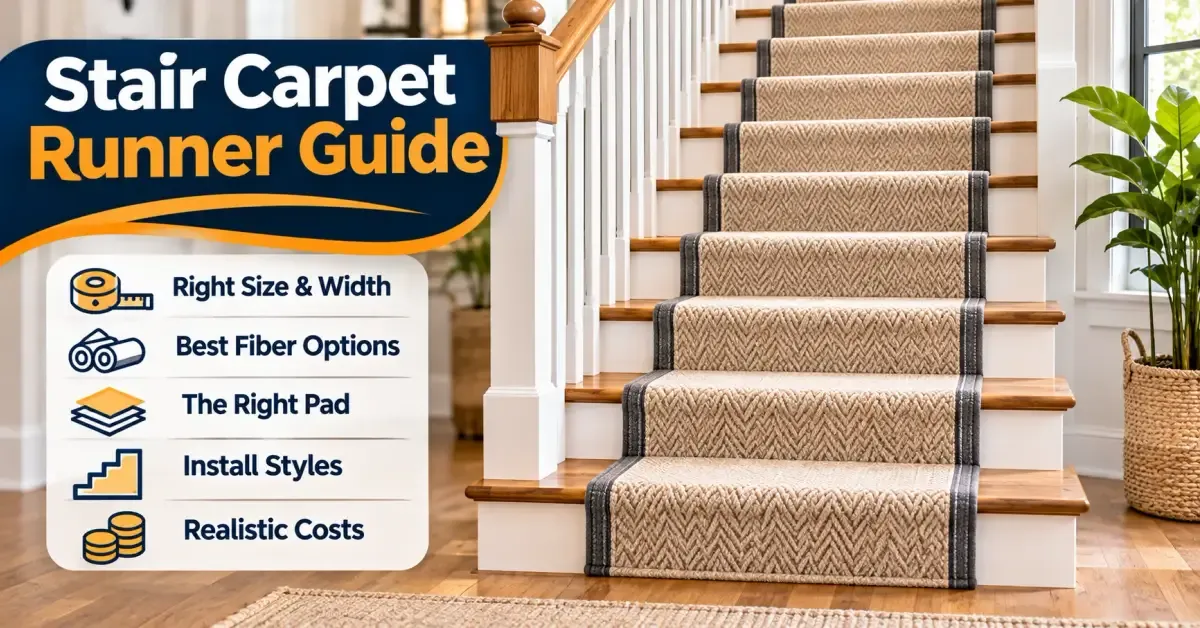
This guide covers size, fiber, pad, installation style and realistic costs from named sources.
What Is a Stair Carpet Runner?
A stair carpet runner is a narrow length of carpet or flatweave that follows the tread and riser of each step. It protects wood stairs from wear, softens noise, and adds grip. Retailers also sell the same product as a staircase runner or stair runner carpet, and some call it a runner rug made for stairs. Stair rugs is a looser term: it can mean a full-length runner or a set of separate treads.
Stair Carpet Runner vs Full Stair Carpet vs Stair Treads
Is a runner a good idea? Usually yes. A runner adds grip, especially on bare feet or socks, and it protects wood from wear. The trade-off is small staple holes in the wood if you remove it later.
| Option | Look | Exposed wood | Install difficulty | Best for |
|---|---|---|---|---|
| Stair carpet runner | Continuous strip down the center | Yes, both sides | Moderate; needs precise alignment | Attractive hardwood stairs |
| Full stair carpet | Wall-to-wall coverage | None | Moderate to hard; needs stretching | Maximum grip and quiet |
| Stair treads (stair rugs sets) | Separate pads on each tread | Yes, plus risers | Easy; often tape or staples | Low budgets, quick updates |
How Wide Should a Stair Carpet Runner Be?
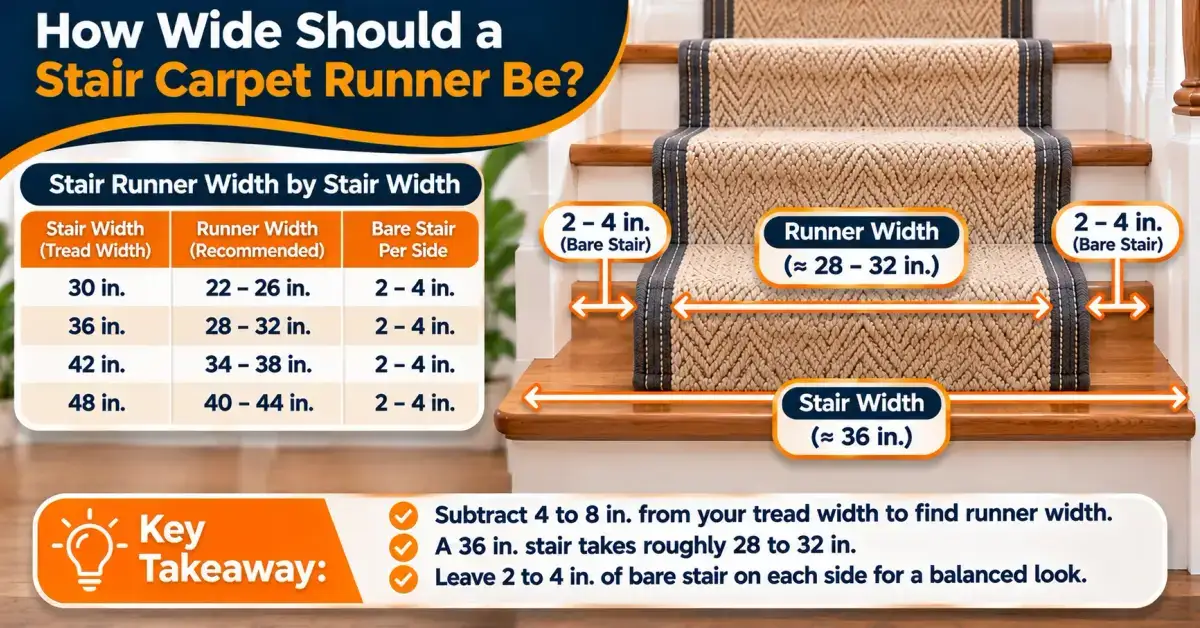
Subtract 4 to 8 in. from the tread width. That leaves 2 to 4 in. of bare stair on each side, which is the range Wayfair recommends. Lowe’s gives one concrete pairing: a runner about 27 in. wide suits a 36 in. stair. That leaves about 4.5 in. per side.
Stair Runner Width by Stair Width
The table follows the Wayfair rule. Lowe’s suggests 32 to 33 in. for a 48 in. stair, a wider reveal, so treat width as a style choice.
| Stair (tread) width | Runner width | Bare stair per side |
|---|---|---|
| 30 in. | 22 to 26 in. | 2 to 4 in. |
| 36 in. | 28 to 32 in. | 2 to 4 in. |
| 42 in. | 34 to 38 in. | 2 to 4 in. |
| 48 in. | 40 to 44 in. | 2 to 4 in. |
Key Takeaway: Subtract 4 to 8 in. from your tread width to find runner width. A 36 in. stair takes roughly 28 to 32 in., and Lowe’s pairs a 27 in. runner with a 36 in. stair.
How Much Bare Stair Should You Leave on Each Side?
Two to 4 in. is the usual guide. Show more when the hardwood stairs are attractive, and keep both sides even. White stairs with a dark runner create strong contrast, so measure carefully.
Custom Length, By the Foot and Wide Stair Runners
Pre-hemmed runners come in fixed lengths. Custom length runners are cut and finished to your measurements, with serged or bound edges. Some stores sell broadloom by the foot, and finishing costs extra. Check the maximum width a retailer offers before you shop. A long staircase may need two joined pieces.
How Much Stair Runner Do You Need?
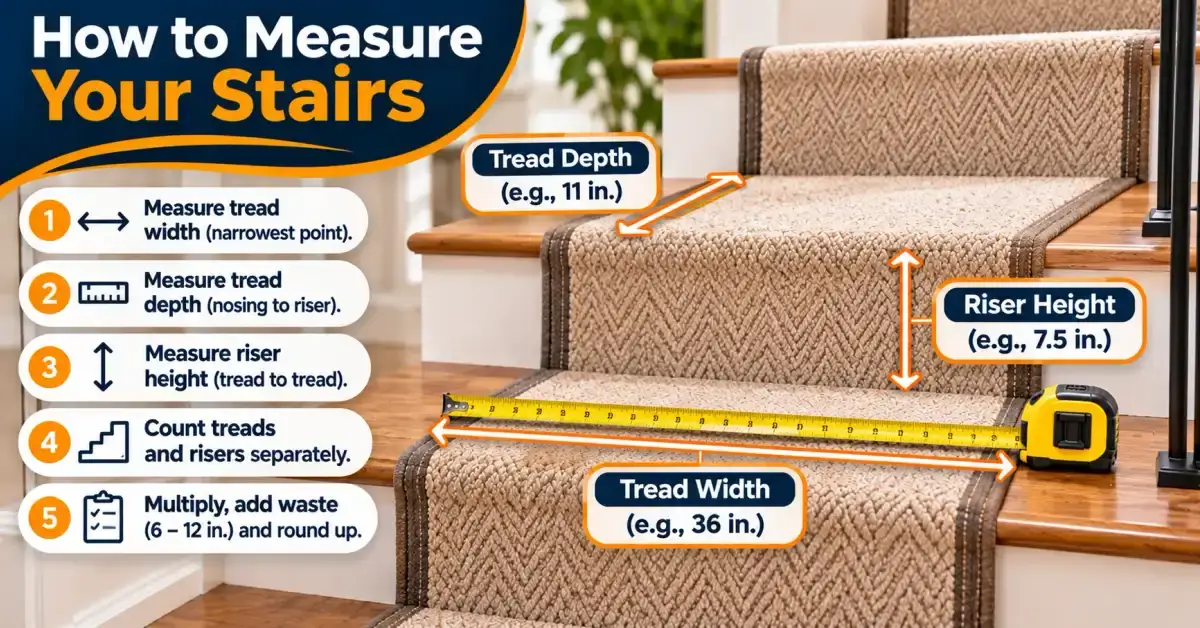
Use this formula: (tread depth x number of treads) + (riser height x number of risers) + waste. Convert the total to feet and round up. Home Depot adds 6 in. for waste, Angi suggests 6 to 8 in., and Wayfair allows 6 to 12 in. Add more if the pattern repeats or the runner will turn a corner.
How to Measure Your Stairs
- Measure tread width at the narrowest point.
- Measure tread depth from nosing edge to riser.
- Measure riser height from tread to tread.
- Count treads and risers separately, since landings change the totals.
- Write the numbers down, then multiply and add waste before ordering.
Worked Example for a 14-Step Staircase
Assume 14 treads at 11 in. and 14 risers at 7.5 in.
| Item | Waterfall | Hollywood |
|---|---|---|
| Treads: 11 x 14 | 154 in. | 154 in. |
| Risers: 7.5 x 14 | 105 in. | 105 in. |
| Subtotal | 259 in. | 259 in. |
| Allowance | 6 in. waste | 14 in. nosing wrap + 18 in. extra |
| Total | 265 in. (22.1 ft) | 291 in. (24.25 ft) |
| Order | 23 ft | 25 ft |
Bob Vila says to add 1 in. per nosing plus at least 18 in. spare for Hollywood style, and gives no extra figure for waterfall. Many real flights have one fewer tread than risers, so recount yours.
Stairs With a Landing, a Turn or a Corner
Treat each straight run as a separate runner, as Runrug advises. A landing needs its own piece or a bound rug. Winders and corners need extra length and careful pattern matching, so many homeowners hire a pro for turns.
Waterfall vs Hollywood Installation
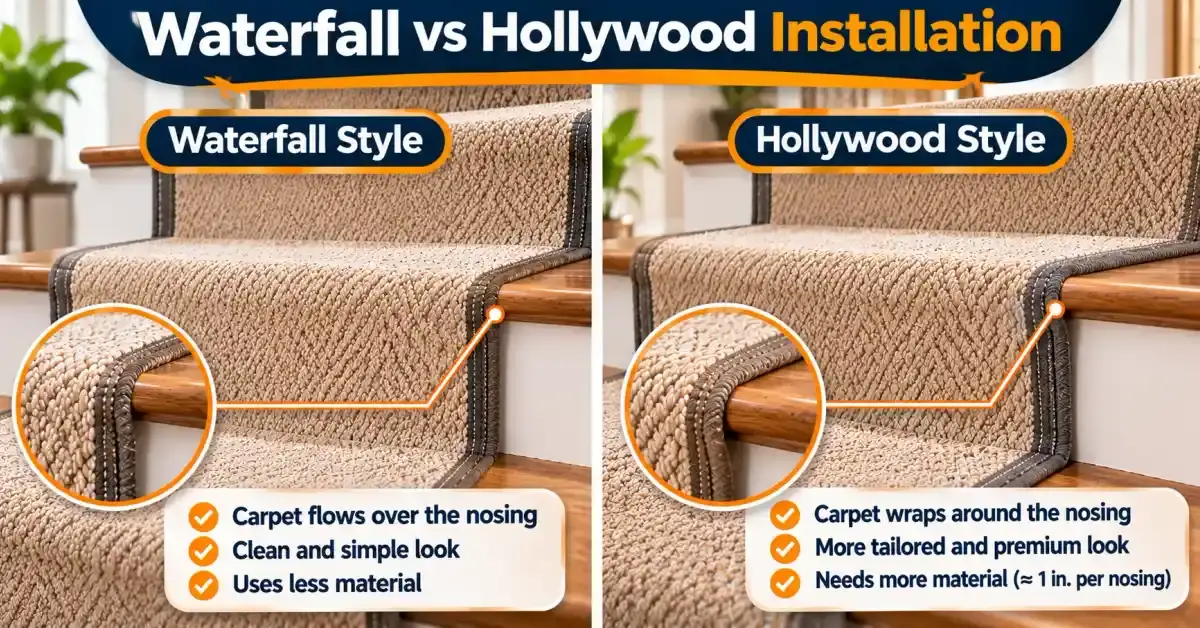
Waterfall installation lets the runner flow over the nosing and down the riser in one pass. It uses less carpet and takes less skill, so it suits most DIY jobs and basement stairs. Hollywood installation, also called cap and band, wraps the runner under the nosing and starts a new piece on the riser. It looks sleeker and tailored, uses more carpet, and demands neat folds.
Best Material for a Stair Runner
Wool, Nylon, Triexta, Polypropylene and Natural Fibers Compared
Fiber claims below come from This Old House, HGTV and retailer guides, so treat rankings as general guidance.
| Fiber | Durability | Stain behavior | Cost level | Best for |
|---|---|---|---|---|
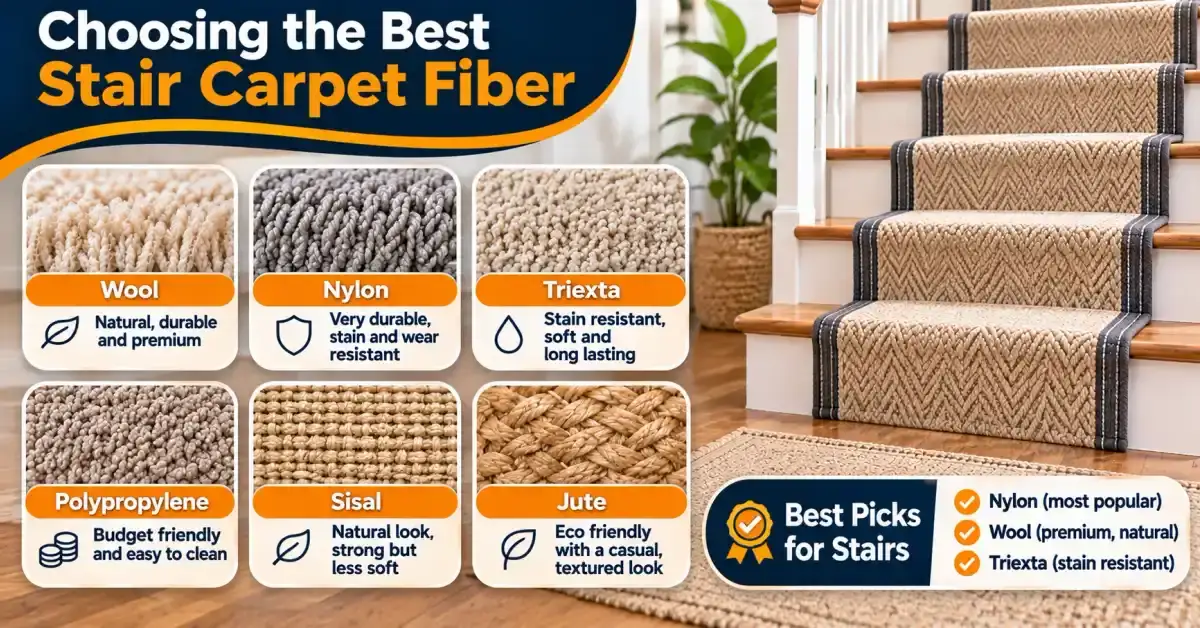
| Wool | Durable, resists crushing | Good if you treat spills promptly | Higher | High end, elegant stairs |
| Nylon | Excellent resilience | Good, often stain treated | Moderate | Busy households |
| Triexta | Durable | Built-in stain resistance | Between nylon and wool | Kids and spills |
| Polypropylene (olefin) | Lower resilience, can crush | Good | Cheap | Budget runs, basement stairs |
| Jute or sisal | Coarse natural look | Stains easily, can be slippery | Moderate | Natural farmhouse look |
Wool resists compressing, and nylon comes a close second in performance at a generally lower cost. Triexta has stain resistance built into the fiber. Polypropylene is inexpensive and resists stains. Lowe’s calls wool durable and easy to clean, and describes sisal as earthy. Sellers of natural fiber carpet warn that sisal and jute can feel slippery on stairs, so check the weave before you buy.
Pile Type and Weave: Low Pile, Loop, Berber and Flatweave
The best material for a stair runner depends on traffic, pets and budget. Dense, low pile holds up best on stairs. Berber loop pile is hardy but can snag on pet claws. Flatweave and kilim styles lie flat and wear evenly. Stair runner rugs that are loosely woven or hand knotted can stretch or fray when stapled, as Emily Henderson found, so choose a tight weave for stapling.
What Pad Goes Under a Stair Runner?
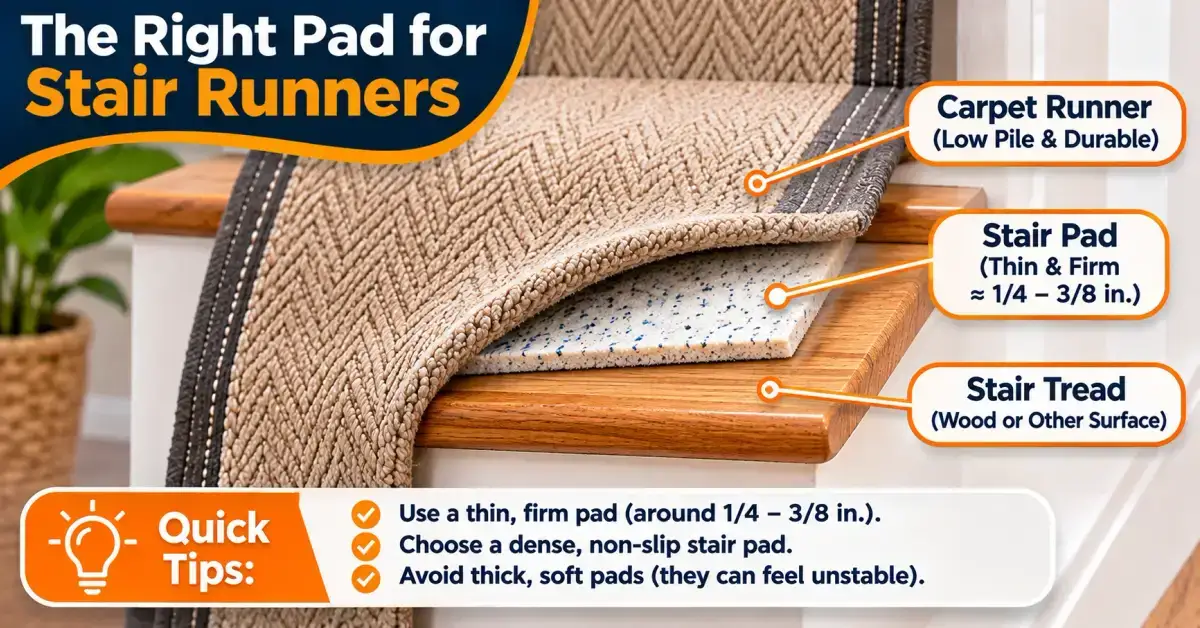
Use a thin, firm pad cut about 1 in. narrower than the runner and place it on the treads. The Carpet and Rug Institute says stairs and other heavy-traffic areas need thinner, firmer cushion. For Berber or low-profile carpet, it lists a maximum of 3/8 in. thickness at 8 lb density. That limit is CRI guidance for low-profile carpet, not a rule written only for runners. Angi’s other guide calls half-inch padding ideal for stairs, so check your carpet maker’s pad requirement.
Key Takeaway: Pick a thin, firm pad, cut it narrower than the runner, and follow your carpet maker’s limits. CRI advises 3/8 in. at 8 lb density for low-profile carpet.
Choosing the Color and Pattern
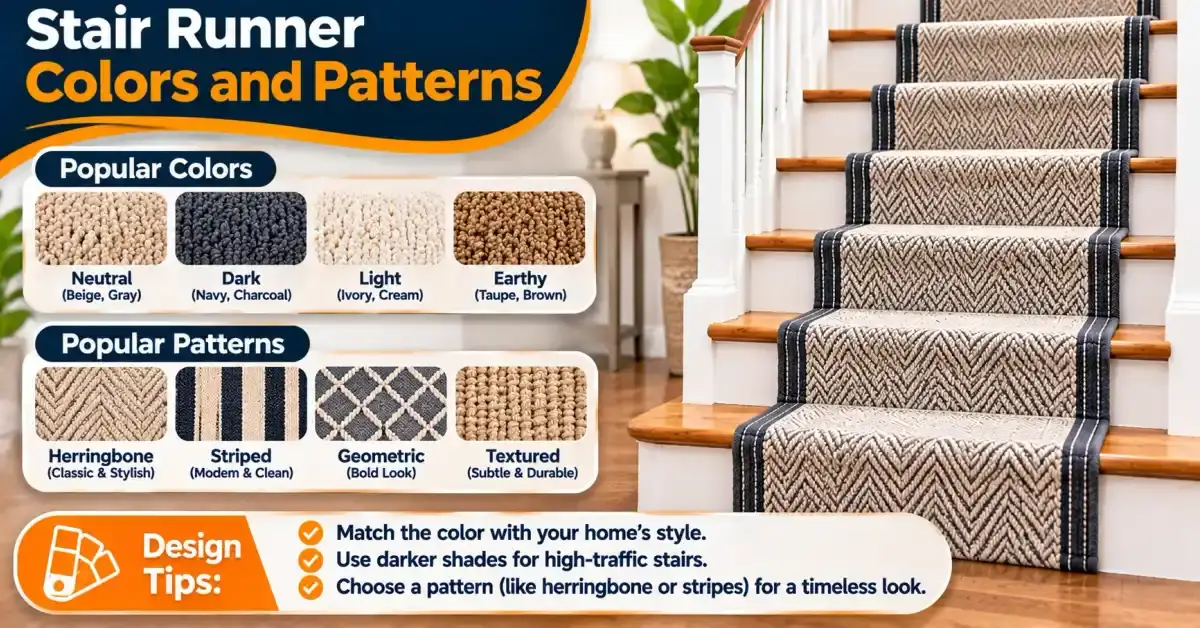
Patterns and darker tones hide wear, while pale solids show every scuff. A bold or unique pattern becomes a focal point, so choose it deliberately.
Striped, Herringbone and Patterned Stair Runners
Striped and herringbone designs add movement, while a runner with border frames the stair. Lowe’s warns that geometric patterns are hard to align. Check that stripes meet at each riser, and buy extra length for pattern repeats. Floral, vintage and traditional patterns hide small misalignments better than strict geometrics.
Neutral, Colorful and Dark Colors on Stairs
Neutral beige, cream or brown blends with most hardwood stairs. Green and blue add color without shouting. Black and white patterns feel crisp. Lowe’s suggests brighter colors for low-traffic stairs. A cool gray suits modern homes, and designer styles follow the same rule: pick a look you can live with for years.
Can You Put a Stair Runner Over Carpeted Stairs?
Yes, with limits. Low-pile, well-secured carpet is generally suitable for a runner, while thick plush or loose carpet usually requires removal. Choose a low-pile runner, since one retailer advises pile under 1/4 in. and staples or carpet-rated double-faced tape. Another suggests tacks or staples for extra security. Rubber-grip rug pads compress the carpet underneath and create instability. Follow the runner maker’s instructions.
How Much Does a Stair Carpet Runner Cost?
Budget by scenario, not one number. Figures below come from third-party pages checked in November 2026. Prices vary by region, so request local quotes.
| Scenario | Published range | Source |
|---|---|---|
| Carpet runner installed (covers the middle of each step) | $500 to $2,000 | HomeGuide |
| Typical runner project | About $500 to $700, 5 to 6 hours | Angi |
| Carpeting stairs, full coverage | $14 to $36 per step | Angi, 2026 data |
| One high-end project with landing rugs | About $2,000 (vs a $5,000 quote) | Emily Henderson |
Emily Henderson’s total included $1,058 for rugs, $180 for binding, $165 for pad and about $600 for installation. It is one homeowner’s project, not an average. Hunker puts brass stair rods at about $14 each and up. Published ranges suggest a runner often costs more per step than carpeting stairs, because of precise labor and finer materials, but sources define scope differently. A cheap runner saves money upfront, though budget fibers wear faster.
Key Takeaway: Plan for roughly $500 to $2,000 for an installed runner (HomeGuide), and expect more for curves, landings, binding and high end wool.
Installing a Stair Runner: DIY or Professional?
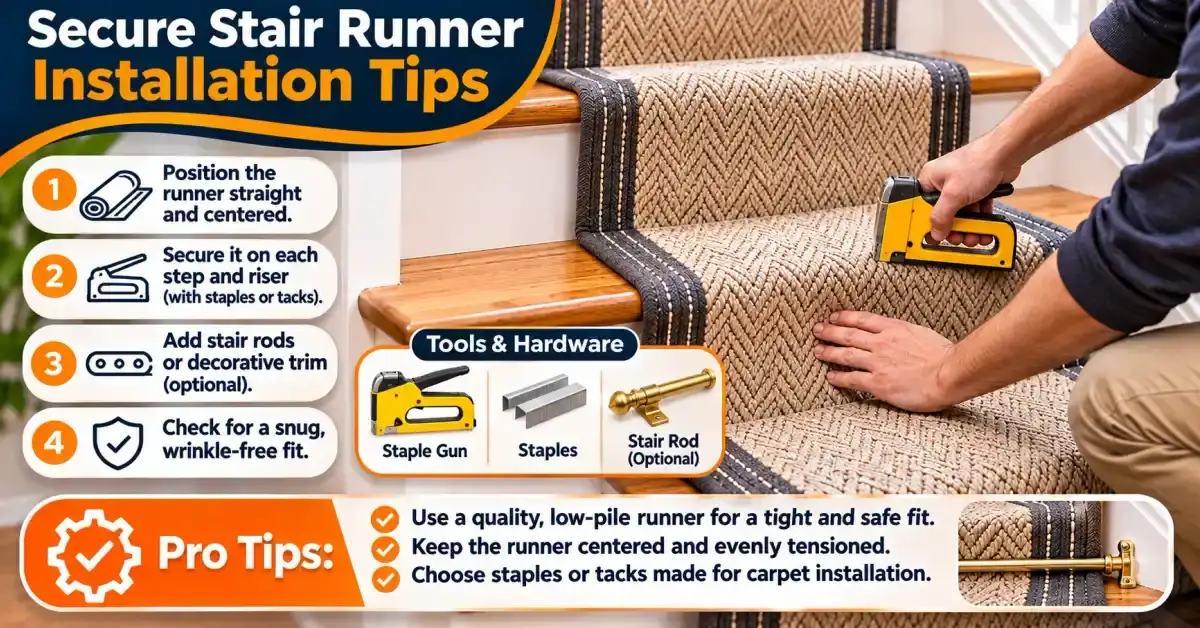
Most homeowners can install a runner on straight stairs with a staple gun, measuring tape and patience. Home Depot rates it intermediate and estimates 2 to 4 hours. Angi estimates 5 to 6 hours. Staple from the center outward about every 3 in., and keep the runner centered with pencil marks. Staple the runner directly to the stairs, never through the pad. Hire a pro for curved stairs, winders or a Hollywood finish. Stairs with a runner look best when the edges stay straight.
At the top, leave about 1 in. of extra runner to tuck under the raw edge and staple it. Some installers add a metal threshold there. At the bottom, fold the edge under into a hem and staple it to the bottom riser.
Avoid these mistakes:
- Misaligned patterns across risers.
- Seams placed on a visible tread.
- Stapling tufted wool without a tight weave.
- A pad cut as wide as the runner.
- A runner so wide it hides the wood.
- No spare length for restapling or repairs.
Stair Runner Care and Safety
Vacuum with an upholstery or stair attachment, and blot spills quickly. A runner does not make stairs safe by itself. The Consumer Product Safety Commission links more than 3.0 million emergency-department injuries a year, about 20 percent of the total, to stairs, ramps, landings and floors combined. Secure the runner firmly, keep the pad thin and flat, and use a handrail. Indoor carpet is not meant for outdoor stairs.
Stair Carpet Runner FAQs
Are Stair Rods Necessary?
+
No. Stair rods are decorative and do not hold the carpet down. Staples or tack strips do that job.
How Do You Keep a Stair Runner From Slipping?
+
Use a firm tread pad and staples or tack strips. Lowe’s also places double-sided carpet tape along the top edge of the riser under the nose, then staples it. Rely on fastening, not tape alone.
Can I Use a Regular Runner Rug on Stairs?
+
Only if the weave is tight and the edges survive stapling. Loose or hand-knotted rugs can stretch, fray or slip.
Should the Runner Match the Landing Carpet?
+
Not exactly, but the colors should coordinate. Lowe’s suggests matching or complementing existing carpet, and a bound rug works well on landings.
Are Stair Runners Outdated?
+
No. Well Woven answers that stair runners are not outdated. Style depends on color and pattern, and classic neutrals age well.
Choosing the Right Stair Carpet Runner
The right stair carpet runner starts with three decisions: width, length and pad. Subtract 4 to 8 in. from tread width, use the length formula with waste, and pair a durable fiber with a thin, firm pad. Choose waterfall installation for easier DIY and Hollywood for a tailored look. Order a sample first.
Need a carpet cleaning company you can trust? We handle residential and commercial carpet cleaning, rug cleaning, upholstery cleaning, and pet stain and odor removal —our team is ready to help.

Michael Sanders
Michael Sanders is a home care and cleaning industry writer covering carpet maintenance, flooring care, and household cleaning practices across the United States. His work focuses on practical, research-backed guidance — from stain and odor removal to deep extraction methods and indoor allergen prevention. Michael collaborates with cleaning professionals to ensure accuracy, and his writing reflects a genuine interest in helping homeowners make informed decisions about caring for their homes.