

Blog · Carpet Cleaning Guide
Carpet vs Rug: What Is the Difference and How to Choose
Carpet is a floor covering installed wall to wall over a pad, while a rug is a separate, movable piece that covers only part of the floor. That one rule settles most carpet vs rug questions.
Published November 27, 202610 min read

Everyday speech blurs the two words, though, so this guide also shows where the line gets fuzzy. You will find a quick comparison table, 2026 cost figures from published sources, care advice from the Carpet and Rug Institute (CRI), and a room-by-room guide. A short checklist at the end helps you choose for your floor, your room, and your budget.
What Is the Difference Between a Rug and a Carpet?
The difference comes down to installation and coverage. Carpet is fixed to the floor and covers most or all of a room. A rug sits loose on top of the floor and covers one area. Britannica draws the same line for both the United States and Great Britain.
What Is Carpet?
Carpet is a textile floor covering, usually installed wall to wall. Installers stretch it over a separate cushion pad and fasten it to tack strips along the room's edges. Because it is fixed in place, you clean it where it lies and replace it as a whole.
What Is an Area Rug?
An area rug is a finished piece, with bound or woven edges, that rests on top of a floor. You can roll it up, move it, wash it, or swap it for a new one. People use an area rug to define a seating area, protect a busy path, or add color.
Key Takeaway: Carpet is installed wall to wall over a pad and stays put. A rug is a loose, movable piece that covers part of the floor.
Carpet vs Rug at a Glance
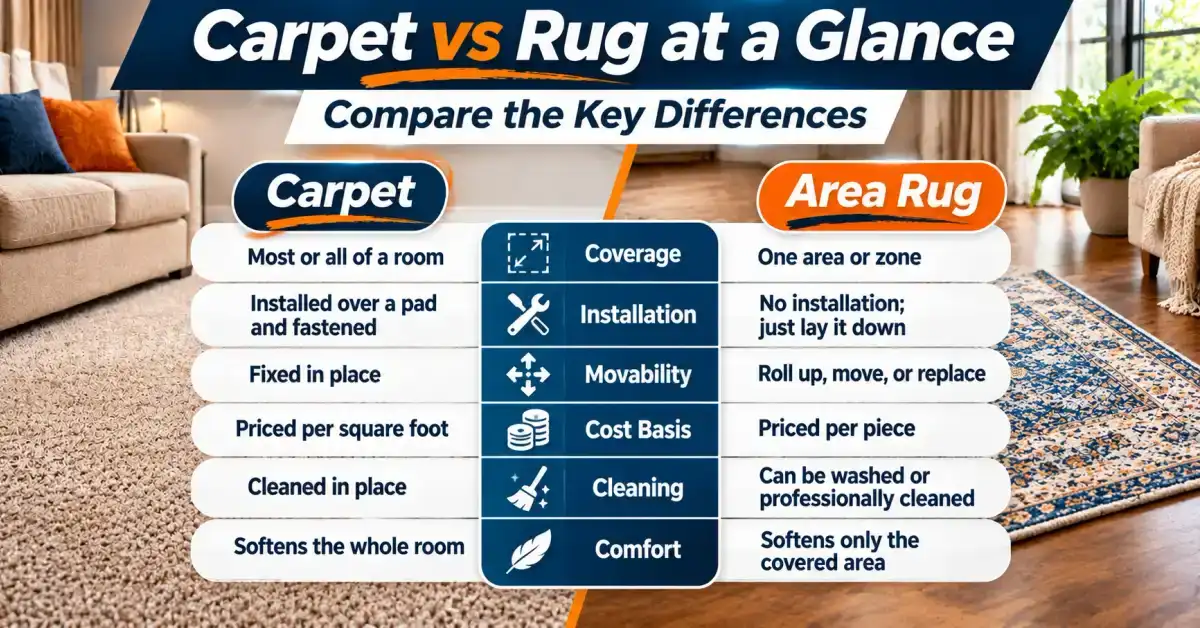
The table below shows the difference between carpet and rug on the points buyers ask about most.
| Feature | Carpet | Area rug |
|---|---|---|
| Coverage | Most or all of a room | One zone of a room |
| Installation | Installed over a pad and fastened at the edges | None; lay it down |
| Movability | Fixed in place | Roll up, move, or replace |
| Cost basis | Priced per square foot, plus installation | Priced per piece, with a very wide range |
| Cleaning | Cleaned in place | Small rugs can be washed; larger rugs go outdoors or to a cleaner |
| Comfort and noise | Softens the whole room | Softens only the covered area |
| Replacement | Replace the whole floor covering | Replace one piece |
| Main advantage | Even softness and warmth | Flexibility and easy updates |
| Main drawback | Costly to replace | Can slip, curl, or bunch without a pad |
Why the Difference Between Rug and Carpet Gets Blurry
The difference between rug and carpet gets blurry because "carpet" names both a material and a type of installation. A piece of carpet material can be cut, finished, and sold as a rug. Dictionary definitions overlap too: Merriam-Webster describes a rug as a thick fabric with a nap or pile and a carpet as a heavy, often tufted fabric, and both serve as floor coverings. Handmade pieces add more confusion, since Britannica notes that the names rug and carpet are used interchangeably for them.
Is There a Size Rule?
No official size line exists. Some sellers treat anything around 4x6 feet or smaller as a rug, but that is an informal habit. Retailers list common rug sizes of 5x8, 6x9, 8x10, and 9x12 feet. A 9x12 rug is still a rug because it stays loose. Many size guides also suggest leaving 12 to 18 inches of bare floor around a living room rug. The rug and carpet difference comes down to how the covering is used and installed, not to a fixed size.
Do Americans and Brits Use the Words Differently?
Mostly no. Britannica says that in both Great Britain and the United States, "rug" often means a partial floor covering and "carpet" often means a wall-to-wall one. Individual speakers in either country still use the words loosely, so context matters more than accent.
Can a Carpet Be a Rug?
Yes, in one case. Mills make carpet in wide rolls called broadloom, commonly 12 or 15 feet wide. A shop can cut a piece, sew a binding strip over the raw edges to stop unraveling, and sell it as an area rug. Wall-to-wall carpet already installed in a room is not a rug.
Carpet vs Rug Cost: What You Will Actually Pay
Cost depends on whether you cover a whole room or a single zone. ConsumerAffairs (updated August 2026) puts installed carpet, padding included, at about $3 to $12 per square foot, with materials making up roughly 50% to 70% of that price. Fiber, pile, and pad quality drive that spread, and fixed roll widths can leave offcuts in rooms that do not match them.
| Item | Typical range | Source |
|---|---|---|
| Installed carpet | $3 to $12 per sq ft | ConsumerAffairs |
| Carpet padding, if bought separately | From about $1 per sq ft | Thumbtack (July 2026) |
| Installation labor | About $1 to $2.50 per sq ft | ConsumerAffairs |
| Old floor removal | About $1 to $4 per sq ft | ConsumerAffairs |
| Carpet roll widths | 12 ft, 13 ft 6 in, 15 ft | Thumbtack |
| 8x10 area rug | About $100 at big-box stores, $2,000 and up for quality or handmade | Dwell |
An 8x10 rug covers 80 square feet. By simple math, a $100 rug costs about $1.25 per square foot, and a $2,000 rug costs about $25. So installed carpet costs less per square foot than a quality rug, but more than a budget rug. Rugs also skip labor and removal fees, though you may still want a pad.
Key Takeaway: Installed carpet runs about $3 to $12 per square foot. A budget 8x10 rug costs far less per square foot, while a quality rug can cost more than carpet.

How to Clean and Care for Carpet and Rugs
CRI, the national carpet and rug trade association, publishes care guidance that suits both floor coverings.
Carpet Care Routine
- Vacuum at least once a week, and more often where traffic is heavy. CRI calls this a rule of thumb. Choose a vacuum with the CRI Seal of Approval.
- Blot spills right away with a dry white cloth or plain white paper towel. Blot, do not scrub.
- Test any cleaner on a hidden spot first, and pick products with the CRI Seal of Approval.
- Book a professional deep clean every 12 to 18 months.
- Stop dirt at the door with mats outside and inside, and take shoes off.
Rug vs Carpet: Which Is Easier to Clean?
It depends on the rug. Small machine-washable rugs are the easiest, because you can wash them at home. You can shake or beat larger rugs outdoors and then vacuum them. Go gently on fringe. Send heirloom-type rugs to a professional. Carpet cannot leave the room, so it relies on weekly vacuuming and a periodic deep clean.
Key Takeaway: Vacuum weekly, blot spills, and deep clean carpet every 12 to 18 months. Rugs are easier to move and often easier to wash, but heirloom rugs need a professional.

Rug vs Carpet by Room
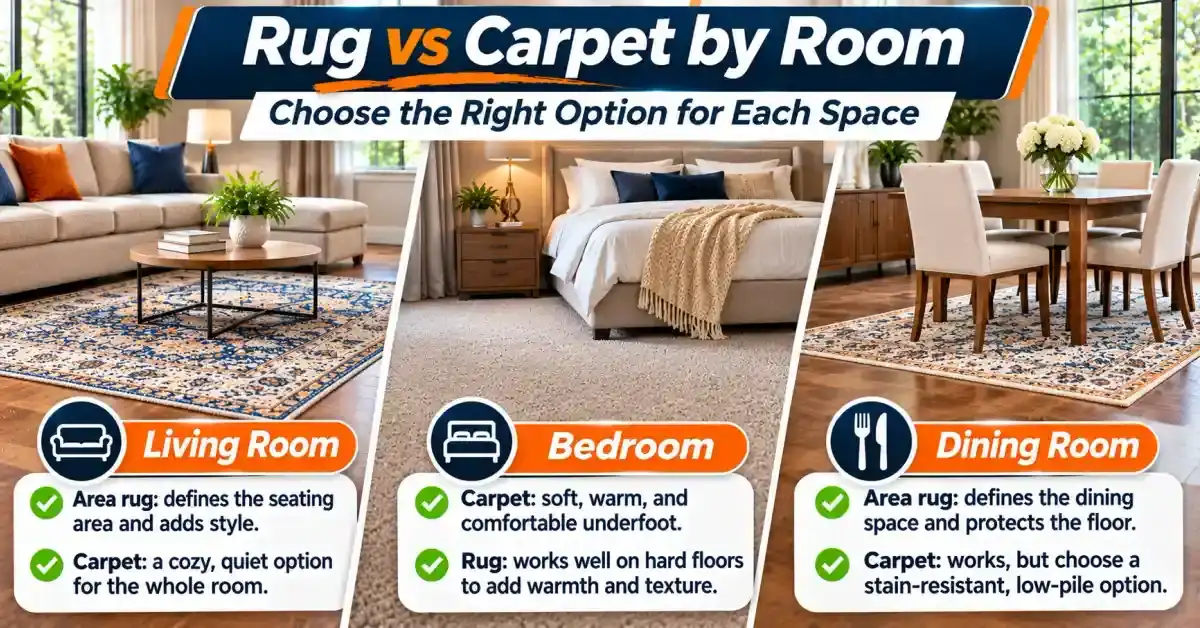
Use this table as a starting point, then adjust for pets, kids, and how much cleaning you want to do.
| Room | Better pick | Why |
|---|---|---|
| Bedroom | Carpet, or a large rug | Soft and quiet underfoot; choose a rug if you want to keep hardwood |
| Living room | Either | Carpet gives even softness; an area rug defines seating and shows the floor |
| Kitchen or dining | Washable rug, or none | Spills are likely, so easy cleaning matters |
| Entry or hallway | Mat or runner | Dirt and heavy traffic; you can shake it out |
| Kids' room | Carpet or washable rug | Soft landing, with simple cleanup after spills |
| Rental | Area rug | No installation and nothing to remove; check your lease |
| Over hardwood | Area rug with a floor-safe pad | Protects wear spots and keeps the wood visible |
Can You Put a Rug on Carpet?
Yes. A rug on carpet adds texture, defines a zone, and can cover a worn spot. Flat-weave rugs lie neatly on low pile, while thick rugs on thick carpet tend to bunch. Most guides suggest a pad made for carpet, often with a felt top and a rubber bottom, because standard rubber pads grip carpet pile poorly. Match the pad's thickness to the pile, and trim it slightly smaller than the rug. Curled corners can trip people, so check them often. A rug also shields carpet from wear in busy spots, but lift it now and then and vacuum underneath, because dirt collects there.
Key Takeaway: You can put a rug on carpet. Use a flat weave on low pile, add a carpet-specific pad, and check the corners for curling.

Rug vs Mat: A Quick Guide
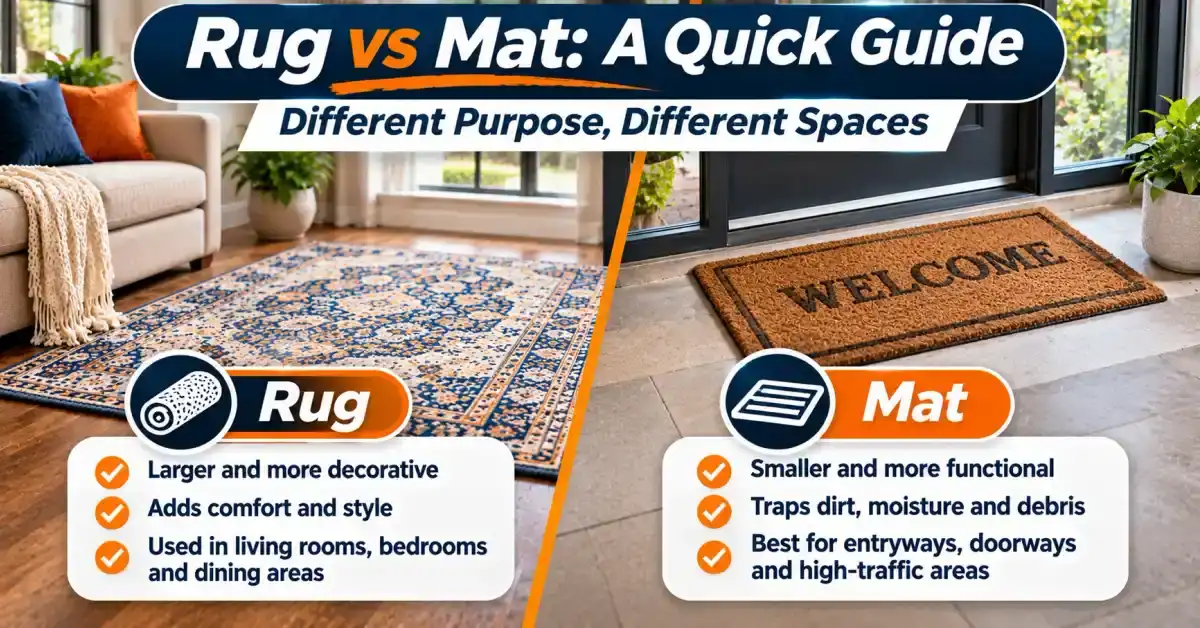
A mat does a job, while a rug decorates and defines space. Mats provide traction, trap dirt or moisture, or protect the floor. Use a mat where dirt, water, or slipping is the problem, and a rug where looks and comfort matter. A doormat is the classic example, and CRI recommends mats both outside and inside. Carpet tiles sit between the two. They are modular squares of carpet that you lay across a room and replace one at a time.
How to Choose Between Carpet and a Rug
Answer these six questions to settle the carpet vs rug choice for each room.
- Room use: Pick carpet for bedrooms and large rooms where you want even softness, and a rug for a single zone.
- Floor underneath: If you want to keep hardwood visible, choose a rug.
- Rental status: Choose a rug unless your lease allows installed carpet.
- Budget: Whole-room carpet is priced per square foot, while a rug is priced per piece.
- Cleaning effort: Decide between a washable rug and carpet that needs weekly vacuuming plus a deep clean every 12 to 18 months.
- Redecorating: Choose a rug if you like to change your look often.
Frequently Asked Questions About Rugs and Carpet
Frequently Asked Questions
Which Is Better, Carpet or Rug?
+
Neither wins everywhere. Carpet suits bedrooms and large rooms, while rugs suit rentals, hardwood floors, and rooms you redecorate often. Many homes use both.
Which Is Cheaper, Carpet or a Rug?
+
It depends on size and quality. A budget 8x10 rug can start near $100, while installed carpet runs about $3 to $12 per square foot. Quality rugs can cost more per square foot than carpet.
Can a Rug Be Called a Carpet?
+
Informally, yes, especially for handmade pieces, where Britannica says both names are interchangeable. Area rug is clearer for a loose piece. Wall-to-wall carpet is not called a rug.
Are Rugs Better for Hardwood Floors?
+
Often, yes. Rugs protect high-wear spots and keep the wood visible elsewhere. Most guides suggest a felt or natural-rubber, non-adhesive pad. Check the pad's details and the floor maker's instructions, because some pads can discolor finishes.
Do Rugs Need a Pad?
+
Usually. A pad keeps a rug from slipping and adds cushioning. Use a carpet-specific pad on carpet and a floor-safe felt or rubber pad on hardwood.
Is Wall-to-Wall Carpet Still in Style?
+
Designers disagree. Florida Realtors (January 2026) reports that designers see high-end, natural-fiber wall-to-wall carpet gaining favor, while Good Housekeeping (September 2026) calls the style polarizing. Choose based on comfort, budget, and cleaning effort.
Final Verdict on Carpet vs Rug
Choose carpet when you want fixed, even softness across a room. Choose an area rug when you want flexibility, floor protection, or easy updates. In the end, installation and coverage matter more than size. Use the checklist above to settle carpet vs rug for each room in your home.
Need a carpet cleaning company you can trust? We handle residential and commercial carpet cleaning, rug cleaning, upholstery cleaning, and pet stain and odor removal —our team is ready to help.

Michael Sanders
Michael Sanders is a home care and cleaning industry writer covering carpet maintenance, flooring care, and household cleaning practices across the United States. His work focuses on practical, research-backed guidance — from stain and odor removal to deep extraction methods and indoor allergen prevention. Michael collaborates with cleaning professionals to ensure accuracy, and his writing reflects a genuine interest in helping homeowners make informed decisions about caring for their homes.