
Blog · Carpet Cleaning Guide
Interlocking Carpet Tiles: Types, Real Costs, and What They Cannot Do
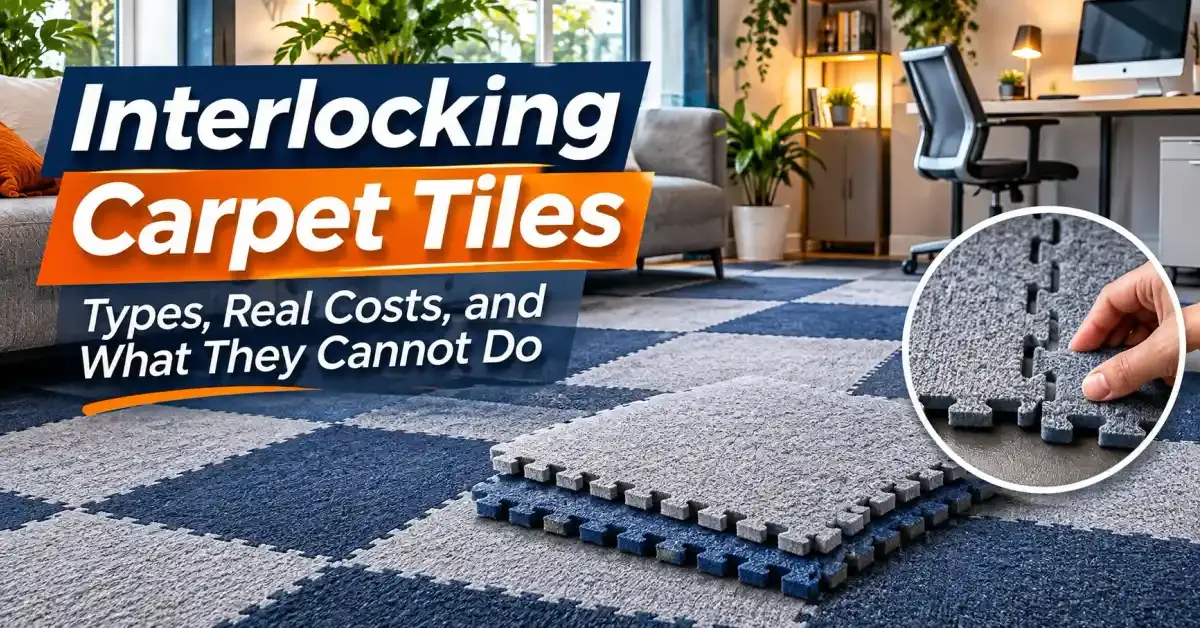
Interlocking carpet tiles are carpet-topped squares that snap together without glue, usually over a foam or raised plastic base. They suit dry, flat, hard floors with light to moderate traffic, such as basements, playrooms, home offices, and rentals. Foam versions cost about $2 to $3 per square foot in November 2026. The trade-offs are visible seams, dents under heavy furniture, and trouble on damp slabs.
Published November 23, 20269 min read
This guide covers types, real costs, installation, and limits.
What Are Interlocking Carpet Tiles?
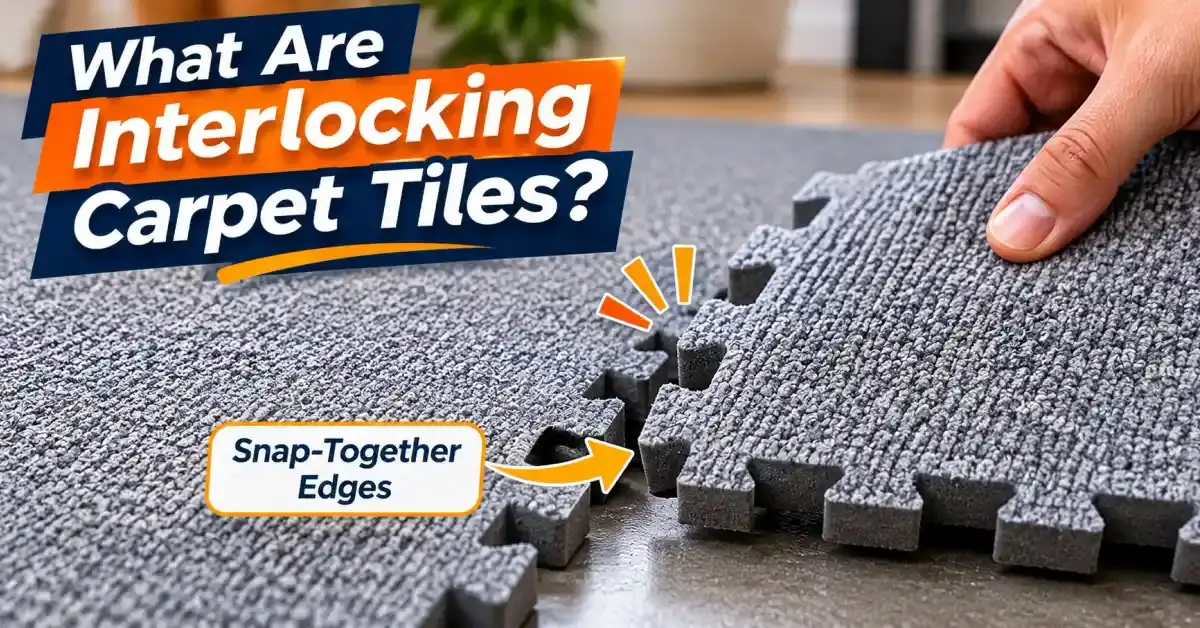
Interlocking carpet tiles, also sold as interlocking carpet squares, pair a carpet surface with a base that locks to its neighbors. Most home versions bond polyester fiber to closed-cell EVA foam, usually in 2 x 2 foot squares. Others use a raised plastic base, often 1 x 1 foot. Because the tiles float over the floor instead of bonding to it, you can lift them later.
How the Snap-Together Edges Work
Puzzle-shaped edges or tab-and-loop connectors let tiles snap together by hand. Flooring Inc says the weight of the connected group holds the floor in place, and its tiles include detachable border pieces for finished edges. Greatmats says plastic-base tiles lock tighter once you step on the seams.
Do Interlocking Carpet Tiles Need Glue?
No. Most need no adhesive on a clean, flat floor. Flooring Inc recommends polyurethane adhesive only for wall use. If edges creep in a large open room, double-sided flooring tape along the perimeter helps, and We Sell Mats suggests tape for semi-permanent setups.
Foam, Raised Plastic and Jigsaw: Which Type Fits?
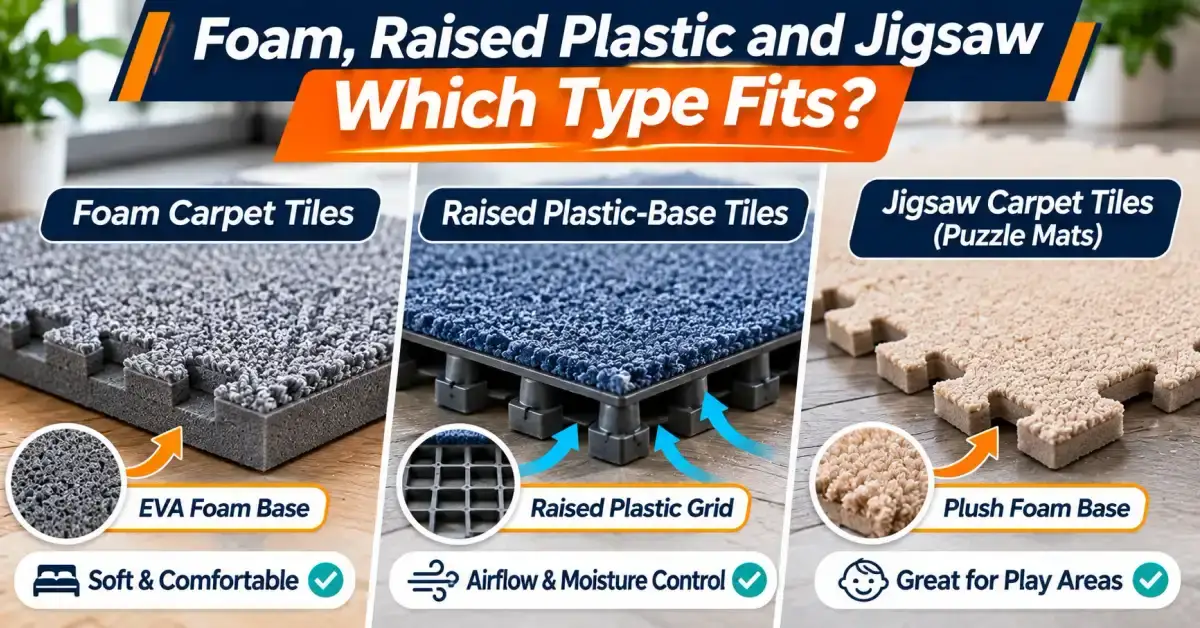
Three products share the "interlocking" label, and they behave differently.
| Feature | Foam | Raised plastic base | Jigsaw (puzzle) mats |
|---|---|---|---|
| Typical size | 2 x 2 ft, about 5/8 in | 1 x 1 ft, about 9/16 in | Thin 12-inch squares |
| Base | Flat EVA foam | Molded plastic grid | Plush EVA foam |
| Moisture behavior | Can trap moisture underneath | Air flows underneath | Check the label |
| Cutting tool | Utility knife | Jigsaw or power saw | Utility knife (thin foam) |
| Best for | Dry basements, bedrooms | Damp-prone spaces | Kids' play areas |
Foam Carpet Tiles
Foam carpet tiles bond carpet to a flat EVA pad, commonly 3/8 to 5/8 inch thick. They feel softest, cut easily, and leave fewer seams because each square covers 4 square feet. Greatmats notes that moisture can get trapped under a flat base and that foam expands and contracts more with temperature. Most already include cushioning, so skip extra padding. Greatmats warns that tiles laid over padded surfaces can separate at the seams.
Raised Plastic-Base Tiles
These tiles sit on a molded plastic grid that lifts the carpet and lets air move underneath. Greatmats recommends them for damp areas. Smaller squares mean more seams, and firm plastic usually needs a saw to cut.
Jigsaw Carpet Tiles (Puzzle Mats)
Jigsaw carpet tiles are interlocking squares with puzzle-shaped edges. Many sold under that name are thin 12-inch plush foam mats for play areas, not 5/8-inch carpet tiles. They suit a playroom corner better than a full-room floor.
Are Interlocking Carpet Tiles Any Good? Pros and Cons
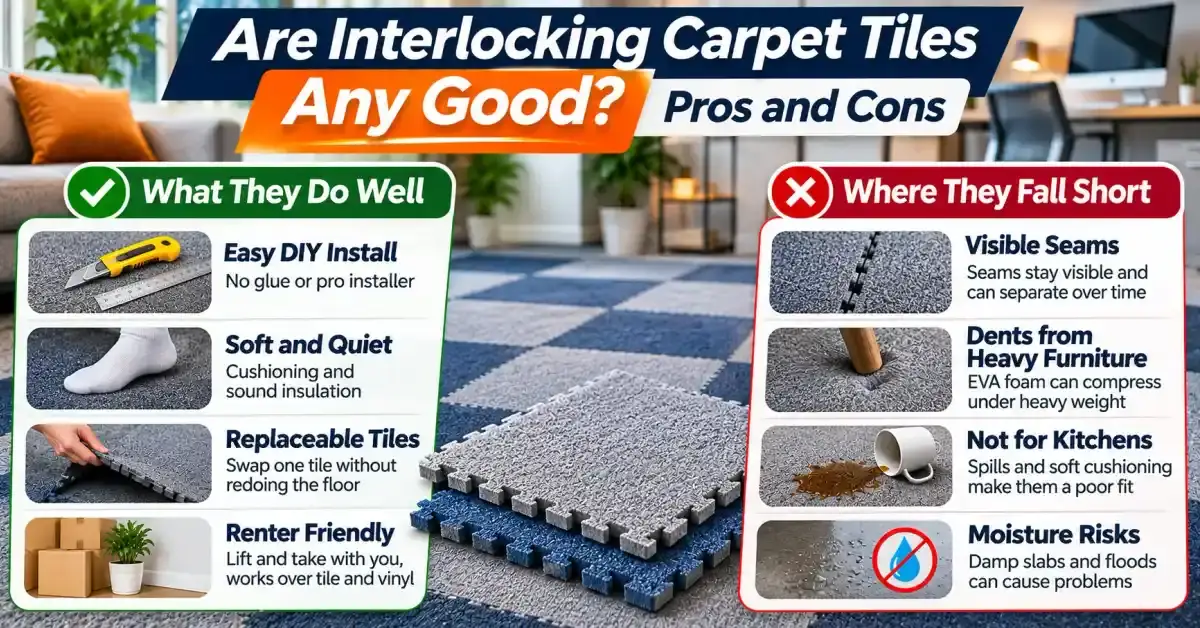
Yes, for the right room. They work best in dry spaces with modest traffic.
What They Do Well
- No glue and no professional installer. A utility knife and a straightedge handle most of the work.
- Soft and quiet underfoot. Flooring Inc cites anti-fatigue cushioning and sound insulation.
- One damaged tile swaps out without replacing the whole floor.
- Renters can lift them later. Hunker adds that they can go over existing tile and vinyl without underlayment.
Where They Fall Short
- Seams stay visible and can separate under foot traffic.
- Heavy furniture or equipment can leave dents in EVA foam, according to Greatmats.
- Kitchens are a poor fit. Hunker calls the cushioning too soft for them.
- Damp slabs and floods cause trouble, as covered below.
Where Interlocking Carpet Tiles Work and Where They Do Not
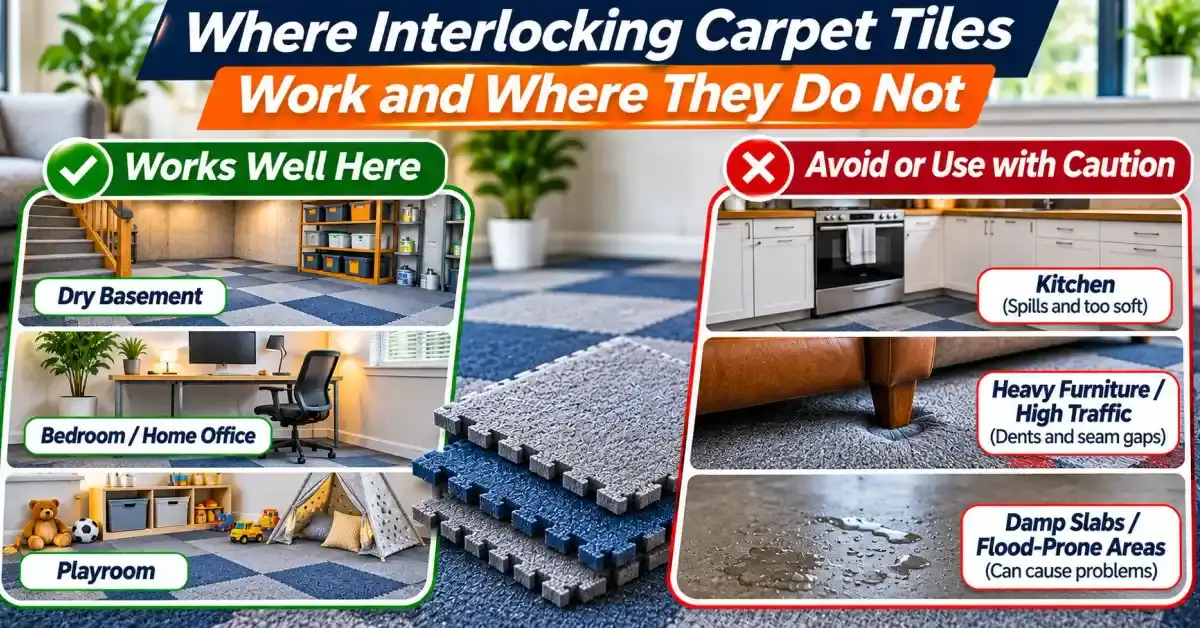
| Location | Fit | Why |
|---|---|---|
| Dry concrete basement | Good | Floats over the slab, no pad needed |
| Bedroom or home office | Good | Light traffic, soft surface |
| Playroom | Good | Cushioning for floor play |
| Over existing carpet | Check | Makers disagree |
| Kitchen | Avoid | Spills and heavy cushioning |
| Heavy furniture or high traffic | Avoid | Dents and seam gaps |
Basements and Concrete Floors
Floating tiles can go straight onto concrete without a pad, according to Greatmats and Flooring Inc. Test the slab first. Hunker advises a moisture test before installing, and the common industry methods are ASTM F2170, which uses in-situ relative humidity probes, and ASTM F1869, which uses calcium chloride. For floating tiles, treat the test as a precaution, not a pass-fail rule.
Are Interlocking Carpet Tiles Waterproof?
Not as a complete floor. The tile surface and foam shed spills, and Flooring Inc advertises a waterproof surface. Yet its own Q&A calls the tiles water resistant, not waterproof, and warns that standing water from flooding can damage them. Liquid can also pass through seams and sit on the slab. After a leak, lift the tiles, then dry both the tiles and the floor underneath.
Key Takeaway: Interlocking carpet tiles resist spills, but water can reach the slab through seams. Treat them as water resistant, not waterproof.
Over Existing Carpet, Hardwood and Vinyl
Makers disagree on carpet. We Sell Mats says not to install over carpet. Greatmats says low-pile, no-pad, wall-to-wall carpet works. Hunker calls tiles poorly suited to it. Follow the instructions in your tile box. On hardwood, Hunker warns that the backing can affect the finish, and Greatmats notes plastic bases may scratch while rubber bases may stain.
How Much Do Interlocking Carpet Tiles Cost?
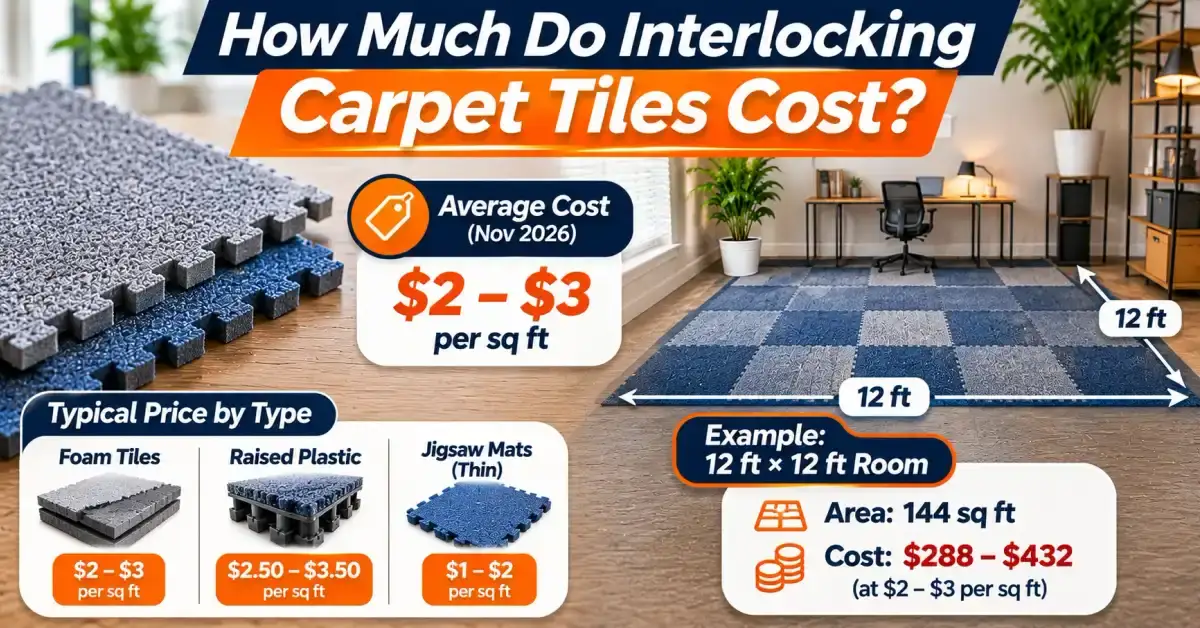
On November 13, 2026, Flooring Inc listed its 5/8-inch Eco-Soft foam tiles at $2.07 per square foot in black, or $8.29 per 2 x 2 foot tile, with other colors up to $2.75. Greatmats listed its Royal tile at $10.98 per tile ($2.83 per square foot), marked down from $19.50. Prices here are in US dollars, and retailers in Canada price differently. Check current listings before you buy.
Angi puts installed rolled carpet at $3 to $11 per square foot, with padding adding up to $2 more, and carpet tiles generally at $2.50 to $11. Foam interlocking tiles sit at the low end, and you skip both the pad and the installer.
A Worked Example for a 12 x 12 Room
- Room area: 12 x 12 = 144 square feet.
- Add 10% for cuts and mistakes, as Angi advises: 158.4 square feet.
- Each 2 x 2 foot tile covers 4 square feet, so 158.4 / 4 = 39.6, which rounds up to 40 tiles.
- At $8.29 per tile, the total is $331.60.
- At $10.98 per tile, the total is $439.20.
Key Takeaway: A 12 x 12 room needs about 40 tiles, which costs roughly $332 to $439 before shipping and tax.
How to Install Interlocking Carpet Tiles
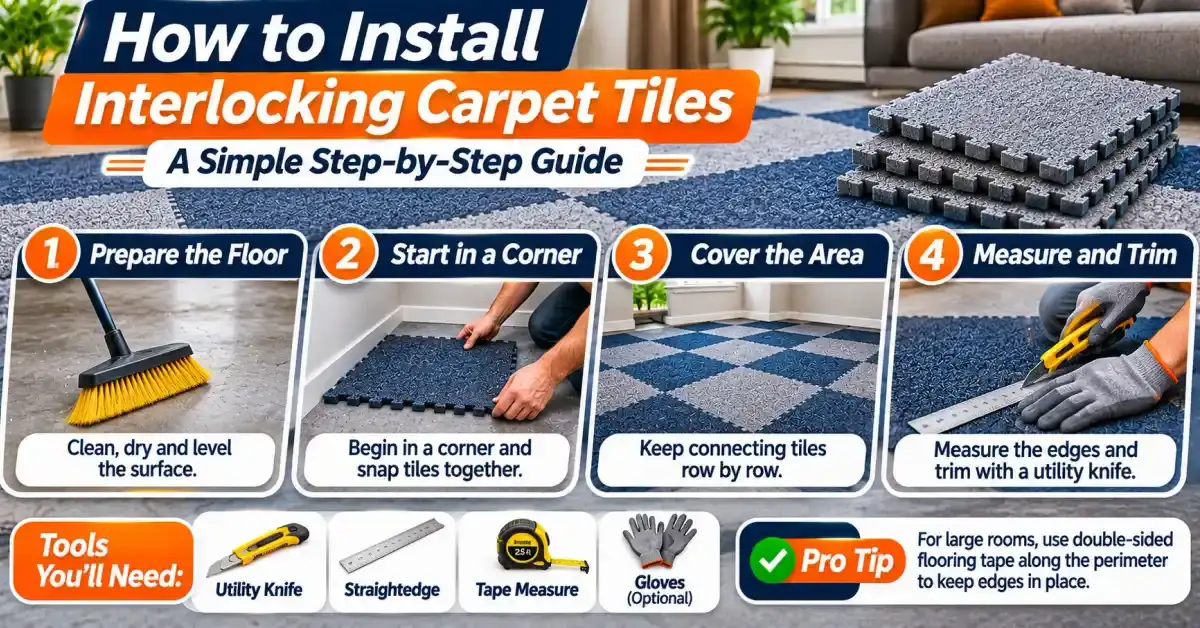
You need a tape measure, a utility knife, and a straightedge. Add double-sided flooring tape if you want to secure the edges.
- Sweep the floor, let it dry, and check concrete for moisture, cracks, and bumps.
- Dry-lay a row across the room to plan where border cuts will fall.
- Start in a corner and work diagonally, as Greatmats recommends.
- Keep the arrows on the tile backs pointing the same way so the pile matches.
- Snap each tile to its neighbors, pressing the edges flat. Step on plastic-base seams to lock them.
- Fit the border pieces along the edges and trim where needed.
- Tape the perimeter if tiles shift in a large open room.
Cutting Tiles and Fitting Borders
Cut foam and rubber bases with a utility knife and a straightedge. Firm plastic bases need a jigsaw or power saw, meaning the power tool, not the puzzle-edge tiles. Measure each gap at the wall, mark the tile, and cut it to fit. Detachable border pieces finish the edge, and a reducer or transition strip smooths the step to the next room.
Care, Furniture and How Long Interlocking Carpet Tiles Last
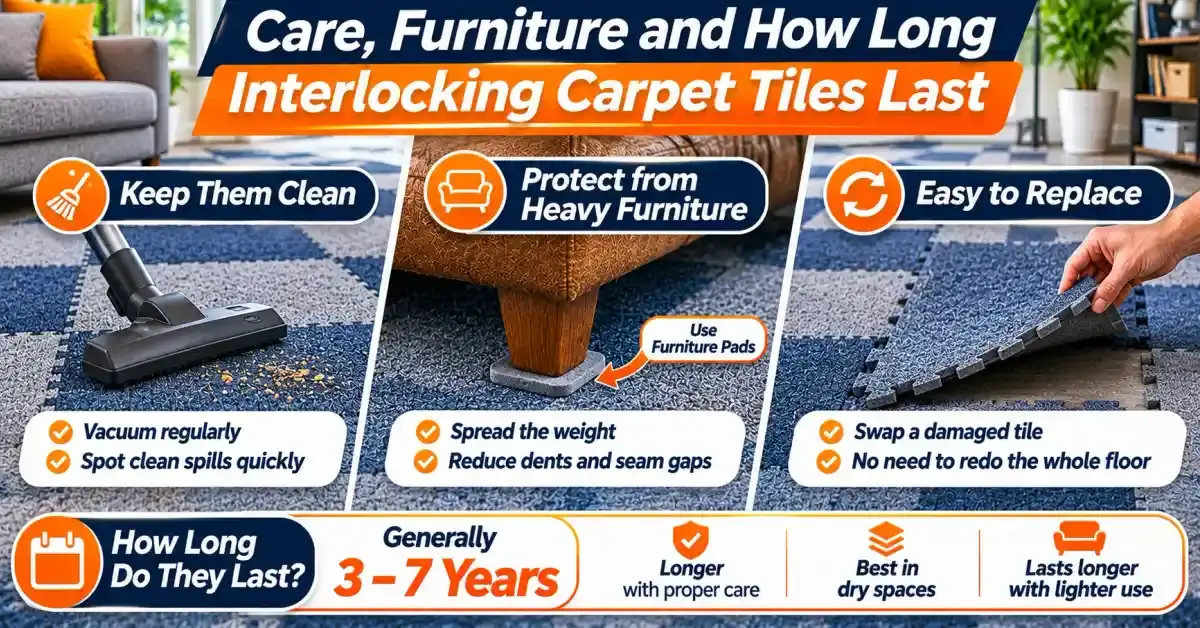
Wipe spills quickly and vacuum gently. Makers differ here, since one says its standard tiles are not meant to be vacuumed, so read your label. Wide furniture cups spread weight and limit dents in foam bases.
Lifespan depends on traffic. Greatmats says carpet tiles usually need replacing after one to five years at the earliest, and many last far longer in low-traffic areas. It also says to expect at least the warranty period. Buy a few spares with your order. Flooring Inc changed manufacturers in January 2021, and newer tiles will not match older orders.
Are Foam Carpet Tiles Safe for Kids?
The CPSC requires carpets and rugs sold in the US to meet flammability standards 16 CFR 1630 or 1631, and baby play mats may fall within scope. CPSC staff note that untreated rugs with a polyurethane foam layer typically fail the test. Large carpets must pass, while small rugs that fail must carry a permanent flammability warning. No one can assume a specific tile complies, so check the label and ask the seller. We Sell Mats claims its tiles are free of lead, latex, and phthalates, a vendor claim. Apply the same check to jigsaw carpet tiles sold for play areas.
Key Takeaway: Federal flammability rules cover carpets and rugs, but no one can assume a specific tile complies. Check the label before using tiles in a child's room.
Interlocking Carpet Tiles FAQs
Can You Replace a Single Tile?
+
Yes. Lift the damaged tile and snap in a spare. Keep spares from the same order, because colors can vary between batches.
Do the Tiles Slide or Come Apart?
+
On large open floors, edges can separate under walking. Perimeter tape helps, and plastic-base tiles hold tighter once you step on the seams.
How Many Extra Tiles Should You Buy?
+
Plan on about 10% extra for cuts. For 144 square feet, that means 40 tiles of 2 x 2 feet.
Can You Use Them in a Rental or for Temporary Flooring?
+
Yes. Interlocking carpet squares need no adhesive, so they lift out without damaging the floor. Check your lease and the tile instructions first.
Choosing Interlocking Carpet Tiles: The Short Version
Choose foam for dry bedrooms and basements, raised plastic for damp-prone rooms, and jigsaw mats for play corners. Test the slab, then budget about 40 tiles for a 12 x 12 room. Avoid kitchens and heavy furniture. Match the type to the room, and these tiles deliver a soft, removable floor for a modest price.
Need a carpet cleaning company you can trust? We handle residential and commercial carpet cleaning, rug cleaning, upholstery cleaning, and pet stain and odor removal —our team is ready to help.

Michael Sanders
Michael Sanders is a home care and cleaning industry writer covering carpet maintenance, flooring care, and household cleaning practices across the United States. His work focuses on practical, research-backed guidance — from stain and odor removal to deep extraction methods and indoor allergen prevention. Michael collaborates with cleaning professionals to ensure accuracy, and his writing reflects a genuine interest in helping homeowners make informed decisions about caring for their homes.