
Blog · Carpet Cleaning Guide
Best Carpet for Basement: How to Choose the Right Fiber, Pile and Pad
The best carpet for basement floors is a low-pile synthetic carpet or a set of carpet tiles, installed over a concrete slab that has passed a moisture test. Moisture, not the carpet, is the real risk. The EPA says wet carpet and backing should dry within 24 to 48 hours, because lingering dampness lets mold grow.
Published November 19, 202614 min read
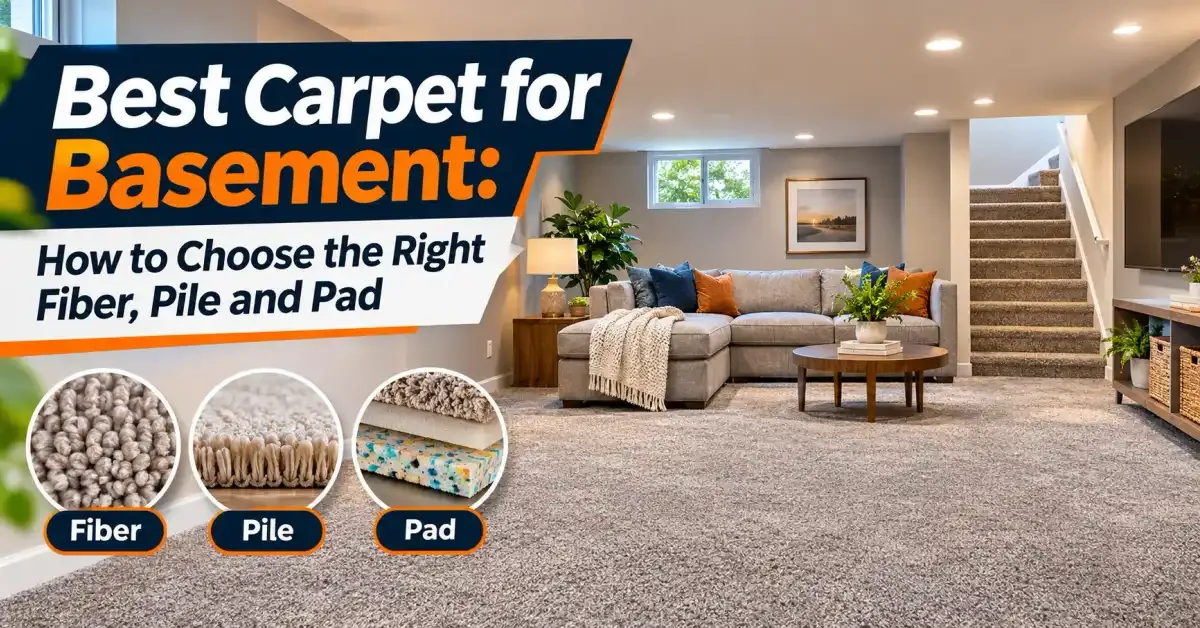
This guide shows how to test your slab, compare olefin, polyester, triexta and nylon, choose pile and pad, and budget for basement carpet. It also covers family rooms and when to skip carpet.
Can You Put Carpet in a Basement?
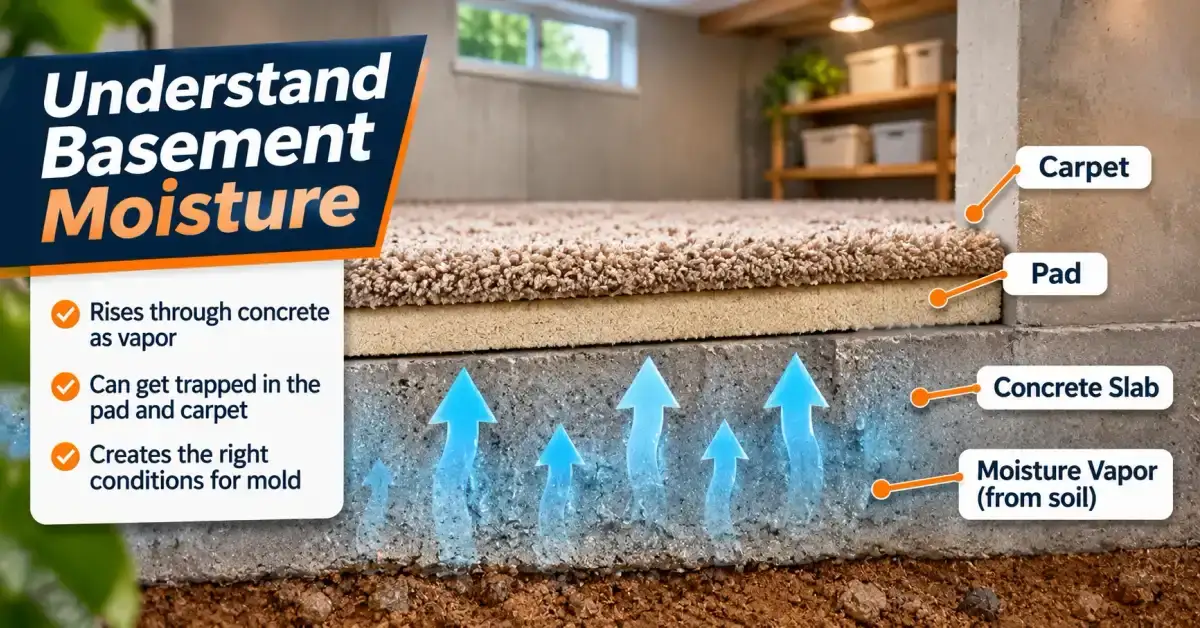
Yes, if the slab stays dry. Moisture reaches a basement floor as vapor through concrete, not only through floods or leaks. Fine Homebuilding explains that without a barrier between soil and slab, soil moisture wicks up through the concrete to the surface. Hunker adds that hydrostatic pressure near a high water table can push moisture upward. Carpet does not cause mold. Moisture trapped in the carpet and pad does. The EPA warns that porous materials such as carpet may need to be thrown away once mold grows in them.
Ask four questions before you shop:
- Does the basement stay dry all year?
- Does it smell musty, or does condensation form on the floor or walls?
- Has it ever flooded?
- Is there a subfloor or vapor barrier under the planned flooring?
Two or more worrying answers mean you should test the slab first, and possibly choose a different floor.
Key Takeaway: Carpet works in a basement only when the slab stays dry, because trapped moisture, not the carpet itself, causes mold.
Can Mold Grow Under Basement Carpet?
Yes. Mold can grow under carpet when the pad or slab stays damp. The EPA advises drying wet carpet and backing within 24 to 48 hours and keeping indoor humidity below 60 percent, ideally between 30 and 50 percent. Locate and fix the water source before you lay anything new.
Test Your Concrete Slab Before You Buy Carpet
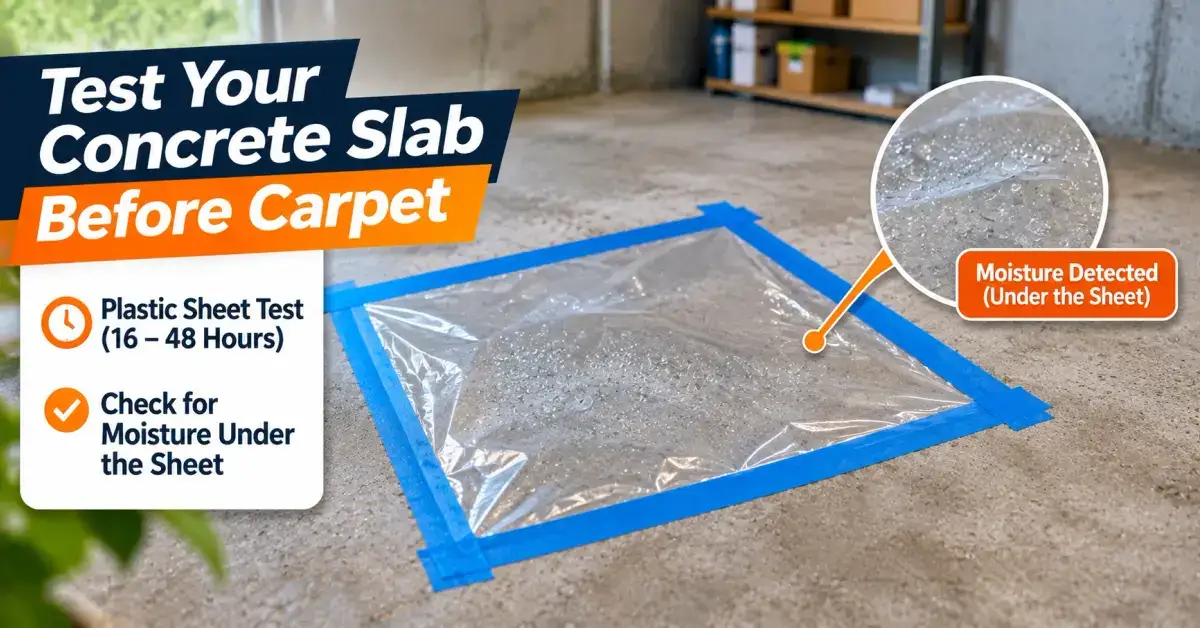
Two tests give you useful answers. The plastic sheet is a quick screen. The relative humidity probe gives a number you can compare with the maker's limit.
The Plastic Sheet Screen
Tape an 18 by 18 inch clear plastic sheet to bare concrete and seal every edge. ASTM D4263 calls for at least 16 hours, and many installation guides suggest 24 to 48. Moisture under the sheet points to slab moisture. Droplets on top of the sheet point to humid room air. Treat the result as a screen, not a warranty-grade test.
The Relative Humidity Test
ASTM F2170 uses probes set into the slab, which need about 72 hours to settle. The National Ready Mixed Concrete Association (NRMCA CIP 28) reports that floor coverings typically call for a reading of about 75 to 80 percent relative humidity or lower. Your carpet, pad and adhesive makers set the real limit, so check their below-grade instructions. The calcium chloride test (ASTM F1869) is a third common method.
Key Takeaway: Run the plastic sheet screen first, then confirm with an ASTM F2170 humidity test if the result looks doubtful or your warranty requires it.
Best Carpet for Basement Floors by Fiber Type
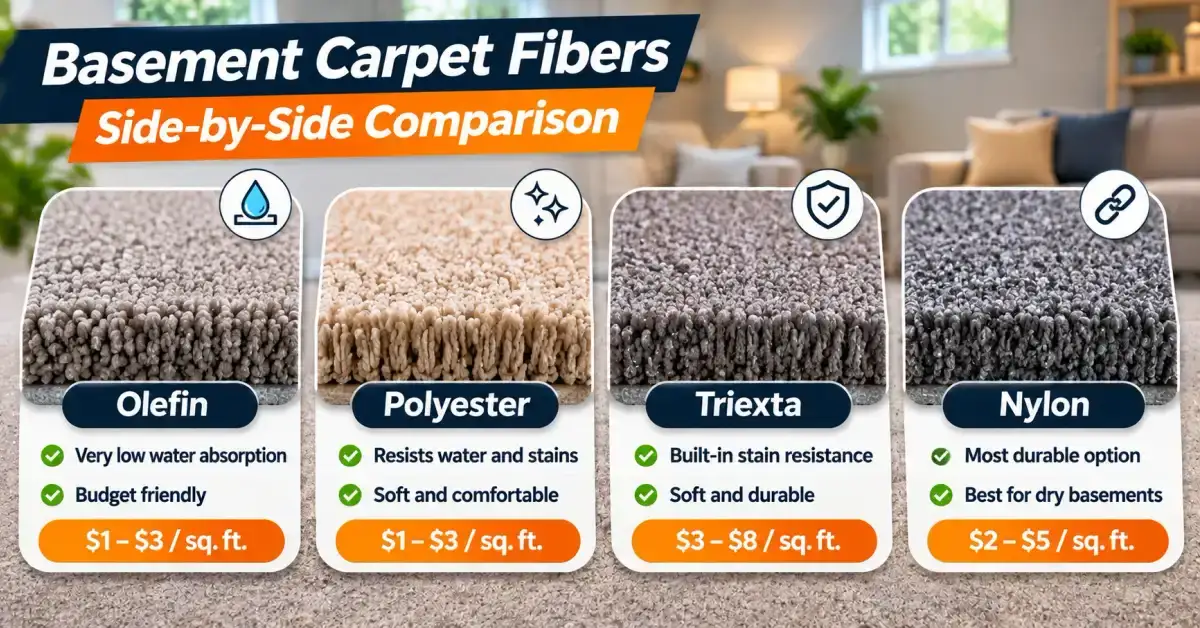
The best type of carpet for basement use is synthetic. Synthetic fibers resist water far better than wool or sisal. Even so, resistant fibers do not make the whole carpet system waterproof, because the backing, pad, seams and slab still matter. Prices below are material costs per square foot from NerdWallet (updated July 2025).
| Fiber | Moisture behavior | Durability and feel | Material cost | Best use |
|---|---|---|---|---|
| Olefin | Absorbs very little water | Crushes in traffic; holds oil stains | $1 to $3 | Damp-prone basements |
| Polyester (PET) | Resists water and stains | Soft; mats in heavy traffic | $1 to $3 | Kids' areas, budgets |
| Triexta | Built-in stain resistance | Soft and durable | $3 to $8 | Family rooms |
| Nylon | Absorbs more unless treated | Most durable | $2 to $5 | Dry, high-traffic rooms |
| Wool | Absorbs and dries slowly | Natural and soft | $4 to $20 | Avoid below grade |
Olefin (Polypropylene)
Olefin is the usual pick for a damp-prone basement because it takes up little water and costs least. It crushes under furniture and traffic, and it attracts oil stains, so skip it for heavy daily use.
Polyester (PET)
Polyester feels soft, resists stains and costs about the same as olefin. It mats down in busy areas. Hunker also cautions that it may look worn within about five years of heavy traffic.
Triexta
Triexta, sold by Mohawk as SmartStrand since 2009 according to Hunker, combines softness with built-in stain resistance. Treat the maker's performance claims as claims, and expect a higher price than olefin or polyester.
Nylon
Nylon is the most durable fiber, but sources disagree on its moisture performance. Some guides call it moisture-resistant, while others say it needs treatment or a dry slab. Choose it for a basement that tests dry and sees heavy foot traffic.
Wool and Natural Fibers
Skip wool, sisal and jute below grade. They absorb moisture and dry slowly, which invites mold.
Best Pile Style and Height for a Basement
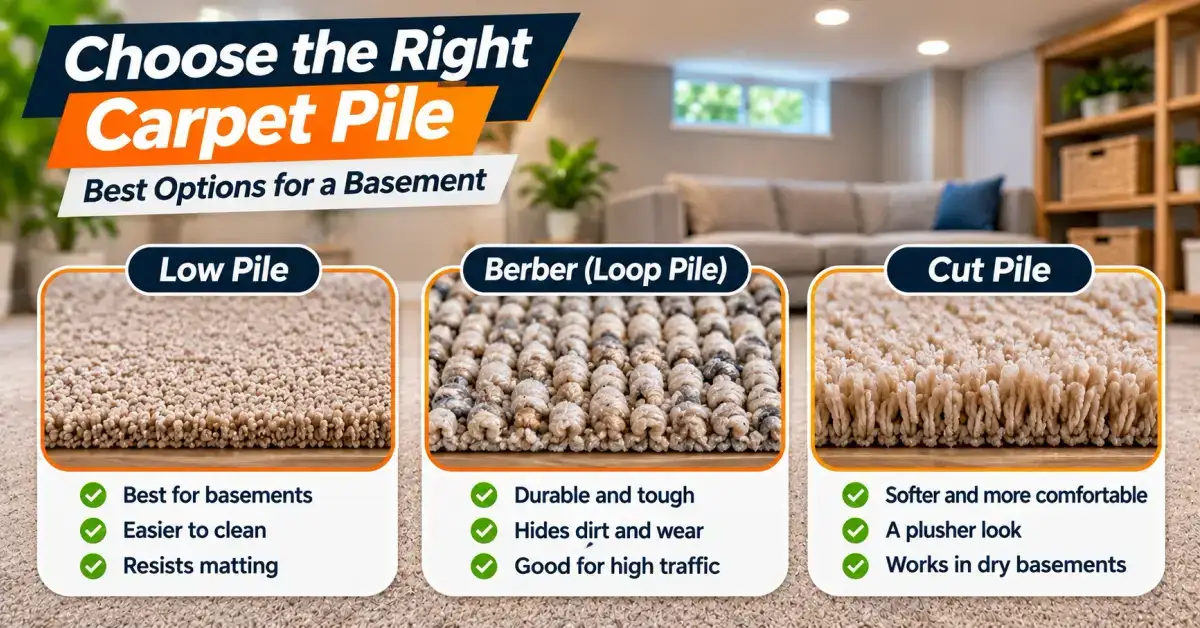
Short, tight construction suits a basement. Fewer fibers hold less moisture, and the surface dries faster after a spill.
Low Pile
Low pile means short, densely packed fibers. Wayfair's guide places flat pile at 0 to 1/4 inch and thin pile at 1/4 to 1/2 inch, with thick pile at 1 inch or more. Stay in the flat or thin range for a basement.
Berber and Loop Pile
Berber is a looped construction that handles traffic and appears in many basement recommendations. Guides disagree on one point. Some warn that loops snag pet claws, and Wayfair calls loop harder to clean. Choose a tight Berber for a dry family room, and a cut pile if you own cats or large dogs.
Cut Pile and Plush
Cut pile works well in traffic areas. Plush and shag hold more moisture and mat under furniture, so avoid them where dampness is possible.
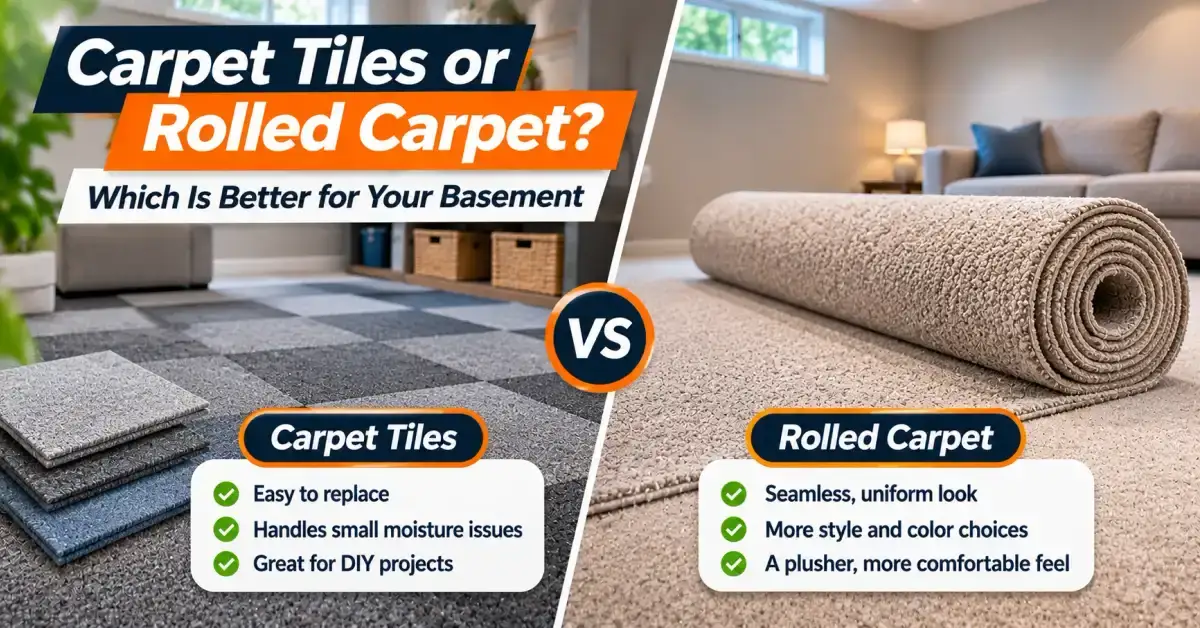
Carpet Tiles or Rolled Carpet Below Grade?
Carpet tiles let you replace one square after a spill, and some have attached bases that sit directly on concrete. Rolled carpet offers more comfort and style choices. It needs a pad (stretch-in) or adhesive (glue-down), following the Carpet and Rug Institute's CRI 105 methods. FlooringStores.com calls stretch-in suitable only for a bone-dry slab with a breathable pad, and notes that glue-down is hard to repair.
Is There Such a Thing as Waterproof Carpet?
Not for true wall-to-wall carpet. Tiles with waterproof bases and water-resistant backings reduce risk, but seams and edges still admit water. Be cautious when a seller promises "100 percent waterproof" without a stated test.
What Goes Under Basement Carpet: Pad, Barrier or Subfloor?
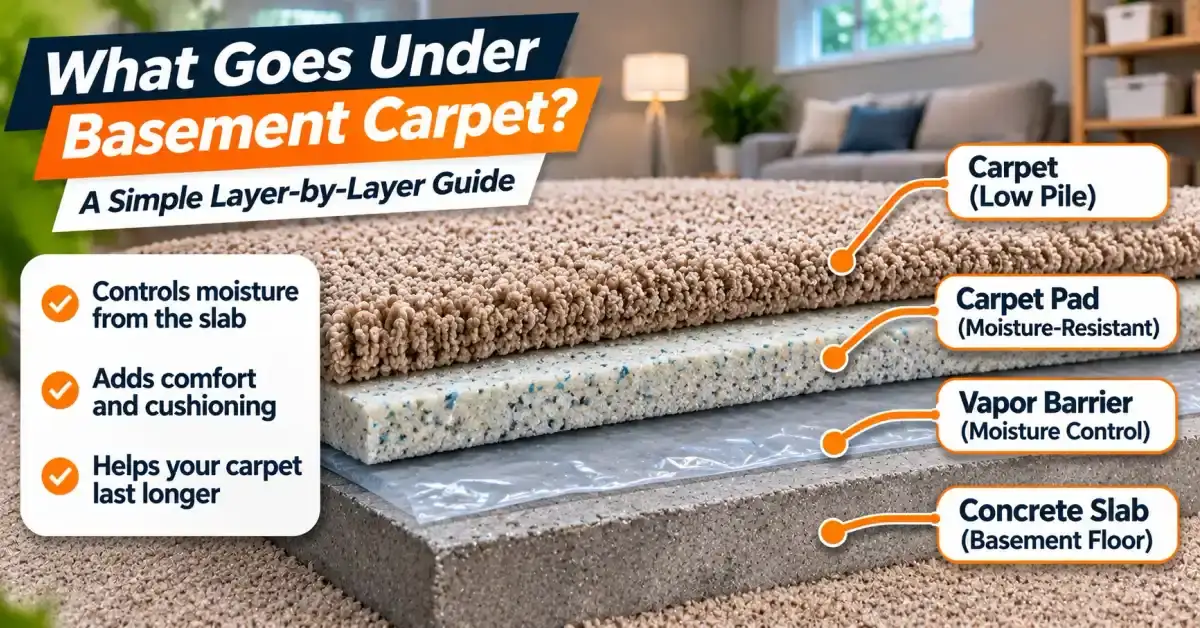
Can you put carpet directly on a concrete basement floor? You can, if the slab has tested dry and your carpet maker's below-grade instructions allow it. A pad adds warmth and comfort. The Carpet and Rug Institute suggests a cushion 1/4 to 7/16 inch thick with 6 pound density for most residential carpet. For Berber or other low-profile carpet, it advises no more than 3/8 inch at 8 pounds. The carpet maker's written requirement overrides both rules.
Experts disagree on moisture control. Floor Trends warns that a basement cushion without a moisture barrier can lead to mold and mildew. Hunker reports that some experts oppose impermeable rubber pads, and Green Building Advisor notes that many carpets and cushions are vapor-permeable, so a sealed layer can trap moisture. Avoid sponge-like foam either way. Raised subfloor systems such as DRIcore lift the carpet off the slab, and the maker lists carpet as a compatible finish.
Key Takeaway: Test the slab first, choose a dense pad within the carpet maker's thickness limits, and follow its written below-grade instructions rather than any single rule about barrier pads.
Best Carpet for Basement Family Rooms, Kids and Pets
| Use | Fiber | Style | Note |
|---|---|---|---|
| Family room or theater | Triexta or treated nylon | Low cut pile | Comfort pad; dry slab |
| Kids' play area | PET polyester or tiles | Low pile | Easy spot replacement |
| Pets | Olefin or nylon | Tight cut pile | Avoid loose loops |
| Damp-prone basement | Olefin | Low pile or tiles | Dehumidifier |
How Much Does Basement Carpet Cost?
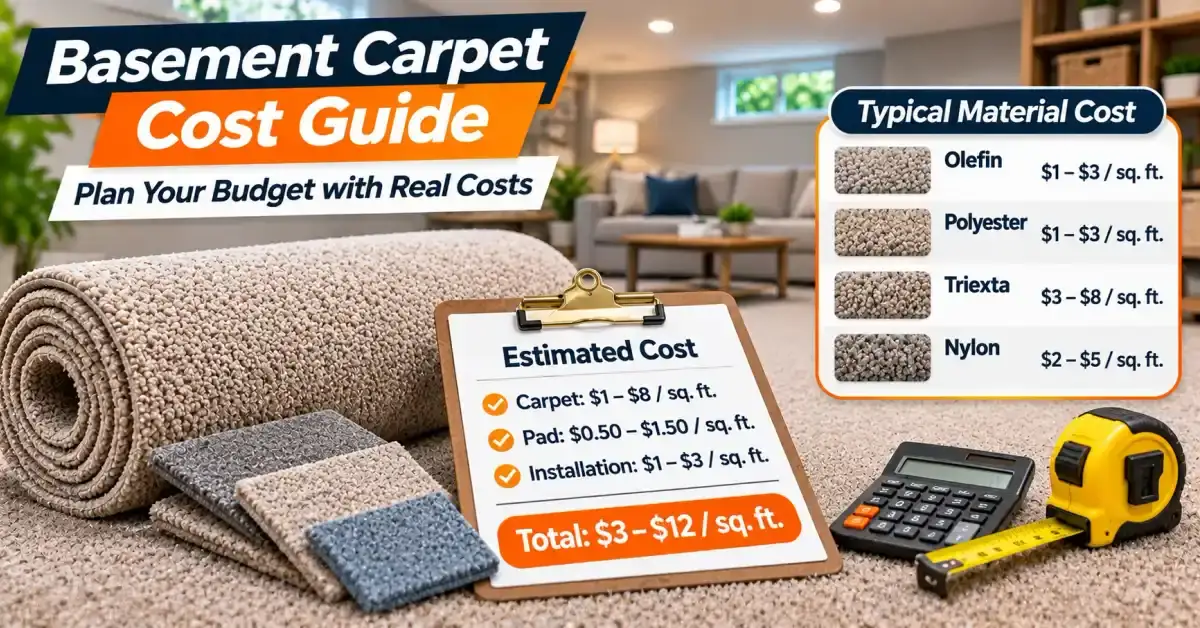
Expect about $3 to $11 per square foot installed, according to NerdWallet (July 2025) and This Old House (June 2026). Padding adds roughly $0.75 to $2 per square foot, and labor runs about $0.50 to $1. A 500 square foot basement typically falls between $1,500 and $5,500. Fiber choice drives most of the spread, with olefin and polyester at the bottom and wool at the top. Prices vary by region and change over time, so get a current quote.
When Carpet Is the Wrong Choice for a Basement
Choose another floor if the slab fails its test, the basement has flooded before, or the floor sweats in summer. Luxury vinyl plank, tile, sealed concrete, or carpet tiles over a raised subfloor with an area rug all tolerate moisture better. The EPA notes that moldy carpet may need disposal, which makes the wrong choice expensive. Many homeowners on forums favor vinyl plank where dampness or pets are a concern, though that is opinion, not testing.
How to Keep Basement Carpet Dry
Run a dehumidifier and aim for the EPA's 30 to 50 percent humidity range. A humidity meter costs about $10 to $50. Dry spills within 24 to 48 hours, and fix leaks before they reach the carpet. After a spill, remove standing water, run fans and the dehumidifier, and dry the pad too, because the EPA says the pad must dry along with the carpet. Hunker also mentions a moisture-blocking concrete primer as an extra step.
Carpet for Basement Floors: Quick FAQs
Should You Glue Down or Stretch In Basement Carpet?
+
Glue-down suits a slab with proven low moisture and a compatible adhesive. Stretch-in needs a bone-dry slab and a breathable pad. Follow the carpet maker's instructions.
Do You Need a Dehumidifier With Basement Carpet?
+
Usually, yes. A dehumidifier keeps humidity in the EPA's 30 to 50 percent range, which protects carpet and pad.
What Is the Best Carpet for Basement Stairs?
+
Choose low-pile, tightly constructed carpet with a firm pad. Carpet Exchange recommends nylon for stair durability and a pile under 1/2 inch, with about 3/8 inch ideal. Check the stairwell for dampness first, since nylon needs a dry space.
What Is the Cheapest Way to Cover a Concrete Basement Floor?
+
Olefin carpet has the lowest material cost, at $1 to $3 per square foot. Fixr puts concrete sealer at about $1 to $4 per square foot and paint at $2 to $4, labor included. That can undercut installed carpet, but you get a hard, cool floor, so add an area rug.
Choosing the Best Carpet for Basement Floors: Final Advice
The best carpet for basement floors is low-pile synthetic carpet or carpet tiles over a slab that has passed a moisture test. Test first, pick olefin, polyester or triexta for dampness, and reserve nylon for dry rooms. If the slab fails, choose another floor.
Need a carpet cleaning company you can trust? We handle residential and commercial carpet cleaning, rug cleaning, upholstery cleaning, and pet stain and odor removal —our team is ready to help.

Michael Sanders
Michael Sanders is a home care and cleaning industry writer covering carpet maintenance, flooring care, and household cleaning practices across the United States. His work focuses on practical, research-backed guidance — from stain and odor removal to deep extraction methods and indoor allergen prevention. Michael collaborates with cleaning professionals to ensure accuracy, and his writing reflects a genuine interest in helping homeowners make informed decisions about caring for their homes.