

Blog · Carpet Cleaning Guide
Plaid Carpet: How to Choose, Install and Care for It
Plaid carpet is carpet woven, tufted or printed with crossing stripes that form a check, a grid or a tartan. You can lay plaid carpet wall to wall, run it up a staircase, or buy it as tiles and rugs. Most search results show only product pages, so the questions that matter go unanswered. What does it cost, how does pattern matching change your order, and how do you clean it?
Published November 26, 202612 min read

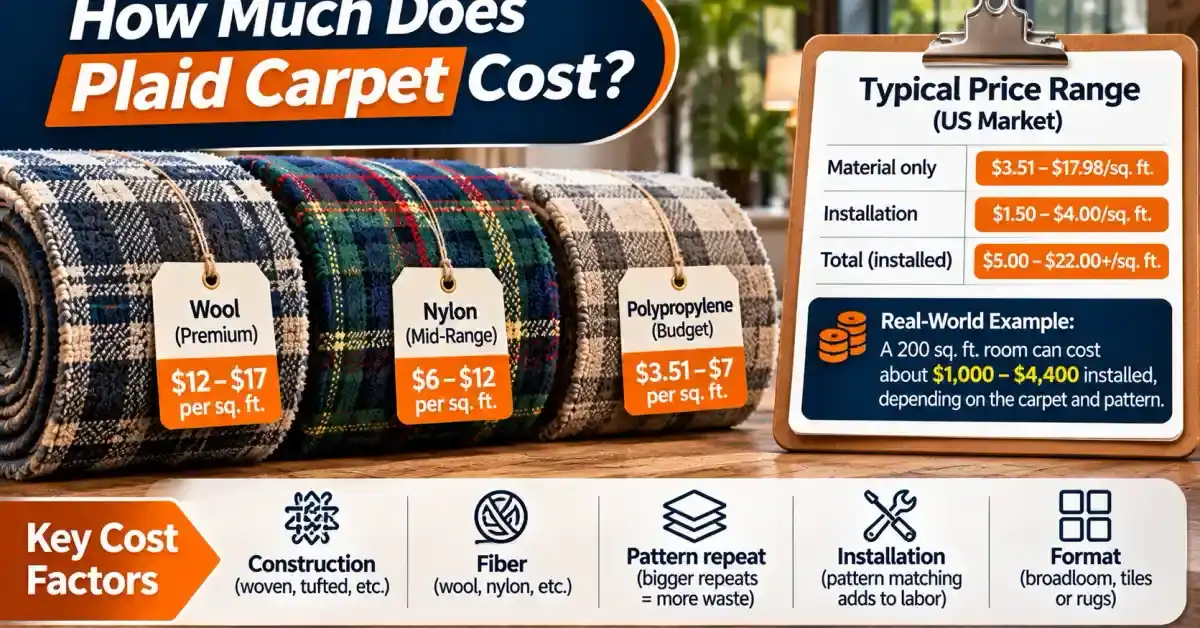
Retail listings checked on November 17, 2026 ran from about $3.51 to $17.98 per square foot for material alone. Patterned carpet needs extra material and an installer who has matched patterns before. Wool plaid carpet flooring also needs gentle cleaning and a close read of the maker's care label.
What Is Plaid Carpet? Plaid vs Tartan Explained
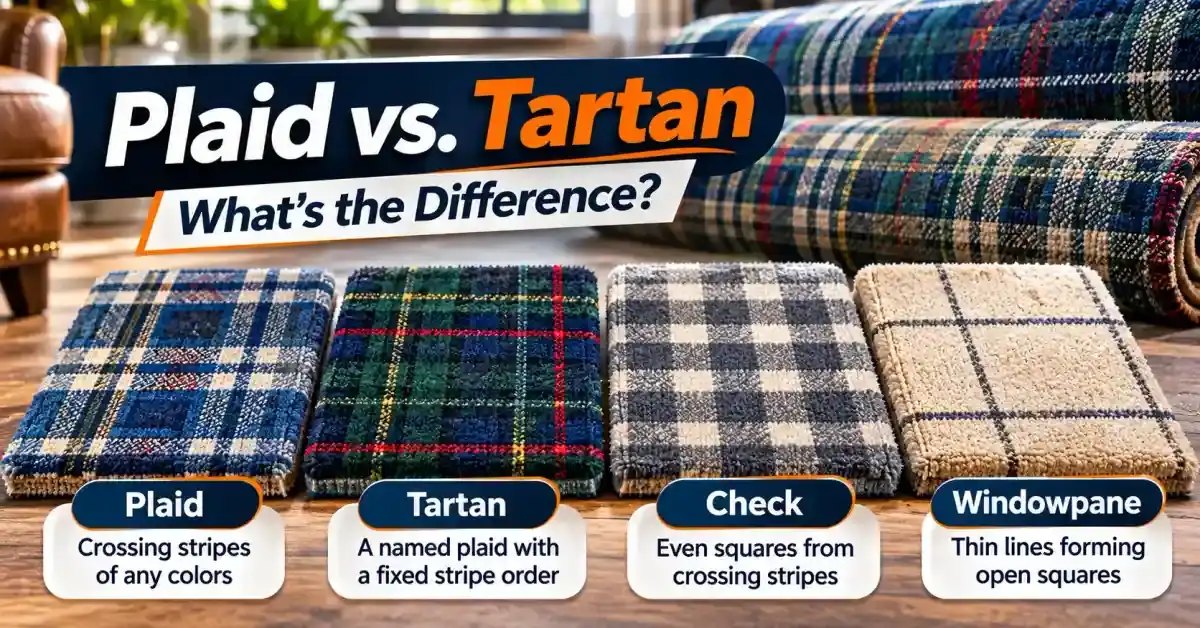
Plaid carpet has stripes of two or more colors that cross at right angles to form a check, a grid or a tartan. Designs range from quiet two-tone checks to bold, multi-band patterns. Retailers use the words plaid and tartan loosely, which causes confusion. A tartan is a plaid with a fixed stripe sequence, often registered with the Scottish Register of Tartans, which launched on 5 February 2009, according to National Records of Scotland. Every tartan is a plaid, but many plaids are not tartans.
Plaid, Tartan and Check: A Quick Glossary
| Term | What it means | Carpet example |
|---|---|---|
| Plaid | Crossing stripes of any colors and widths | Most carpet sold under this name |
| Tartan | A named plaid with a fixed stripe order | Black Watch, a tartan in blue, green and black |
| Check | Even squares from crossing stripes of similar width | Low-contrast neutral checks |
| Windowpane | Thin lines forming open squares on a plain ground | Subtle grids that wear like a solid color |
Types of Plaid Carpet: Construction and Fiber
Woven, Tufted and Flatweave Plaid Broadloom
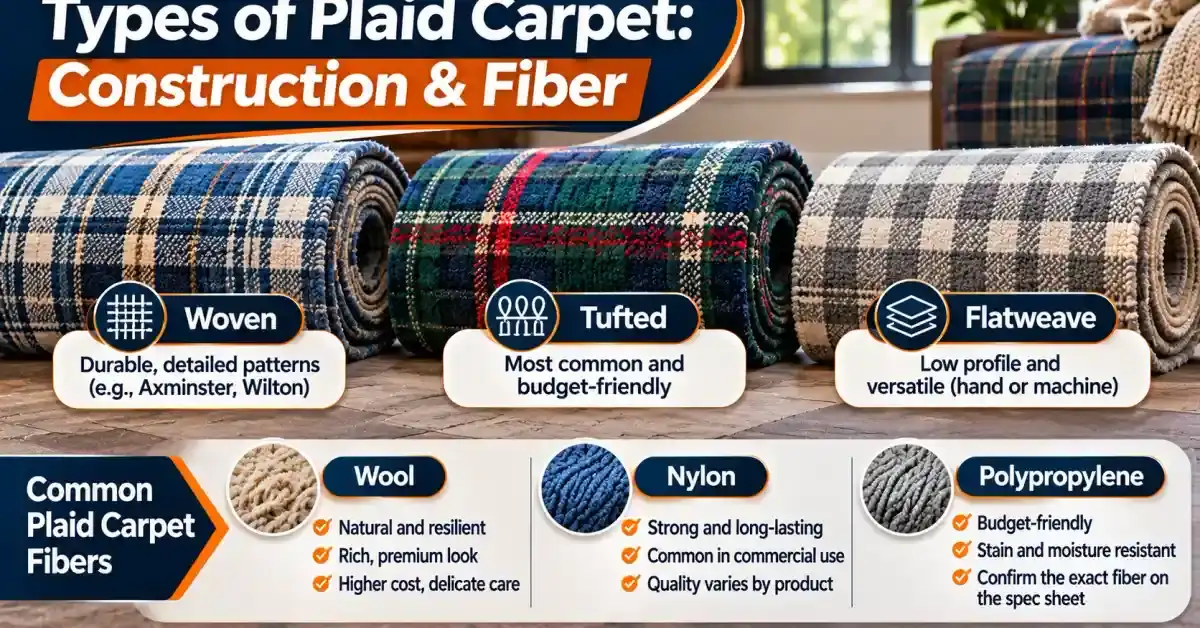
Broadloom is carpet sold in wide rolls that an installer cuts to fit your room. Plaid broadloom comes in several builds, and each one repeats its pattern at a different size. The repeat is the distance a pattern travels before it starts again, and a bigger repeat usually means more waste at the seams.
| Build | How it works | Real example |
|---|---|---|
| Axminster | Woven; yarns go in by color, which suits intricate patterns | Interiors lists an 80% wool, 20% nylon Axminster, 13'2" wide, with pattern sizes from about 10 to 26 inches |
| Wilton | Woven from one continuous yarn | Sold by several mills, often in wool blends |
| Hand-loomed flatweave | Woven by hand with no pile | Couristan Highland Plaid: 100% wool, 15' wide, 12" x 13" repeat |
| Machine-woven flatweave | Woven flat with no pile | Home Carpet One Pristine Plaid: wool-nylon blend, 10.5" x 10.5" repeat, 13'2" wide, felt pad included |
| Tufted or printed | Needles push yarn through a backing, and the pattern comes from printing or colored yarns | Shaw Scottish Plaid II: printed nylon, 12' wide. Joy Carpets Glenview Plaid: nylon, 18" x 18" repeat, 13'6" wide |
Tufting is the most common way to make carpet in the United States, so most budget plaid lines use it. Woven builds cost more but hold fine pattern detail well.
Wool, Nylon or Polypropylene?
| Fiber | Strengths | Watch for |
|---|---|---|
| Wool | Resilient natural fiber with rich color and a premium look | Higher price; reacts badly to heat, harsh cleaners and heavy wetting |
| Nylon | Common in commercial carpet; Dalton Hospitality sells plaid in solution-dyed nylon | Quality varies by line, so check the spec sheet |
| Polypropylene | Often sold as a budget fiber | Confirm the fiber on the spec sheet, because plaid lines differ |
Ratings belong to a product, not a fiber. Paradiso rates its Ax Plaid 5 out of 5 for durability but only 3 out of 5 for stain resistance, and it lists the carpet as not pet friendly. Read the numbers for the exact carpet you plan to buy.
Plaid Carpet Tiles and Rugs
Carpet tiles shift the work from seaming a roll to laying squares in the right direction. That suits small rooms, offices and renters. Interiors also notes that a mill can cut and bind a plaid rug from broadloom, so you can match a room without covering the whole floor.
How Much Plaid Carpet Costs
Prices vary with fiber, construction and pattern repeat. These material prices came from retailer pages on November 17, 2026, so check them again before you buy.
| Carpet | Fiber and build | Price seen |
|---|---|---|
| Shaw Scottish Plaid II (FlooringInc) | Nylon, printed | $3.51 per sq ft (sale price, Nov 16 to 22) |
| Shaw Philadelphia Scottish Plaid II, commercial (Georgia Carpet) | Nylon, 12' roll | $3.39 per sq ft |
| Pristine Plaid (Home Carpet One) | Wool-nylon blend flatweave | $8.24 per sq ft |
| Ax Plaid (Paradiso) | Woven cut pile | $17.98 per sq ft (MSRP) |
These figures cover material only. Plaid wall to wall carpet also needs extra yardage for the pattern match, and you must add pad, installation and delivery. Some retailers include pad, while others do not. Landry & Arcari lists plaid rugs from $2,632 to $4,590, but those are cut-size rug totals, so do not compare them with the per-square-foot prices above.
Is Plaid Carpet More Expensive Than Plain Carpet?
Usually yes. Complex weaving or multiple yarns raise the factory cost, seams need extra material so the pattern lines up, and installers spend more time on layout. No reliable source gives a flat percentage for the difference, so ask for a written quote that lists material, pad and labor separately.
Plaid Carpet Wall to Wall: How to Plan the Pattern Match
Wall-to-wall plaid succeeds or fails on planning. The pattern runs across every seam, so a small error at one wall carries across the whole room. Plan the layout before you order, not after the roll arrives.
Pattern Repeat and How Much Extra to Order
Extra yardage depends on the repeat size, the roll width and the room shape. Sources disagree on the amount. Flooring Clarity suggests about 10% to 15% extra for patterned carpet, while figures quoted in Google's AI Overview have run as high as 25% to 40%. Neither number is an industry standard. A large repeat in a room with many doorways needs more than a small repeat in a plain rectangle. Georgia Carpet also warns about pattern run-off, where the pattern drifts out of line along a long seam. Have the installer measure the room and write down the order quantity.
Key Takeaway: No single percentage fits every plaid. Repeat size, roll width and room layout decide how much extra carpet you need, so get the installer's measured quantity in writing.
Is Plaid Wall to Wall Carpet Hard to Install?
It asks more of the installer than plain carpet, because seams and stretching must keep the lines straight. Georgia Carpet says stretch-in installation gives the best alignment and that glue-down can weaken the match. Stanton advises matching the pattern at the center of the seam first, then stretching outward to both sides. Masland calls for a power stretcher and stay nails. A plaid also exposes a crooked room or a skewed roll, as Interiors points out, because the eye follows straight lines. Many makers want the room held at a set temperature before and after installation. Masland and Joy Carpets name 65°F for 48 to 72 hours, but that figure is product specific.
Key Takeaway: Stretch-in installation by an installer who has matched patterns gives the best result. Glue-down can weaken the match, and a room that is out of square will show.
Questions to Ask Before You Order
- What is the pattern repeat size, and how wide is the roll?
- Can I see a seam plan or layout sketch?
- Will you stretch the carpet in or glue it down?
- Who calculates the extra material, and is it in the quote?
- Have you installed patterned carpet before, and can I see the work?
- Can I get a sample that shows one full repeat?
A sample smaller than the repeat can show the colors in the wrong proportion, so always ask for a full-repeat sample.

How Plaid Carpet Wears
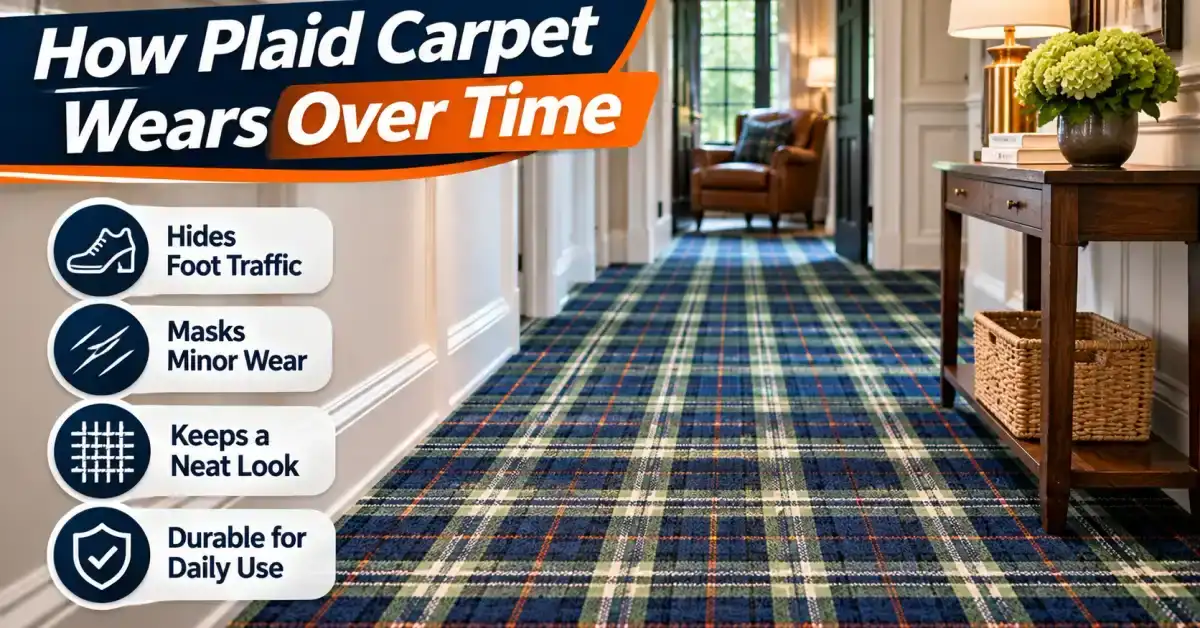
Pattern breaks the floor into small areas, so soil and traffic lanes are harder to spot than on a plain color. Interiors reports the same, though no lab test backs it up.
| Plaid usually hides | Plaid can show |
|---|---|
| Light soil and everyday footprints | Lint on dark navy or black bands |
| Early traffic lanes | A crooked wall or a skewed roll |
| Minor wear in busy halls | Poor seam matching |
Does Plaid Carpet Hide Stains and Dirt?
It hides soil and wear better than a plain color, but it does not erase stains. Stain resistance depends on the fiber and the specific line, as Paradiso's 3 out of 5 rating for one product shows. Pet owners should read the maker's pet and stain details for the exact carpet instead of relying on the pattern.
How to Clean and Care for Plaid Carpet
Care rules depend on the fiber, and wool needs the most caution. Always follow the maker's care label, and test any product on a hidden spot first.
Everyday Care
Vacuum often with a cleaner that carries the Carpet and Rug Institute Seal of Approval. For cut-pile wool over a pad, Shaw recommends a rotating brush or beater bar. Rotate area rugs every 3 to 6 months so wear spreads evenly. Flatweave has no pile, so check the maker's vacuum advice before using a beater bar.
Spills and Spot Cleaning
- Blot the spill right away with a clean white cloth, and do not rub.
- Dampen a fresh white cloth with cool water and blot again.
- Work from the outside of the spill toward the center.
- On wool, use a WoolSafe-approved product after a hidden-spot test, because dark plaid bands can bleed.
- Blot out leftover moisture and let the area dry fully.
Deep Cleaning and When to Call a Professional
Advice on hot water for wool conflicts. BISSELL says never to use hot water on wool because heat can felt and shrink the fibers. Couristan's wool-blend care guide allows professional hot water extraction at 120°F to 160°F with WoolSafe-approved products. Follow your carpet maker's guide, and hire a firm with wool experience. An IICRC Certified Firm employs at least one IICRC certified technician, and you can verify a firm on the IICRC locator. A cleaner can remove soil, but cannot fix a poorly matched seam.

Colors and Rooms That Suit Plaid
Blue, Green, Red or Neutral?
Blue and green suit traditional rooms. Black Watch, a widely worn tartan, combines blue, green and black, and Joy Carpets offers a Glenview Plaid colorway named Tartan Green. Red reads bold, and Isberian shows a Grand Tartan in red next to a Fort William tartan in cobalt blue. Neutral plaids are the safest choice, and Landry & Arcari notes that a neutral plaid can almost look like a stripe. Home Carpet One sells Pristine Plaid in Wheat, Heather, Linen and Stone.
Best Rooms for Plaid Carpet
Bedrooms, studies and libraries suit plaid because the pattern adds warmth without shouting. Stairs work too, though a staircase needs its own layout for the centerline, binding and landings. Basements need extra care, covered in the FAQ below.

Frequently Asked Questions
Is Plaid Carpet in Style?
+
Mostly yes, in classic and neutral versions. Homes & Gardens calls plaid a controversial carpet trend that designers now adapt for contemporary homes, and 2026 coverage describes wall-to-wall carpet returning in bedrooms, stairs and some living rooms. Some designers still avoid wall-to-wall carpet, so treat it as a matter of taste.
Can You Put Plaid Carpet in a Basement?
+
Sometimes. Test the concrete slab for moisture first, then pick a synthetic fiber with a moisture-resistant pad. Trade guides generally advise against wool below grade. Follow the carpet maker's installation guide.
Is Plaid Carpet Good for Stairs?
+
Yes, with planning. Interiors covers the layout details: a centered stripe, binding, landings and winders. Ask the installer how the pattern will turn at each step and landing.
Can Plaid Carpet Be Made in a Custom Color?
+
Some mills can. Interiors describes a strike-off, a small sample woven in your colors, that takes 4 to 6 weeks. Expect minimum orders and higher prices.
Is Plaid Carpet Right for Your Floor?
Plaid carpet fits when you want a pattern that hides wear in a bedroom, study or staircase and you can pay for careful installation. It fits less well with a tight budget, a large repeat in an out-of-square room, or no installer who has laid patterns. Your next step is simple: ask for a full-repeat sample, the repeat size and a seam plan. Then choose the fiber that matches how you plan to clean it.
Need a carpet cleaning company you can trust? We handle residential and commercial carpet cleaning, rug cleaning, upholstery cleaning, and pet stain and odor removal —our team is ready to help.

Michael Sanders
Michael Sanders is a home care and cleaning industry writer covering carpet maintenance, flooring care, and household cleaning practices across the United States. His work focuses on practical, research-backed guidance — from stain and odor removal to deep extraction methods and indoor allergen prevention. Michael collaborates with cleaning professionals to ensure accuracy, and his writing reflects a genuine interest in helping homeowners make informed decisions about caring for their homes.