
Blog · Carpet Cleaning Guide
How to Stretch Carpet: DIY Steps, Tools, and Costs
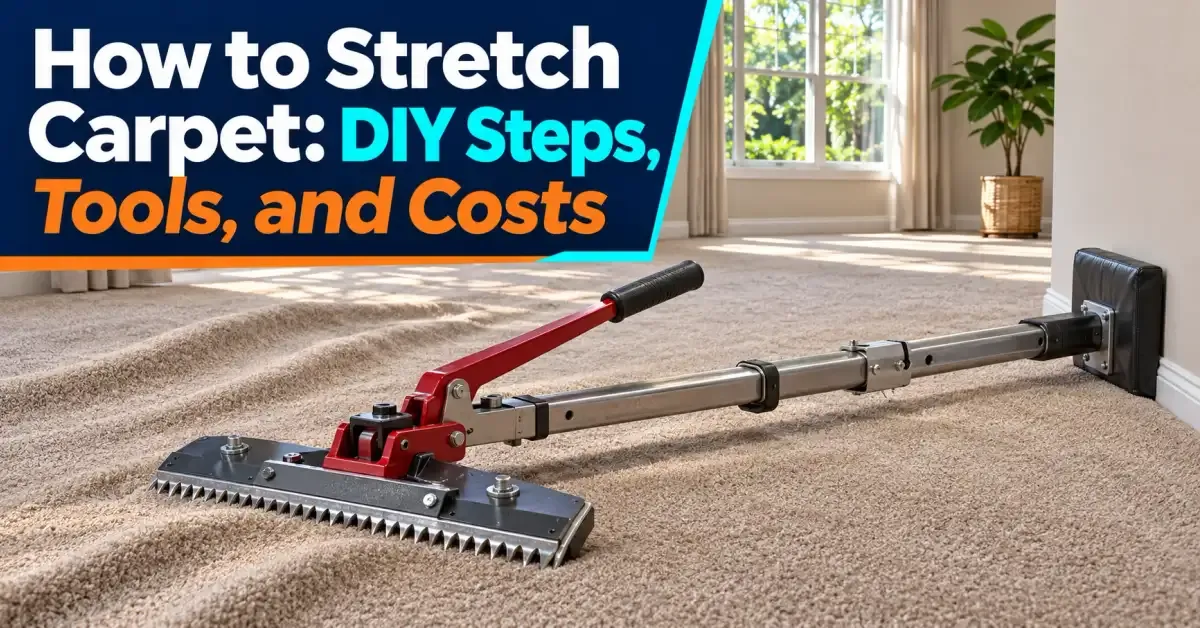
Learning how to stretch carpet comes down to one rented tool and one rule: use a power stretcher, not only a knee kicker. You free the carpet from the tack strips on a few walls and stretch it toward the opposite wall. Then you hook it back onto the pins and trim the edge.
Published November 16, 202613 min read
This guide shows how to stretch carpet yourself, what to check first, and what the job costs. The Carpet and Rug Institute (CRI) says a proper restretch needs a power stretcher and about 1% to 1.5% stretch in each direction. Plan on roughly half a day for one room, while a pro typically charges $100 to $300 for the first room.
Key Takeaway: To stretch carpet properly, rent a power stretcher and a knee kicker. Pull 1% to 1.5% in each direction, and fix pad or backing problems first.
Check Why Your Carpet Is Rippling Before You Stretch It
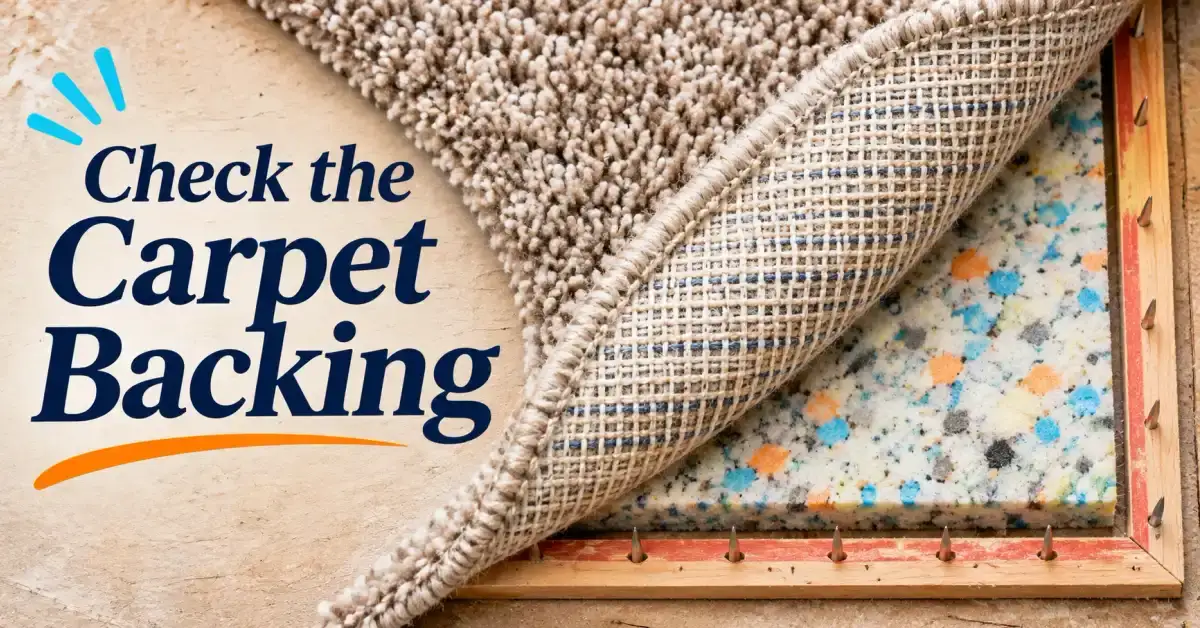
Stretching only fixes carpet that has gone slack. It does nothing for ripples caused by a failing pad, a separating backing, or moisture. To learn how to restretch loose carpet, start by lifting one corner off the tack strip. Peel it back a foot or two and look at what sits underneath.
Problems Stretching Will Not Fix
- Crushed, crumbling, damp, or wrinkled padding. CRI tells installers to confirm the cushion has not wrinkled under the carpet.
- Delamination, where the secondary backing separates from the carpet. CRI lists this as a check before any restretch.
- Moisture or mold from a leak. Fix the source first.
- Glue-down carpet. Power stretching works on stretch-in carpet held by tack strips.
- Worn-out carpet. Angi suggests replacing it when repairs cost more than half of new carpet, when it is past its 5 to 15 year lifespan, or when it has already been stretched several times.
How to Tell If Your Carpet Is a Good Candidate
Your carpet is a good candidate when ripples run across the room and the edges lift easily from the wall. The pad underneath should be flat and springy. Confirm the tack strips are firmly anchored, with rust-free pins that are angled correctly. If a seam crosses the ripple or the pattern looks distorted, call a pro.
Tools You Need to Stretch Carpet Yourself
Two specialty tools do the real work, and you can rent both instead of buying them.
Power Stretcher vs. Knee Kicker
| Tool | What it does | When you need it |
|---|---|---|
| Power stretcher | Braces against the opposite wall and pulls the whole field of carpet tight with a lever | Every full-room stretch |
| Knee kicker | Short tool you strike with your knee to position carpet on the pins | Corners, closets, and spots within about 3 feet of the side walls |
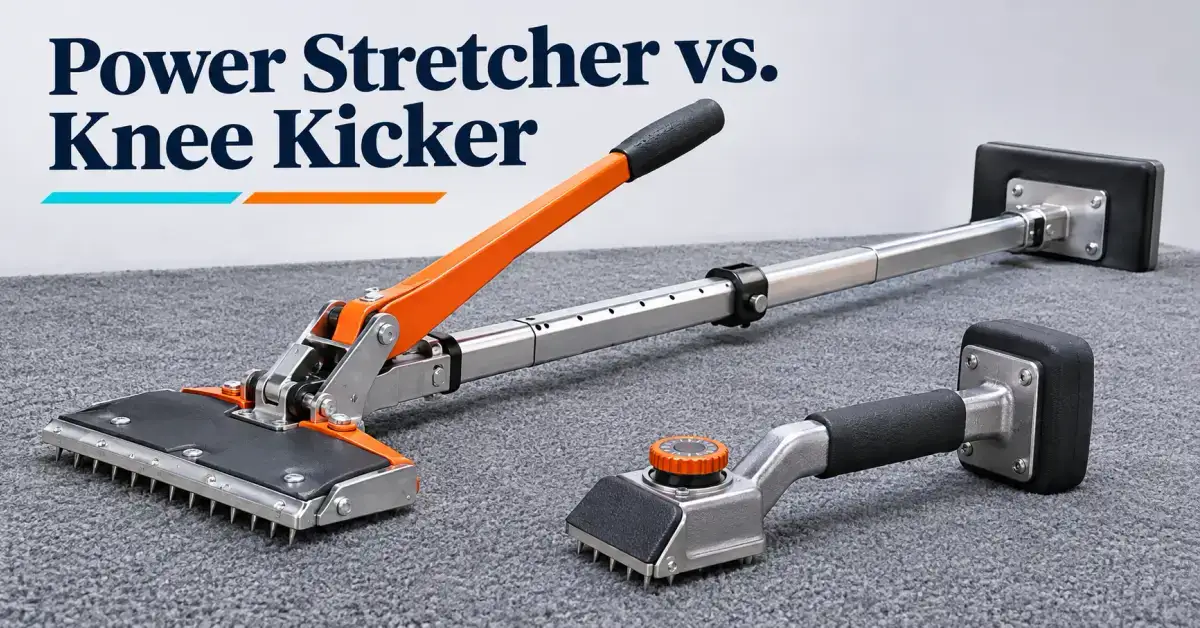
A knee kicker is a positioning tool. CRI's restretching bulletin says it cannot produce enough stretch to prevent future wrinkles. Rent both tools, because the kicker reaches the spots the stretcher cannot.
Key Takeaway: Use a power stretcher for the room and a knee kicker for tight spots. A knee kicker alone will not hold.
Other Tools and Supplies
Gather these before you rent the stretcher:
- Work gloves and knee pads
- Utility knife or curved carpet knife
- Stair tool or carpet tucker
- Pliers and a flathead screwdriver or pry bar
- Hammer or staple gun with 5/16-inch staples for the pad
- Tape measure and white chalk
- New tack strips, only if the old ones are damaged
Rent or Buy a Power Stretcher?
Rent for a single room. Home Depot lists a Carpet Power Stretcher and Case in its tool rental category, and other rental counters carry similar kits. Fees vary by store, so call ahead. Confirm the kit includes the head, tail block, extension tubes, and case. Buying only pays off for repeat jobs, since Angi puts both tools at about $400.
Prepare the Room Before You Restretch
CRI's restretching guidance starts with removing all furniture from the room. That gives the stretcher a clear path and lets you pull the carpet off the tack strips without tearing it. Vacuum first, and let the carpet dry fully if it was cleaned or wet recently.
Can You Stretch Carpet Without Moving Furniture?
Sometimes, but the result suffers. Angi says to ignore fixed items like cabinets and appliances. Never stretch carpet underneath furniture, and remove at least half of it if you cannot clear the room.

How to Stretch Carpet With a Power Stretcher, Step by Step
These steps assume the pad and tack strips passed the checks above. Install any new tack strips and staple down loose pad before you rent the stretcher, so you pay for less rental time.
Step 1: Release the Carpet and Check the Pad
Wear gloves, because tack strip pins are sharp. Start at a corner, lift the carpet off the pins with pliers, and peel it back along the wall like a zipper. Free two or three walls and keep the wall you will stretch away from hooked. CRI's full procedure unhooks every wall, which suits room-wide buckling.
Staple any loose pad about every 3 inches and trim it flush to the tack strips, never over the pins. Set strips so the gap to the wall, called the gully, is slightly less than the carpet thickness and no more than 3/8 inch.
Step 2: Set Up and Use the Carpet Stretcher
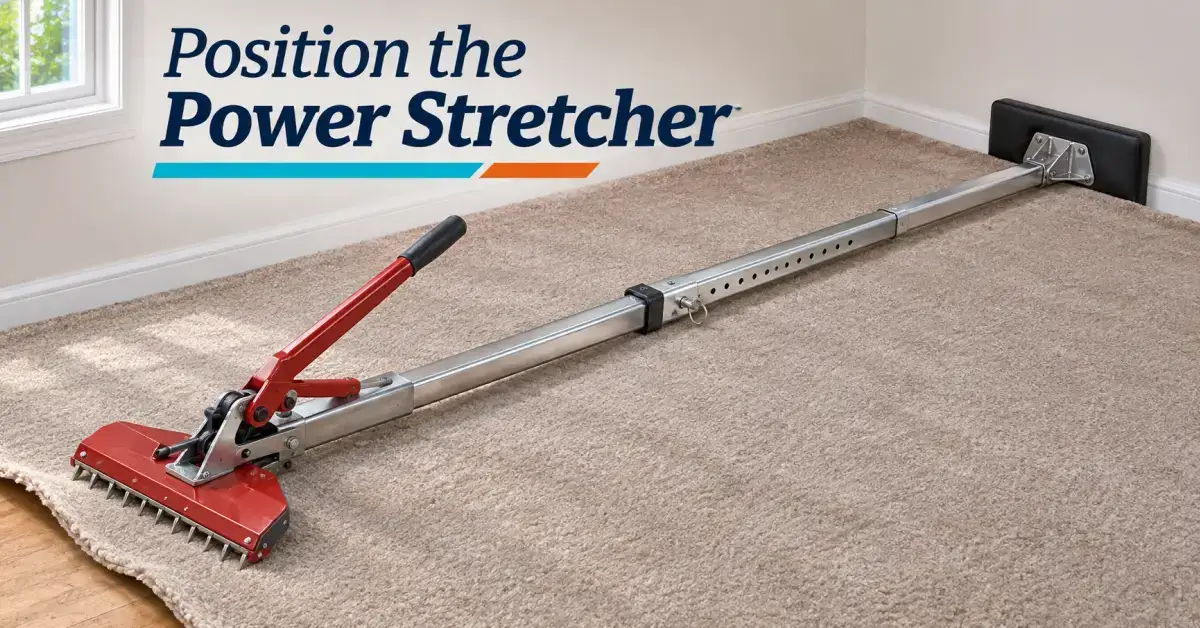
Here is how to use a carpet stretcher: set the tail block against the baseboard on the anchored wall. Extend the tubes until the head sits about 6 inches from the loose edge, with the teeth gripping the backing. Push the lever down firmly, then press the carpet onto the pins.
Watch the lever. If it takes all your strength, you are stretching too tight. If it moves with almost no effort, the carpet is not tight enough.
Step 3: Stretch Wall to Wall in Sections
Work from the anchored wall toward the opposite wall. Manufacturer installation guides say to angle the stretcher about 15 degrees and move the head no more than about two head widths between pulls. Hook the carpet after every pull, then repeat from an adjoining wall to stretch the other direction.
Check your tension with a chalk line, a method one carpet maker, Joy Carpets, suggests. Chalk a line across the carpet near the wall before you pull, then measure how far it travels. In a 12-foot room (144 inches), 1% is about 1.4 inches and 1.5% is about 2.2 inches.
Step 4: Kick the Tight Spots With the Knee Kicker
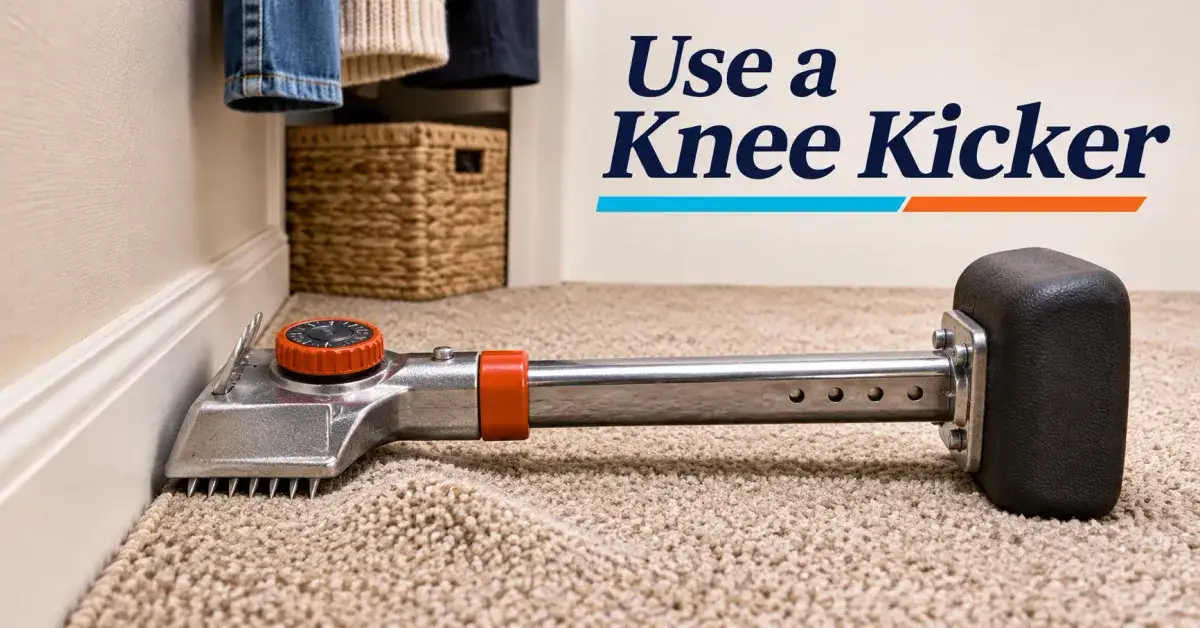
Use the knee kicker for corners, closets, and spaces within about 3 feet of the side walls, where the stretcher will not fit. Set the teeth about 6 inches from the wall and strike the pad with the area just above your kneecap. Hook the carpet right away. Without a knee kicker, you cannot reliably stretch the last few feet near the side walls, so rent one with the power stretcher.
Step 5: Trim and Tuck the Edges
Trim the excess with a sharp knife, cutting from the back on plush carpet to protect the pile. Leave just enough to tuck into the gully, then push it down with a stair tool. Do not pull the carpet past a doorway, where you could break a seam. Use transition molding to hold the edge at the opening. Wait a few hours before moving furniture back, and use sliders for heavy pieces.
How to Stretch Carpet Without a Stretcher
You can pull a small ripple out near a wall without a power stretcher, but you cannot stretch a whole room properly. CRI says a knee kicker cannot produce enough stretch to stop wrinkles from returning, and carpet makers' installation notes call a power stretcher necessary.
What a Knee Kicker Alone Can Fix
A knee kicker handles a short ripple within a few feet of a wall, a loose edge at a doorway, or a closet corner. Set the teeth about 6 inches from the wall, kick, hook, and work along the edge in short steps. Expect it to hold for a while. If ripples span the room or return, you need the stretcher.
Quick Fixes That Only Work for a Short Time
Online tutorials suggest jumping on the carpet toward the wall or rolling it with a weighted roller. Some even build a lever from scrap wood and a jack. These push carpet around, but none of them applies or measures the 1% to 1.5% tension CRI calls for. Treat them as a temporary stopgap.
DIY vs. Hiring a Pro: What Each Option Costs
If you stretch carpet yourself, you save the labor charge, but the gap is smaller than most people expect. Angi puts a DIY job at $50 to $100, though renting the tools can push that higher. Professionals typically charge $100 to $300 for the first room.
| Option | Typical cost | Time | Best for |
|---|---|---|---|
| DIY with rented tools | About $50 to $100 (Angi); tool rental fee varies by store | About 4 to 5 hours | One room with simple ripples |
| DIY with bought tools | About $400 for both tools (Angi) | About 4 to 5 hours | Repeat jobs only |
| Hiring a pro | $100 to $300 for the first room (Angi, HomeGuide); about $50 to $75 for each added room (HomeGuide) | 1 to 2 hours per room (HomeGuide) | Seams, big rooms, patterned carpet |

Hire a pro when a seam crosses the ripple, the room is large, the carpet has a pattern that could visibly distort, or you are tackling stairs. Prices vary by region, so get written quotes.
What to Do If Wrinkles Come Back
Ripples that return usually point to a cause the stretch did not fix. Check these in order:
- Pad: crushed or wrinkled padding lets carpet shift. Replace it before you restretch again.
- Tension: a stretch under 1% leaves slack. Repeat the chalk-line check.
- Adjoining areas: CRI says to restretch connected rooms and hallways too, because an unstretched neighbor can bring wrinkles back.
- Humidity: carpet relaxes in humid weather, and manufacturers set humidity limits for installs, such as 10% to 65% relative humidity for one maker.
- Furniture: dragging heavy pieces pulls carpet off the pins, so use sliders.
If wrinkles return after a proper power stretch, have a pro check for delamination or moisture.

Carpet Stretching FAQs
How long does it take to stretch carpet?
+
A pro averages 1 to 2 hours per room, according to HomeGuide. Expect about 4 to 5 hours if you do it yourself, based on Angi and Bob Vila estimates, including prep and trimming.
How often should you restretch carpet?
+
Angi suggests about once every five years as a rule of thumb. Restretch when you see ripples, loose edges, or trip hazards, not on a fixed schedule.
Can you stretch carpet after cleaning it?
+
Wait until the carpet is fully dry. Some cleaning-related ripples relax as the carpet dries, so check again before you rent tools.
Can you overstretch carpet?
+
Yes. Pulling too hard can distort the pattern, peak the seams, or damage the backing. Use the lever effort and chalk-line checks to stay in range.
Can you stretch carpet on stairs or in a hallway?
+
A hallway works like a narrow room: brace the tail block against the far wall and stretch along its length. Stairs are a different job from a flat room, so most homeowners should hire a pro.
Final Thoughts on How to Stretch Carpet
Now you know how to stretch a carpet the reliable way. Confirm the pad and backing are sound and rent a power stretcher and a knee kicker. Pull toward 1% to 1.5% in each direction, then tuck the edges. Hire a pro when seams, stairs, or patterned carpet are involved, since a first room usually costs $100 to $300.
Need a carpet cleaning company you can trust? We handle residential and commercial carpet cleaning, rug cleaning, upholstery cleaning, and pet stain and odor removal —our team is ready to help.

Michael Sanders
Michael Sanders is a home care and cleaning industry writer covering carpet maintenance, flooring care, and household cleaning practices across the United States. His work focuses on practical, research-backed guidance — from stain and odor removal to deep extraction methods and indoor allergen prevention. Michael collaborates with cleaning professionals to ensure accuracy, and his writing reflects a genuine interest in helping homeowners make informed decisions about caring for their homes.