

Blog · Pest Removal Guide
How to Get Rid of Carpet Beetles: A Step-by-Step Plan
You spot a small mottled beetle on a windowsill, or a fuzzy, bristly larva along a baseboard. Either way, carpet beetles in your house will not vanish after one product, and the order you work in matters more than the brand you buy.
Published November 4, 202614 min read
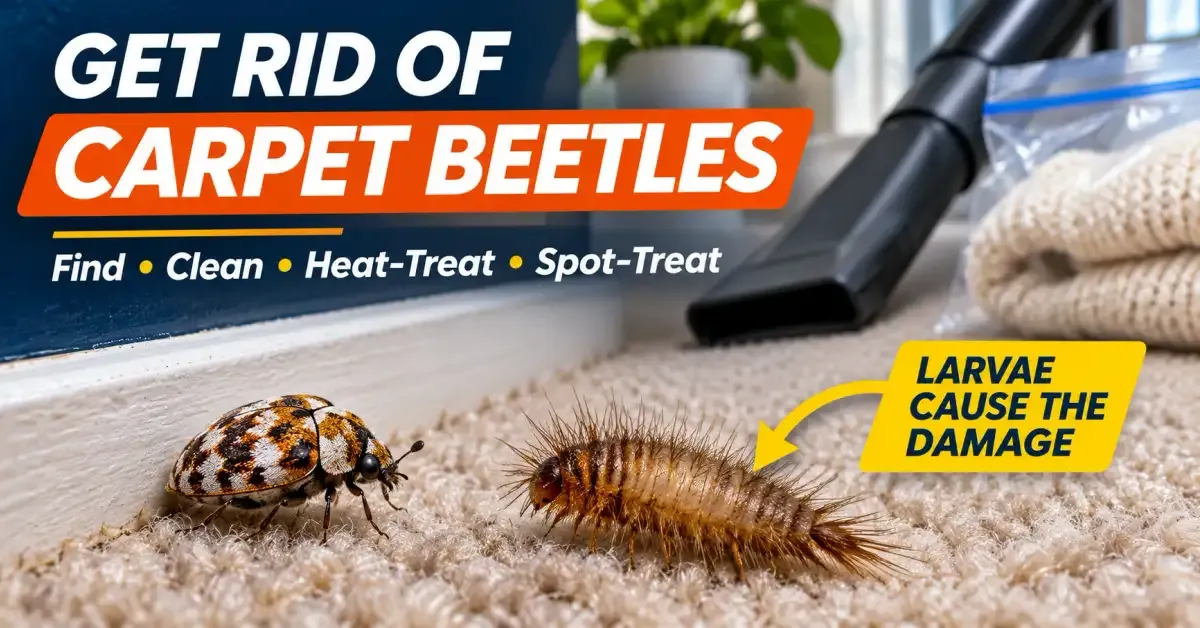
Here is the sequence that works. Find the food source feeding the larvae, clean and vacuum it out, heat-treat what you can wash or freeze, then spot-treat edges and cracks with a labeled product. Adults feed on pollen outdoors and damage nothing. The larvae eat your wool, and they are the real target. This guide covers each step, what a carpet beetle spray can do, and how long it takes.
Why You Suddenly Have Carpet Beetles
What Causes Carpet Beetles to Appear
Adults fly well and come indoors through open windows, doors, vents and torn screens. They also ride in on cut flowers. Females lay eggs close to larval food: wool, silk, fur, feathers, leather, pet hair, lint and stored dry foods.
Larvae may feed quietly for months inside a closet or floor vent. You notice them in spring, when adults emerge and head for the windows. Beetles at the glass often mark the end of a cycle, not the start.
Are Carpet Beetles in 90% of Homes?
No traceable source backs a 90% figure. A 2016 survey in PeerJ sampled 554 rooms across 50 homes near Raleigh, North Carolina. Carpet beetles were one of only four arthropod families found in all 50 homes, while bed bugs appeared in none. Researchers collected living and dead specimens in plain sight across one region, so this is not a national count.
Key Takeaway: Carpet beetles are extremely common, and finding one says nothing about how clean your home is. Fresh damage means larvae are feeding somewhere.
How to Tell It's Carpet Beetles, Not Bed Bugs or Moths
Adults, Larvae and Shed Skins
Adults are oval and roughly an eighth of an inch long. The larvae do the chewing, and the bristly brown cast skins they leave behind are often the clearest sign. Some people search for how to get rid of carpet bugs, but the insect is the same, and three species cause most household problems. For droppings, skins and damage photos, see our guide to the signs of carpet beetles.
Carpet Beetle Species at a Glance
| Species | Adult | Larva | Usually found in |
|---|---|---|---|
| Varied carpet beetle | Mottled white, brown and yellow scales | Bristly and banded, tapers toward the head | Carpets, woolens, furs |
| Furniture carpet beetle | Slightly larger and rounder, mottled | Bristly, similar to varied larvae | Upholstery, padding, feathers |
| Black carpet beetle | Uniformly dark brown to black, shiny | Carrot-shaped, tan to brown, tail tuft of bristles | Woolens, stored grains |
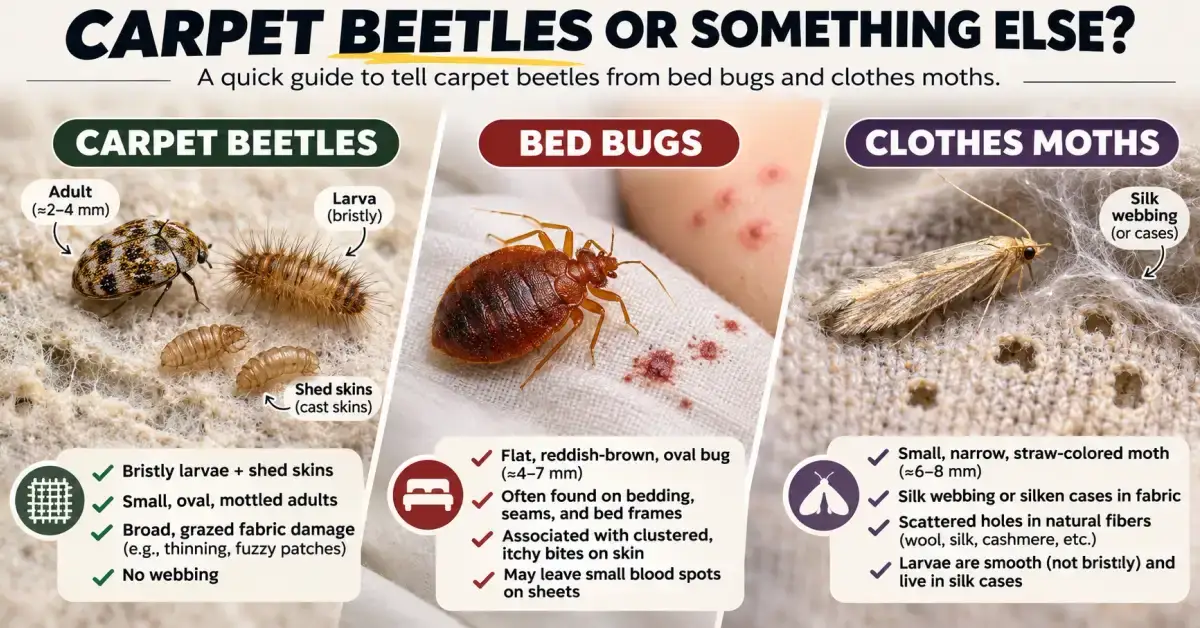
Carpet beetle damage covers a broad grazed area with no webbing. Clothes moths leave scattered holes and silk webbing. That difference is the fastest way to tell them apart.
Do Carpet Beetles Bite?
They do not bite. Some people get an itchy rash from the tiny barbed hairs on the larvae, which break off against skin and mimic bites.
Bed bug bites appear in lines or clusters on exposed skin, often with blood spots on the sheets. A carpet beetle rash is scattered, shows up under clothing, and comes with shed skins instead.
Find the Food Source Before You Treat Anything
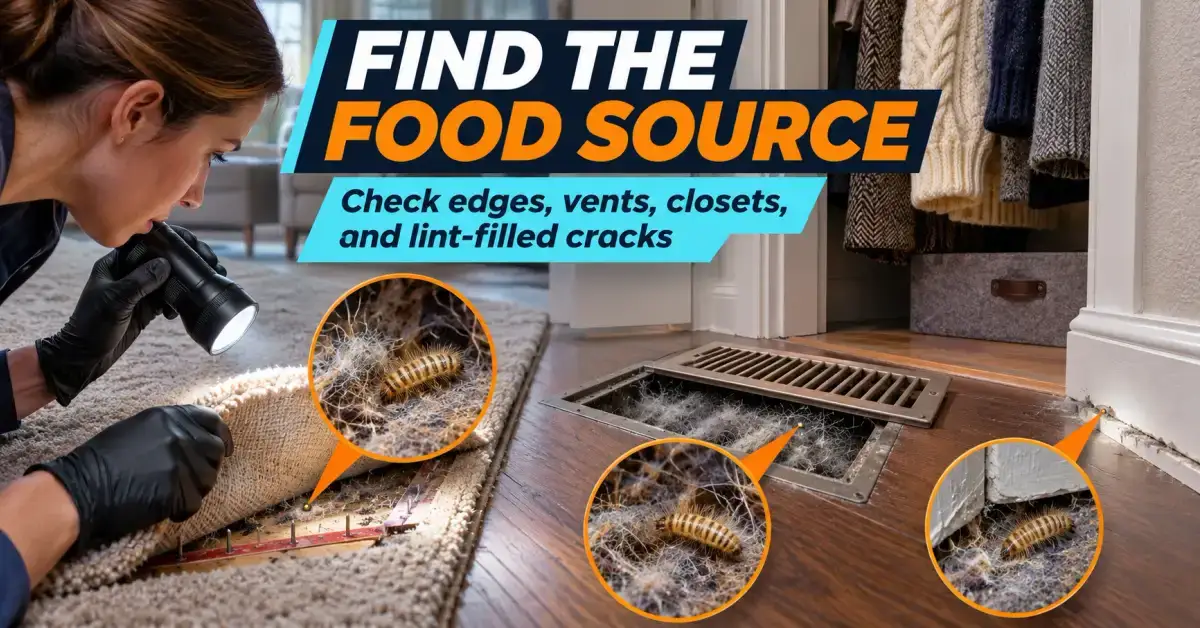
Where Larvae Hide in Your House
Spraying before you find the nest is the main reason carpet beetle treatment fails. Work through this list:
- Floor vents and ducts, especially in homes with pets
- Carpet edges, and under carpet at the tack strip
- Baseboards, corners and floor cracks where lint collects
- Under heavy furniture, and inside upholstered furniture
- Closets holding wool, fur, feathers or leather, and seams of stored clothing
- Stored pet food, cereal, grains and bird seed
- Dead insects in attics and light fixtures, old nests and spider webs
Lift wall-to-wall carpet from the tack strip with needle-nose pliers to check underneath.
Why Adults on the Windowsill Don't Show the Nest
Adults fly and move toward light, so where you see them says little about where larvae feed. The source may be a duct packed with pet hair two rooms away. Pet hair, wool and feathers are rich in keratin, which larvae digest, so one neglected vent can feed a population for years. That is why vacuuming open floor fails while damage continues.
Key Takeaway: Treat the food source, not the beetles you can see. Until the lint, hair or infested fabric is gone, new larvae keep hatching.
How to Get Rid of Carpet Beetles Step by Step
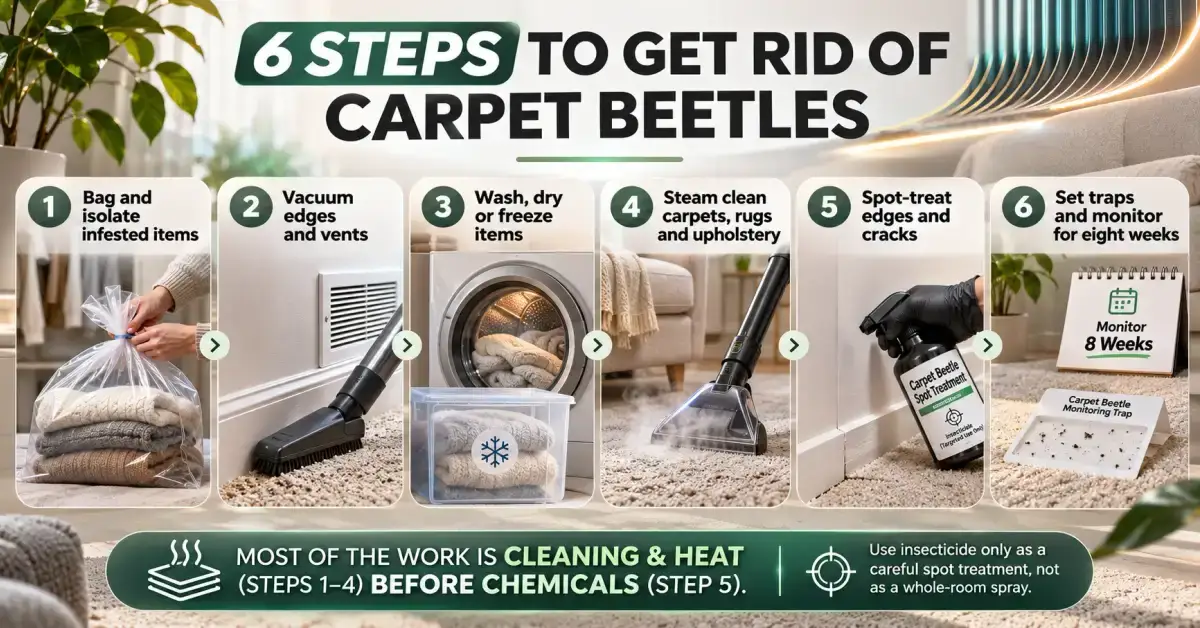
So how do you get rid of carpet beetles? Work through these six steps in order. To kill carpet beetles with the least chemical use, steps one through four do most of the work naturally.
Step 1: Bag and Isolate Infested Items
Put anything showing damage into a sealed plastic bag before carrying it through the house. Carrying it bare to the laundry room spreads the problem.
Step 2: Vacuum the Right Places, Then Empty It Outside
To remove carpet beetles you can reach, start with the vacuum. It lifts eggs, larvae, shed skins and the lint they feed on. Skip the middle of the room. Focus on edges, corners, baseboards, closet floors, under furniture and inside heating vents. Use a crevice tool and a HEPA filter, since larval hairs irritate skin and airways. Then empty the bag or canister outdoors and seal it in the trash.
Step 3: Wash, Dry or Freeze What You Can
Heat and cold kill every stage, eggs included. Hot laundering or dry cleaning kills all life stages, and a clothes dryer on high for at least 30 minutes works on its own. For objects you cannot wash, extension guidance suggests heating them at 120°F or above for at least 30 minutes.
Freezing works too, though the temperature and duration differ by source. One state program says 48 hours in a freezer. University of Kentucky entomologists say 0°F for at least a week, or 72 hours in a deep freezer reaching -20°F. UC IPM suggests two weeks below 18°F.
Key Takeaway: Dry fabrics on high for 30 minutes, heat oven-safe objects at 120°F or above for 30 minutes, or freeze sealed items at 0°F or colder for a week.
Step 4: Steam Clean Carpets, Rugs and Upholstery
Steam puts heat where laundering cannot reach. Work slowly over carpet edges, rug undersides and upholstery seams, where larvae settle. Let everything dry fully and run a fan, because damp carpet creates a different problem.
Step 5: Spot-Treat Edges and Cracks With a Labeled Product
Now consider an insecticide, and not before. Anyone planning to exterminate carpet beetles with chemicals alone skips the steps that matter most. Apply it as a spot treatment along carpet edges, floor and wall junctions, under rugs and furniture, on closet floors and shelving, and into cracks where lint gathers. On an infested carpet you can treat both sides, going lighter on top.
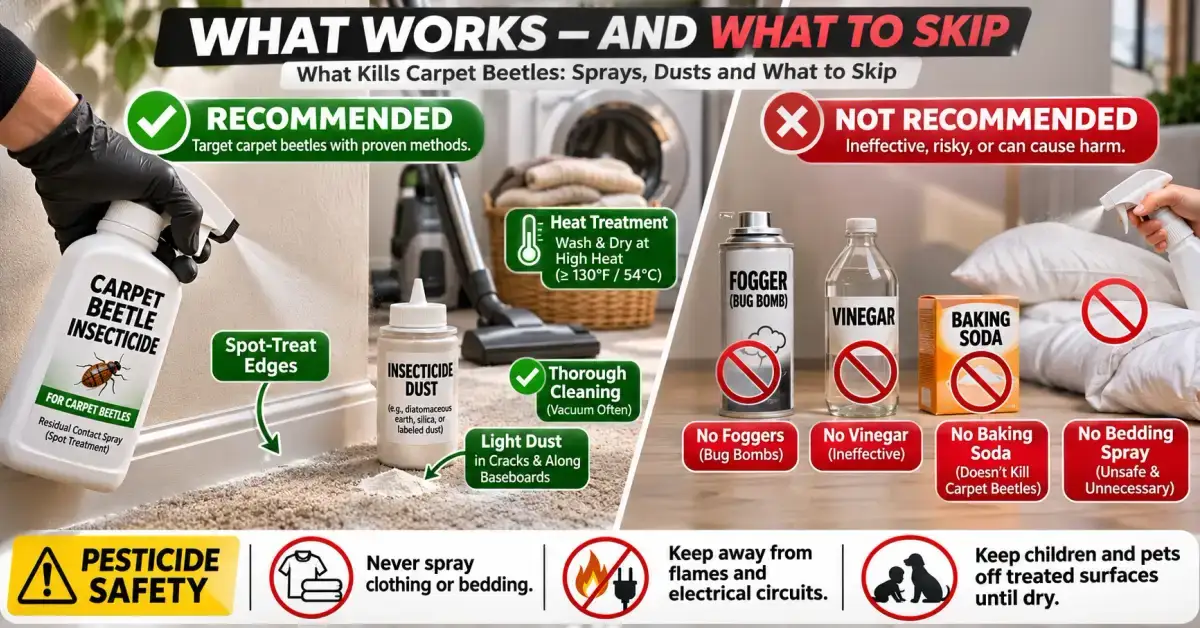
Never spray clothing or bedding. Test linoleum in a hidden spot, apply lightly on parquet, skip asphalt and tile, and keep sprays away from flames, sparks and electrical circuits.
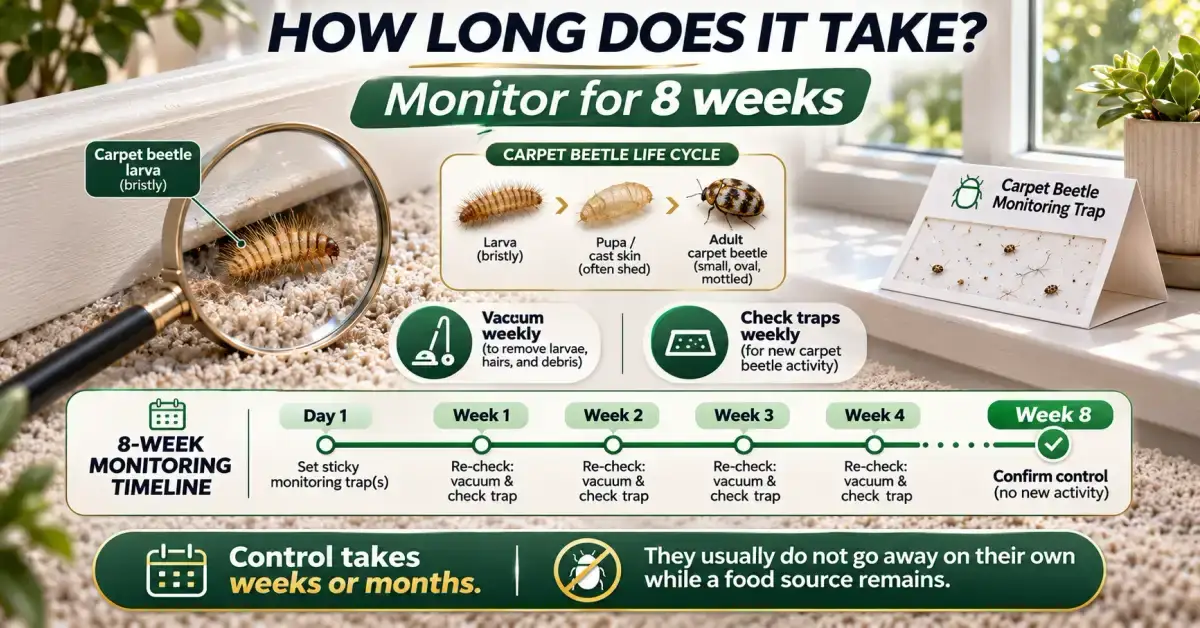
Step 6: Set Traps and Keep Checking for Eight Weeks
Sticky traps monitor progress, they do not solve the problem. Plain traps on windowsills catch adults heading for light. Pheromone traps draw adult males and are species-specific, so match the trap to your beetle.
A workable schedule: bag and clean on day one, re-vacuum and check traps weekly through week four, then confirm no new larvae by week eight.
What Kills Carpet Beetles: Sprays, Dusts and What to Skip
Carpet Beetle Spray: How to Choose One That Works
The label decides this, not the brand. Whether you hold a store brand, a can of Raid or a professional concentrate, check that carpet beetles appear on the label. Using a product against a pest it is not labeled for violates federal law.
Extension sources point to pyrethroids, including permethrin, bifenthrin, deltamethrin, cyfluthrin, cypermethrin, lambda-cyhalothrin and tralomethrin. A residual indoor spray worked into cracks lasts longer than a surface mist. Insect growth regulators also list carpet beetles: methoprene, pyriproxyfen and hydroprene target immature stages rather than killing adults on contact.
No product is a universal pet safe spray. Keep children and pets off treated surfaces until dry.
Diatomaceous Earth and Boric Acid: What They Do and the Safety Catch
So does diatomaceous earth kill carpet beetles? Yes, slowly. It is a dry dust that abrades and dehydrates insects crawling through it, and boric acid dust acts similarly, partly as a stomach poison.
Leading university guidance does not build its program around either one. UC IPM centers on sanitation, heat and labeled spot treatments, and the only dust it names is silica aerogel for attics and wall voids.
Use them carefully. Most diatomaceous earth is amorphous silica but can contain crystalline silica, and long-term inhalation of that form is linked to silicosis and chronic bronchitis. Buy food-grade, apply a thin layer, and avoid breathing the dust. Boric acid is harmful if swallowed, and infants are more sensitive, so registered carpet powders say to apply it only where children and pets cannot reach. Borax is a different product.
Does Vinegar or Baking Soda Kill Carpet Beetles?
No reliable evidence supports vinegar, baking soda or rubbing alcohol as carpet beetle killers. Vinegar cleans well, and cleaning genuinely helps, which is probably how it earned the reputation. No household repellent reliably drives larvae off a food source, so remove the food.
Foggers, Mothballs and Cedar: Read This First
A bug bomb is the wrong tool. A total release fogger settles on exposed surfaces and never reaches the cracks and wall voids where larvae live, and the propellants are flammable enough that the EPA warns about fire and explosion risk.
Moth balls containing paradichlorobenzene or naphthalene do work on fabric pests, but only as a concentrated vapor inside a sealed container. Never scatter them in an open closet. Cedar is largely ineffective, since the oil fades and a tight chest matters more than the wood.
What Kills Carpet Beetles
| Method | Targets | Speed | Safety notes | Evidence |
|---|---|---|---|---|
| Vacuuming edges and vents | All stages, plus food source | Immediate | Empty outdoors | Strong |
| Hot wash or dryer on high | All stages | One cycle | Fabric dependent | Strong |
| Freezing, 0°F or below | All stages | A week or more | Seal in plastic | Strong, durations differ |
| Steam cleaning | Eggs and larvae on contact | Immediate | Dry fully | Strong |
| Labeled residual spray | Larvae and adults treated | Days | Not on clothing or bedding | Strong |
| Diatomaceous earth or boric acid | Insects crawling through | Days | Avoid dust, keep from children | Works, not central to guidance |
| Traps | Adults, monitoring only | Ongoing | Safe | Monitoring, not control |
| Total release fogger | Exposed adults only | Hours | Fire and explosion risk | Not recommended |
| Vinegar or baking soda | Nothing reliably | Not applicable | Safe but ineffective | No reliable evidence |
Key Takeaway: Heat, thorough vacuuming and a labeled spot treatment do the real work. Foggers, vinegar and baking soda do not.
How to Get Rid of Carpet Beetle Larvae in Rugs, Beds and Cars
Wool Rugs and Wall-to-Wall Carpet
Larvae feed where carpet sits undisturbed, so vacuuming the middle of a rug accomplishes little. Concentrate on edges, the underside and the base of the pile. Synthetic carpet is not eaten, but wool, silk and blends are, and a soiled synthetic rug holding pet hair can still feed larvae. Professional hot-water extraction from a carpet cleaning service reaches deep into pile and edges.
Beds and Mattresses
Carpet beetles in bed are usually larvae that wandered in, not a nesting site. Wash everything on the hottest setting the fabric allows. Vacuum the mattress seams, tufts and frame, then steam the seams. Do not spray insecticide on bedding.
Cars
For carpet beetles in car interiors, take out the floor mats and loose items first. Vacuum the seats, seams, under the seats and the trunk, including the spare tire well. Steam the carpet and upholstery, wash removable mats hot, then clear the crumbs and pet hair that attracted them.
How Long It Takes, and Whether They Go Away on Their Own
Carpet beetles are hard to get rid of because the larval stage runs so long. UC IPM puts varied carpet beetle larvae at 220 to 630 days and the black carpet beetle at 166 to 330 days. A beetle you kill today may have hatched last year.
Nothing kills them instantly across a whole house. Heat and a direct contact spray work fastest on what they touch. Sources do not promise a fixed recovery time, so plan on weeks of steady cleaning and allow months for full carpet beetle control in a bad infestation. They rarely go away on their own while a food source remains. They do not feed on people, though larval hairs can irritate skin.
When to Call an Exterminator
Call a professional when the problem is widespread, keeps returning, or you cannot find the source, or when valuable rugs, furs or collections are at risk.
An exterminator can treat cracks, wall voids and ducts properly, and can use restricted products such as resin strips for sealed storage. Cost guides put a typical treatment at roughly $150 to $450, with about $250 commonly cited as an average. Severe cases cost more.
How to Get Rid of Carpet Beetles for Good: Prevention That Works
To prevent a repeat, remove food and block entry:
- Vacuum edges, vents and under furniture weekly, not just open floor
- Clean textiles before long-term storage, since food and perspiration residues attract beetles
- Store woolens in airtight containers, sealed trunks or garment bags
- Seal cracks around closet doors, and repair window screens and door sweeps
- Inspect cut flowers before bringing them indoors
- Remove old spider webs and any bird, rodent, bee or wasp nests
- Keep pet food and bird seed sealed, and clean where pet hair collects
No routine removes the risk completely. These habits just make your home a poor place to feed.
Carpet Beetle FAQs
Do carpet beetles mean your house is dirty?
+
No. One published survey found them in all 50 homes it sampled, so finding one reflects how common they are, not how clean you keep your home.
How many carpet beetles count as an infestation?
+
There is no set number. Repeated larvae, shed skins or fresh damage matter more than a head count.
Where do carpet beetles lay eggs?
+
Close to larval food: wool carpets and rugs, animal skins, furs, feathers and lint-filled cracks.
Can carpet beetles live in synthetic carpet?
+
They do not eat synthetic fibers, but soiled synthetic carpet holding pet hair can still feed larvae.
The Bottom Line
How to get rid of carpet beetles comes down to sequence, not any single product. Find what the larvae are eating, clean and vacuum it out, heat-treat what you can, then spot-treat edges and cracks with a labeled product. Keep checking for eight weeks.
Need a carpet cleaning company you can trust? We handle residential and commercial carpet cleaning, rug cleaning, upholstery cleaning, and pet stain and odor removal —our team is ready to help.

Michael Sanders
Michael Sanders is a home care and cleaning industry writer covering carpet maintenance, flooring care, and household cleaning practices across the United States. His work focuses on practical, research-backed guidance — from stain and odor removal to deep extraction methods and indoor allergen prevention. Michael collaborates with cleaning professionals to ensure accuracy, and his writing reflects a genuine interest in helping homeowners make informed decisions about caring for their homes.