


Blog · Stain Removal Guide
How to Remove Kool-Aid From Carpet: Full Guide
Knowing how to remove Kool-Aid from carpet quickly matters more than it does with almost any other drink spill. Kool-Aid is not just a colored liquid. It stains with the same family of synthetic dyes that carpet mills use to color nylon, which means a spill is literally re-dyeing your floor.
Published October 30, 20269 min read
Half the advice online quietly admits their methods may not fully work, and none of them explain why. This guide gives you the real reason Kool-Aid outlasts juice and soda, the correct method for fresh and dried stains, the fix for red punch and fruit punch, and an honest answer about when a stain is beatable at home and when it needs professional dye treatment.
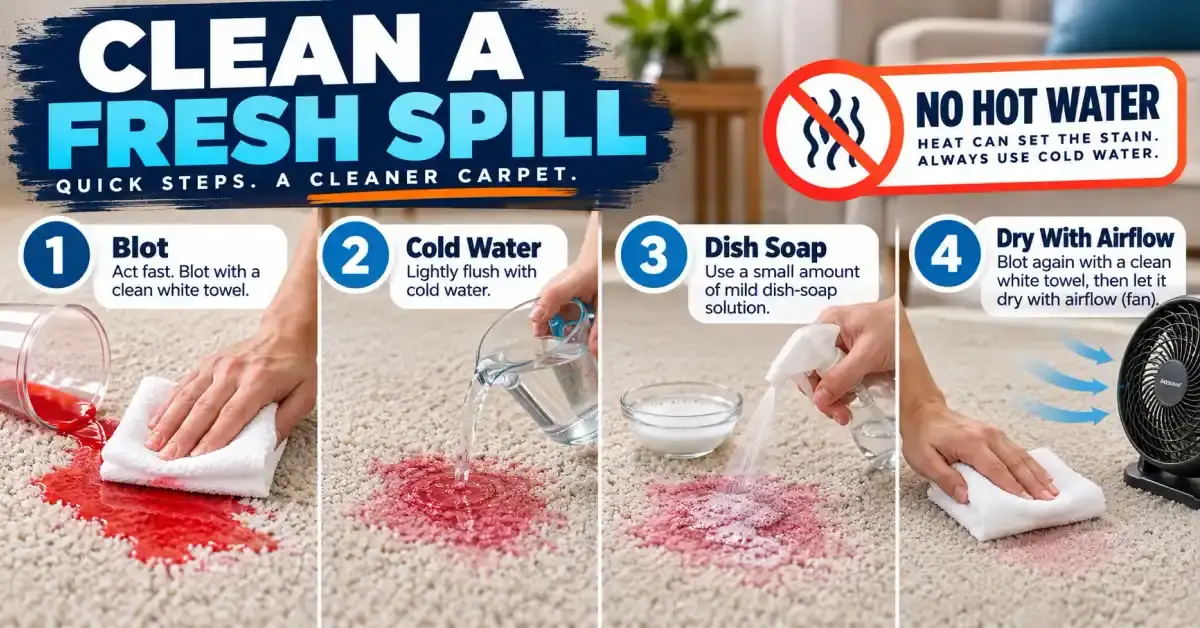
Blot up the spill immediately with white towels. Flush with cold water and blot again. Apply a solution of 1 cup warm water and half a teaspoon of dish soap, blot from the outside in, then rinse with cold water and dry with airflow. Never use hot water on Kool-Aid.
How Do You Remove Kool-Aid From Carpet?
Blot fast, flush with cold water, and work a dish soap solution through the stain before the dye sets. Speed decides most of the outcome.
Press white paper towels or a white cloth into the spill and soak up every drop you can. Work from the outside edge toward the center. Then pour a small amount of cold water on the spot and blot again to dilute what remains.
Mix half a teaspoon of clear dish soap into a cup of warm water. Dampen a white cloth, blot the stain, and rotate to a clean section as color transfers. If color remains, add half a cup of white vinegar to 2 cups of water and repeat the blotting cycle. Vinegar helps release the dye from the fiber.
Finish with a cold water rinse to pull out all soap, blot dry, and point a fan at the spot. Never scrub at any stage. Scrubbing spreads dye and frays the pile.
Why Does Kool-Aid Stain Carpet Worse Than Other Drinks?
Kool-Aid stains worse because its colorants are acid dyes, the same chemical class used to dye nylon carpet at the mill. Red 40 and Blue 1, the synthetic colorants listed on Kool-Aid packaging, bond to nylon fiber through the same dye sites the manufacturer used. A Kool-Aid spill is not sitting on your carpet. It is dyeing it.
This is why Kool-Aid outlasts coffee, soda, and most juices. Those stains are mostly surface soil and tannins. Kool-Aid is a chemical bond forming in real time, and heat or delay strengthens that bond.
Here is how common drink spills compare:
| Drink Type | Main Stain Problem | Difficulty | Key Risk |
|---|---|---|---|
| Kool-Aid | Synthetic acid dye | Very high | Dye bonds to nylon like mill dye |
| Red wine | Tannins and pigment | High | Wicking back overnight |
| Fruit punch | Dye plus sugar | Very high | Dye stain plus sticky residue |
| Coffee | Tannins | Moderate | Setting with heat |
| Soda | Sugar and mild color | Low | Resoiling from sugar residue |
Red is the hardest color of all. Red 40 is the most concentrated dye in the lineup and the one most attracted to nylon.
How Do You Get Red Punch Out of Carpet?
Red punch comes out with the same cold water, dish soap, and vinegar sequence, applied with more patience. Red punch and red Kool-Aid share the identical Red 40 dye problem, so the chemistry does not change. The workload does.
Anyone figuring out how to get red punch out of carpet should plan on multiple passes. Blot the fresh spill hard, flush with cold water, and run the dish soap cycle until color transfer stops. Then switch to the vinegar solution and keep blotting. Red dye releases in stages, and stopping after one round is the most common reason a pink shadow stays behind.
Always work from the outer edge inward. Red dye spreads easily, and pushing it outward turns a coin-sized spot into a saucer-sized one. A parent who caught a red punch spill at a birthday party and ran four blotting cycles in twenty minutes got the spot out fully. The same spill left until after the party usually leaves pink.
How Do You Get Fruit Punch Out of Carpet?
Fruit punch needs the dye treatment plus an extra rinse for sugar. Learning how to get fruit punch out of carpet means solving two problems at once. Punch drinks like Hawaiian Punch carry the same synthetic dyes as Kool-Aid, but they add heavy sugar and citric acid to the mix.
Follow the full method from the first section: blot, cold flush, dish soap cycle, vinegar cycle if needed. Then rinse the area with cold water one extra time, more than feels necessary. The dye is what you see. The sugar is what you miss, and it stays behind as an invisible sticky film unless the rinse is thorough.
Blot the rinse water out completely and dry with a fan. Damp sugar residue in warm carpet is also a magnet for ants and pests, one more reason the final rinse earns its time.
How Do You Get Old, Dried Kool-Aid Stains Out of Carpet?
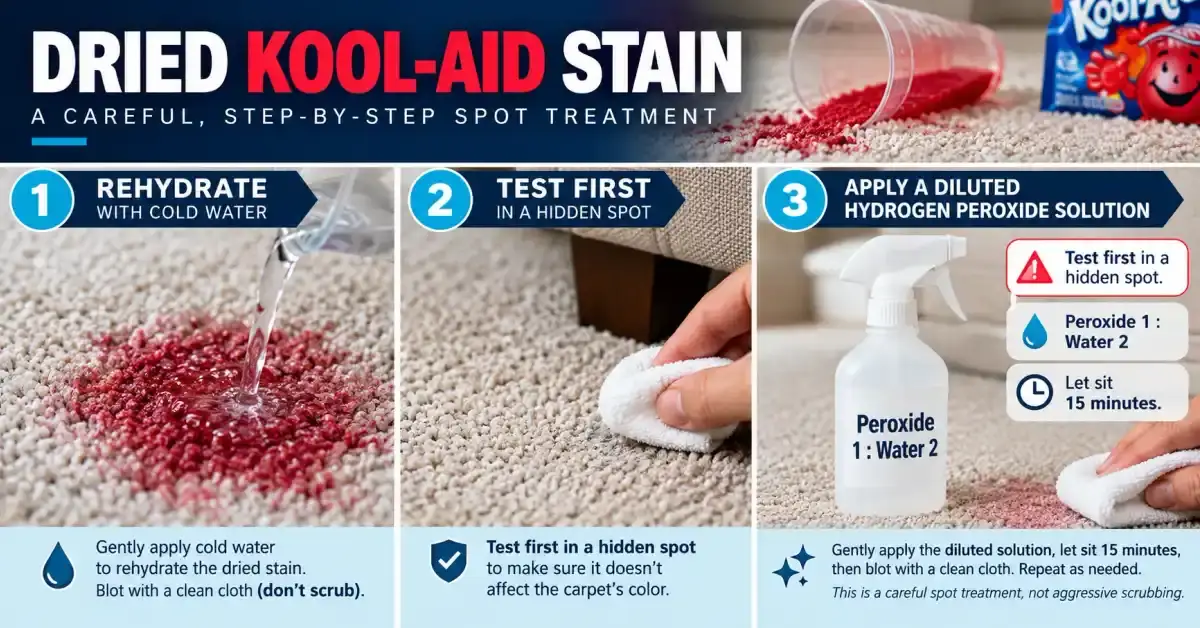
Dried Kool-Aid needs rehydration first, then a stronger oxidizer with a colorfast test. Once the dye has set, dish soap alone rarely moves it.
Dampen the stain with cold water and let it sit for ten minutes to soften the dried dye and sugar. Blot, then mix 1 part hydrogen peroxide with 2 parts water. Test this on a hidden spot of carpet first and wait fifteen minutes, because peroxide can lighten some carpet colors. If the test spot is safe, apply the solution to the stain, let it dwell fifteen minutes, and blot.
Repeat the peroxide cycle two or three times before judging results. Dwell time does more work than product strength. An enzyme cleaner is a reasonable alternative for punch stains with heavy sugar content, following the label's dwell instructions.
A homeowner who found a month-old purple stain under a couch cushion needed three peroxide sessions across two days, but the stain faded to invisible. Old does not always mean permanent. It means slower.
Why Does the Spot Turn Gray Weeks After the Stain Is Gone?
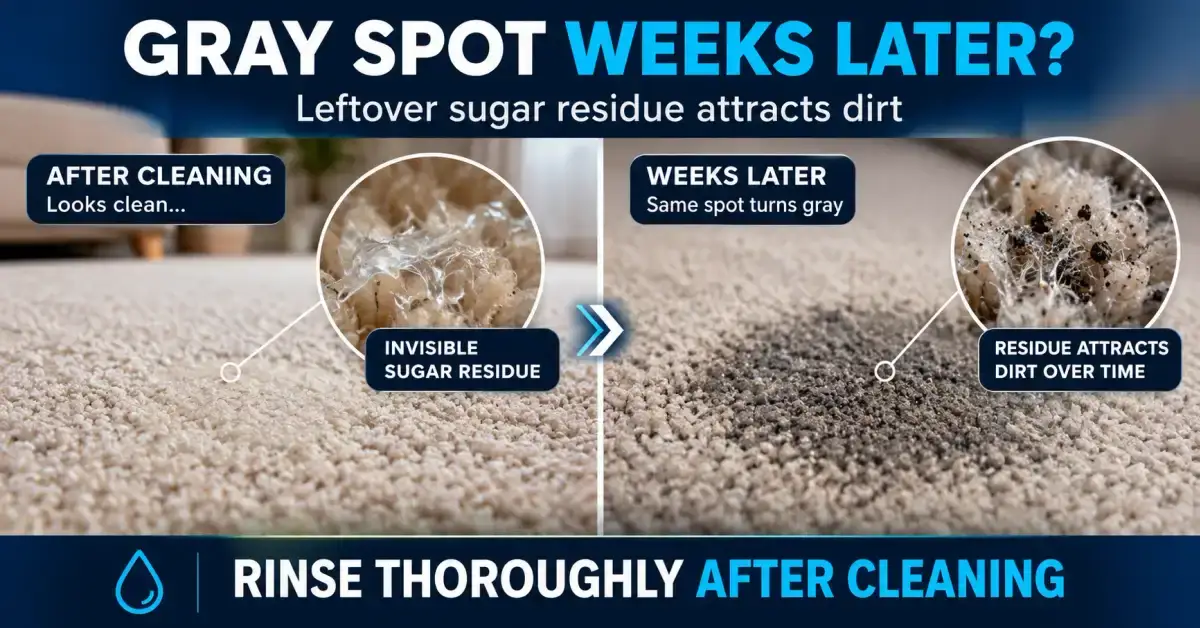
The gray patch is leftover sugar residue collecting dirt, not the stain returning. This catches homeowners constantly, and almost no cleaning guide explains it.
Kool-Aid and punch leave two things in carpet: dye you can see and sugar you cannot. If the cleaning stops when the color disappears, a sticky sugar film stays coated on the fibers. Every footstep after that presses household soil into the film, and within weeks the spot reappears as a dull gray shadow.
The fix is the step most people skip: a full cold water rinse and blot cycle after the stain looks gone. If a gray patch has already formed, treat it with the dish soap solution and rinse thoroughly. The soil lifts easily once the sticky layer dissolves.
Can Kool-Aid Stains Be Removed Completely, or Are Some Permanent?
Most fresh Kool-Aid stains come out completely, but old red dye on untreated nylon can leave a permanent tinge. An honest guide has to say so. University of Georgia Extension's carpet stain-removal testing on artificial fruit drink stains found that no method they tested totally removed artificial fruit drink stains from carpet, and a faint color trace may remain.
The outcome depends on three things:
| Factor | Better Outcome | Worse Outcome |
|---|---|---|
| Response time | Blotted within minutes | Left overnight or longer |
| Fiber type | Solution-dyed or stain-treated | Untreated nylon |
| Dye color | Blue, green, orange | Red 40 |
Solution-dyed carpet has color locked through the fiber and few open dye sites, so Kool-Aid has nowhere to bond. Untreated nylon accepts the dye readily.
When home methods stall, professionals have one tool homeowners do not: specialty dye-stain treatment using reducing agents and controlled heat transfer. It chemically breaks the dye bond instead of washing at it. A homeowner who fought a dried red stain for a week watched a technician remove it in one visit with a heat transfer spotting process. That chemistry is not safe for DIY use, which is exactly why it works.
What Mistakes Make a Kool-Aid Stain Worse?
Hot water is the biggest mistake, because heat sets acid dye. Carpet mills use heat to lock dye into nylon, and hot water on a Kool-Aid spill recreates that dye bath on your floor. Cold water only, at every step.
Scrubbing spreads the dye outward and pushes it deeper. Over-wetting drives dye and sugar into the padding, where no surface cleaning reaches. Colored towels can transfer their own dye into wet carpet and stack a second stain on the first.
The quieter mistakes are skipping the final rinse, which causes the gray patch problem, and using steam cleaners or irons on an untreated stain. The popular iron-and-towel trick applies direct heat to unbonded dye, and on a red stain it can set what it was supposed to lift.
Why Acting Fast on Kool-Aid Spills Actually Matters
Kool-Aid gives you a shorter window than almost any household spill. University of Georgia Extension testing concluded that artificial fruit drink stains are among the hardest carpet stains to fully remove, with even their best methods leaving traces once the dye sets.
The Carpet and Rug Institute advises blotting rather than rubbing and pretesting every cleaning agent in a hidden area, since over-wetting can also damage carpet backing. The IICRC classifies synthetic food dye among the most difficult carpet spot-removal categories, often requiring specialty dye-stain treatment by trained technicians when home methods fail.
Warranty terms raise the stakes further. Manufacturer stain warranties from brands like Shaw and Mohawk commonly limit or exclude synthetic food and beverage dyes such as Red 40, and improper treatment can put remaining coverage at risk. Minutes matter with this stain more than almost any other.
Common Questions About Kool-Aid Stain Removal, Answered
Does Kool-Aid stain carpet permanently?
+
It can, especially red Kool-Aid left to set on untreated nylon. Fresh spills treated within minutes usually come out completely. Speed and fiber type decide the outcome.
Does baking soda remove Kool-Aid stains?
+
No, baking soda cannot break a dye bond. It absorbs moisture and odor but leaves the color behind. Use the dish soap and vinegar method instead.
Is hydrogen peroxide safe for Kool-Aid stains on carpet?
+
Yes, diluted 1 part peroxide to 2 parts water, but only after a colorfast test in a hidden spot. Peroxide can lighten some carpet dyes. Wait fifteen minutes on the test area before treating the stain.
Does the iron and towel method really work on Kool-Aid stains?
+
It is risky, because heat can permanently set acid dye. It sometimes lifts moisture and partial color, but on red dye it can lock in what remains. Cold methods are safer and usually more effective.
How do you get blue or purple Kool-Aid out of carpet?
+
Use the same cold water, dish soap, and vinegar method. Blue 1 and purple blends generally release easier than Red 40. Expect fewer passes than a red stain needs.
How do you get Kool-Aid out of white or light carpet?
+
The standard method works, and peroxide is lower risk on white carpet since bleaching is less visible. Rinse thoroughly so no residue grays the spot later. Repeat gentle cycles rather than one aggressive attempt.
How do you get Kool-Aid smell out of carpet?
+
Rinse the sugar residue out with cold water, then mist the area lightly with a half vinegar, half water mix and blot. The sweet smell comes from leftover sugar, not the dye. Dry fully with airflow.
Will a carpet cleaning machine remove a Kool-Aid stain?
+
A machine helps extract moisture and residue but will not break the dye bond by itself. Treat the stain first, then use the machine with cold water to rinse and extract. Skip any heat setting.
How do you get Kool-Aid out of a car carpet or rug?
+
Use the same method with less liquid, since car carpet is glued down with no airflow underneath. Blot aggressively, apply solution sparingly, and dry with doors open or a fan. For rugs, clean from the front with towels underneath.
When should you call a professional for a Kool-Aid stain?
+
Call when a red stain survives two full treatment rounds, when the spill is old, or when the carpet is under warranty. Professional dye-stain treatment can break bonds that home products cannot. Waiting longer only lets the dye cure harder.
The one idea worth carrying away is that this stain is a dye job in progress, and everything about how to remove Kool-Aid from carpet flows from stopping that dye before it bonds. Cold water buys time, heat ends the game, and the final rinse protects the spot for months after the color is gone.
Need a carpet cleaning company you can trust? We handle residential and commercial carpet cleaning, rug cleaning, upholstery cleaning, and pet stain and odor removal —our team is ready to help.

Michael Sanders
Michael Sanders is a home care and cleaning industry writer covering carpet maintenance, flooring care, and household cleaning practices across the United States. His work focuses on practical, research-backed guidance — from stain and odor removal to deep extraction methods and indoor allergen prevention. Michael collaborates with cleaning professionals to ensure accuracy, and his writing reflects a genuine interest in helping homeowners make informed decisions about caring for their homes.

