

Blog · Pest Identification Guide
Brown Carpet Beetle: How to Identify It, Its Larvae, and Look-Alikes
You notice small brown bugs with a hard shell near the baseboard, or fuzzy brown "worms" crawling across the carpet. Your first question is simple: what are they, and are they a problem?
Published November 2, 202612 min read
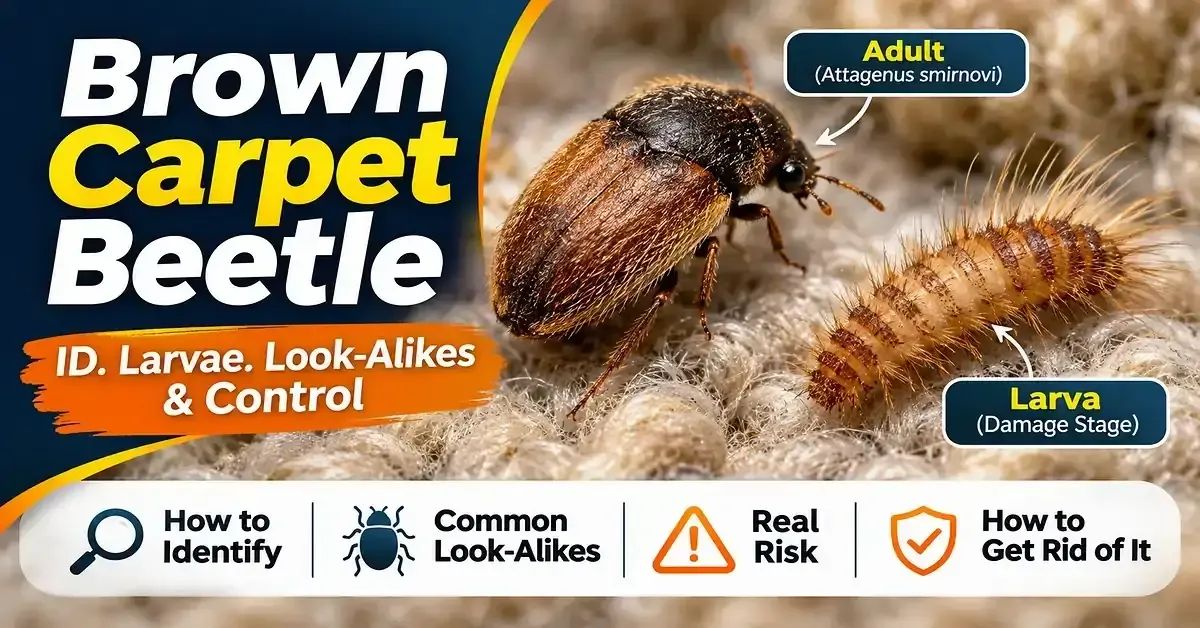
The brown carpet beetle is a real species, Attagenus smirnovi, but it is still rare in the United States. That means the bug in your home may be a close look-alike. The good news is that the same cleanup steps work for all carpet beetles. This guide shows you how to identify the adult beetle and brown carpet beetle larvae. You will also learn to tell them apart from common look-alikes, judge the real risk, and get rid of them.
What Is a Brown Carpet Beetle?
The brown carpet beetle (Attagenus smirnovi) is a small beetle in the Dermestidae family, a group often called skin beetles. In the United Kingdom, people also call it the vodka beetle, because its scientific name sounds like the Smirnoff brand. The name honors E. S. Smirnov, who first noticed the beetle in Moscow in 1961. Scientists formally described the species in 1973.
The beetle is native to Africa. Since the 1960s, it has spread through much of Europe. A 2019 report in Fragmenta Entomologica calls it a common pest of homes and museum collections in Central and Northern Europe. Its larvae feed on animal protein, such as wool, fur, feathers, skin, and hair. They also eat starchy foods like flour and cereals.
Key Takeaway: The brown carpet beetle is one species, Attagenus smirnovi. It is a small skin beetle whose larvae eat wool, fur, feathers, and some stored foods.
Is It Found in the United States?
In North America, the clearest record comes from Canada. Researchers confirmed adults and larvae in a Toronto apartment in 2016 and published the find in ZooKeys in 2019. They said finding both stages suggests the beetle is established there.
In the United States, the evidence is thin. GBIF, a global biodiversity database, lists only a handful of community-reported iNaturalist sightings from Michigan, New York, Alaska, and Utah between 2023 and 2026. Major US carpet beetle guides, such as UC IPM's, don't cover it. Based on these limited records, most "brown carpet beetles" in American homes are likely black, furniture, or varied carpet beetles. For a sure ID, take a sample to your county extension office.
Key Takeaway: This beetle is rare in the US so far, so confirm the ID, but use the same control steps either way.
What Does a Brown Carpet Beetle Look Like?
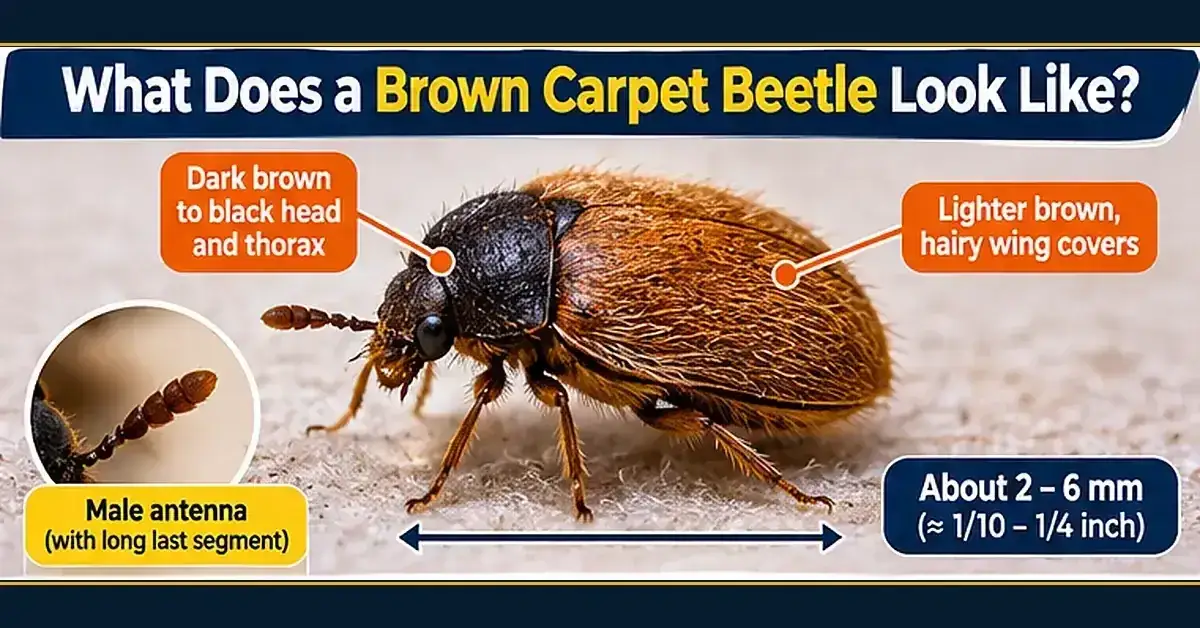
Adults are small and oval. Sources give slightly different sizes, from about 2 to 6 mm (roughly 1/10 to 1/4 inch). Wikipedia lists 2.3 to 4 mm, while the English Heritage fact sheet lists 4 to 6 mm. Females are usually larger than males.
The easiest clue is the two-tone, black and brown body. The head and the plate behind it are dark brown to black. The wing covers are lighter brown to yellow-brown and covered in short, dense hairs. Under a magnifier, males show a very long last segment on each antenna.
Adults can fly in warm weather, and they often gather at windows and lights. Compare that with the black carpet beetle, which UC IPM describes as shiny black or dark brown all over, with no two-tone look.
Brown Carpet Beetle Larvae: The Stage That Does the Damage
Most people see the larvae before they ever spot an adult. Nebraska Extension notes that carpet beetles often show up indoors as "fuzzy worms." They are not worms, though. Colorado State University Extension points out that carpet beetle larvae have three pairs of legs, which true worms lack.
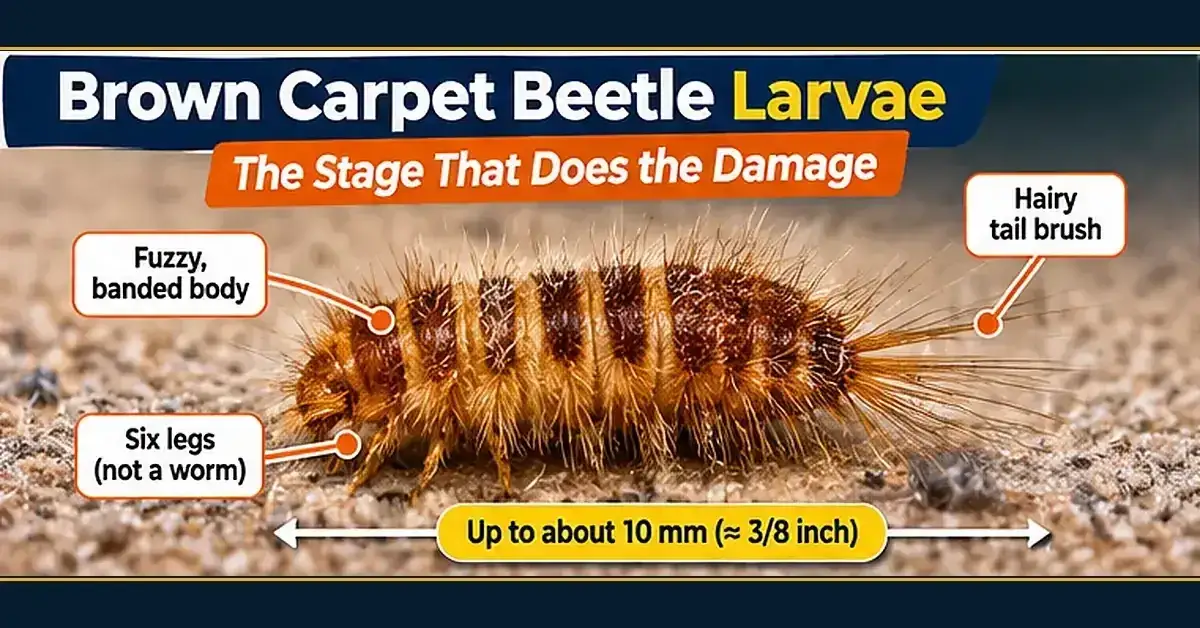
These larvae start out tiny, under 1 mm at hatching, and grow to about 10 mm (roughly 3/8 inch). They are torpedo-shaped, often curved, and narrow toward the rear. Their bodies look ginger-brown, with darker bands of hair and a brush of long hairs at the tail.
The larvae, not the adults, do the feeding. They hide in fluff, lint, and dirt in dark, quiet spots and chew on wool, fur, and feathers. As they grow, they shed striped skins, and those skins are often the first sign of a problem. English Heritage notes that these larvae are almost impossible to tell apart from two-spot carpet beetle larvae without expert help.
Key Takeaway: Brown carpet beetle larvae are fuzzy, banded, ginger-brown, and up to about 10 mm long. They have a hairy tail brush and six legs, so they are not worms.
Small Brown Bugs With a Hard Shell in Your Carpet: What Else Could They Be?
If you keep finding small brown bugs with a hard shell in your carpet, you are probably looking at one of three things. First, adult carpet beetles are small, oval, hard-shelled insects with dark brown or black bodies, according to University of Illinois Extension.
Second, many hard brown "shells" are not live bugs at all. UC IPM explains that carpet beetle larvae leave brown, shell-like, bristly skins when they molt. If the shell never moves, it is probably an empty skin.
Third, pantry pests such as drugstore and cigarette beetles are about 1/8 inch long, reddish-brown, and hard-shelled. They breed in dried food and often wander into nearby rooms.
Key Takeaway: Hard brown "bugs" in carpet are usually adult carpet beetles, empty larval skins, or pantry beetles that wandered away from dried food.
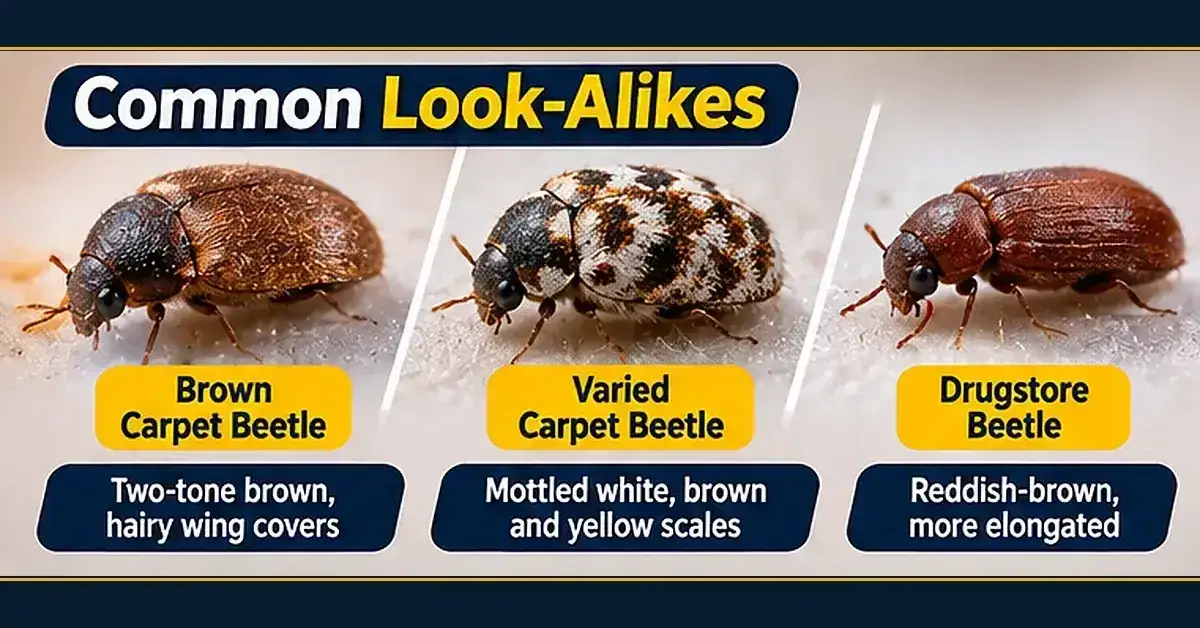
Seeing a carpet beetle brown in color doesn't confirm the species, so use this table to compare the most common look-alikes.
Brown Carpet Beetle Look-Alikes
| Bug | Size | Look | Where you find it | Bites? |
|---|---|---|---|---|
| Brown carpet beetle (adult) | About 2 to 6 mm | Dark head, light-brown hairy back | Wool, fluff, hidden corners | No |
| Black carpet beetle (adult) | 1/8 to 3/16 inch | Shiny black or dark brown all over | Windows, closets, carpet edges | No |
| Varied carpet beetle larvae | About 3/16 to 1/4 inch | Brown, banded, bristly | Under furniture, closets, carpet edges | No |
| Drugstore or cigarette beetle | About 1/8 inch | Reddish-brown, smooth, hard | Pantry, dried food | No |
| Bed bug | 5 to 7 mm, about apple-seed size | Flat, oval, brown to reddish-brown | Mattress seams, bed frames | Yes |
Sizes come from UC IPM, West Virginia University Extension, Iowa State Extension, and the EPA.
Are These Beetles Harmful?
Brown carpet beetles damage belongings, not people. The larvae chew wool rugs, fur, feathers, upholstery, and stored woolens, and this species also feeds on flour and cereals. They are not known to spread disease.
UC IPM says a few adult carpet beetles indoors are no cause for alarm. You need to act when larvae are breeding in fabrics or other materials. So if you are asking, "Should I worry about carpet beetles?", the answer depends on whether you find larvae and damage.
Do They Bite?
No. Carpet beetles do not bite people. The itchy bumps some people get come from the larvae's hairs.Penn State Extension reports that medical tests linked skin reactions to larval hairs from four carpet beetle groups. One of those groups is Attagenus, the genus this beetle belongs to.
A 2021 study in a CDC journal, on a related carpet beetle, found these rashes are easily mistaken for bed bug or flea bites. If a rash is severe or spreading, see a doctor.
Where They Come From and Where They Hide
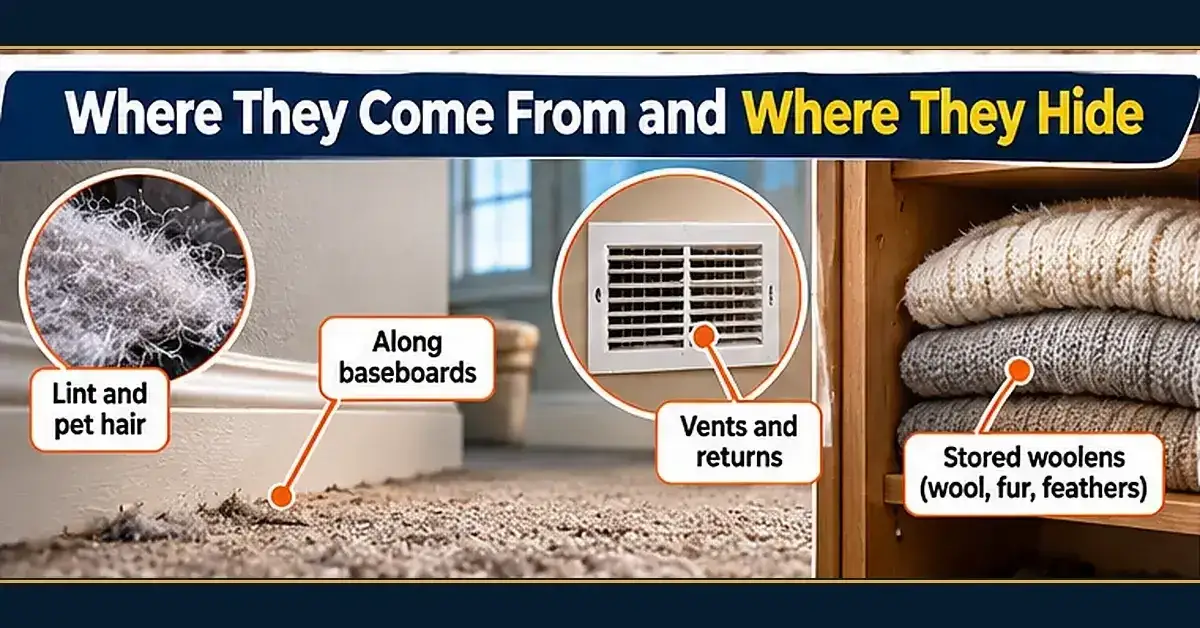
Adult carpet beetles fly in through open windows, doors, and vents, drawn by light. Larvae and eggs also ride in on secondhand rugs, woolens, and furniture. In Europe, records link brown carpet beetles to bird nests, including swift nests in a Polish attic and pigeon nests in London.
Inside, larvae hide where food collects and people rarely clean:
- Closets and stored woolens
- Under furniture and along carpet edges
- Behind baseboards
- Piles of pet hair and lint
This beetle prefers warm, heated buildings. English Heritage says it does not live outdoors in the UK. Colorado State Extension notes that common US carpet beetles show up most in late winter and early spring.
Heating Vents, Air Ducts, and Return Vents
Your heating and cooling system can quietly feed carpet beetles. University of Kentucky Extension says they thrive on lint, hair, and debris inside floor vents and ducts. UF/IFAS adds that regular cleaning won't remove dust from air-conditioning ducts, and debris in ventilation ducts can be a source of infestation. Rutgers notes that females lay eggs in hot-air furnace ducts and recommends checking both heat ducts and cold-air returns.
Remove vent covers, vacuum inside as far as you can reach, and change filters on schedule. If larvae keep coming back, consider professional duct cleaning.
Key Takeaway: Lint and pet hair inside vents and ducts can feed carpet beetle larvae, so check heat ducts and returns when larvae keep coming back.
How Long Does the Life Cycle Last?
This beetle goes through four stages: egg, larva, pupa, and adult. English Heritage says it usually completes one generation a year, and more than one in hot conditions.
Adults live about 20 days at most under good conditions, according to research cited in Fragmenta Entomologica. The larvae spend most of the year feeding. A study of library infestations found it prefers about 66 to 93°F and air below 55% humidity, which matches many heated homes year-round.
How to Get Rid of Brown Carpet Beetles
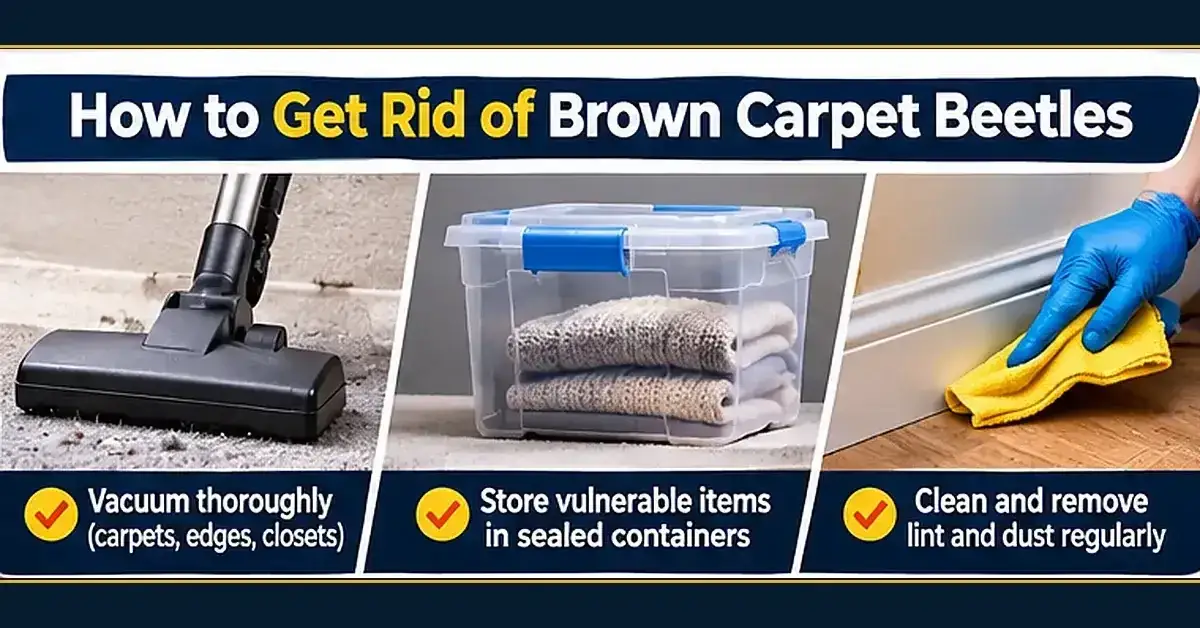
No US guide covers this species yet, but the proven carpet beetle methods from UC IPM and other extension services should work on it. Follow these steps in order:
- Find the source. Look for the most damaged item, piles of fluff, old nests, or dusty vents. Larvae wander, so damage in one room may start in another.
- Vacuum thoroughly. Clean carpet edges, under furniture, closets, and inside vents. Empty the bag or canister outside right away.
- Wash or dry-clean. Wash items in hot water or have them dry-cleaned. University of Kentucky Extension says dryer heat works too.
- Freeze what you can't wash. Seal items in a plastic bag and freeze them below 18°F for two weeks, as UC IPM advises. The shorter times listed on some websites may not kill every stage.
- Use heat carefully. Heat items to 120°F or higher for at least 30 minutes, but only if the material can take it.
- Store woolens clean and sealed. Use airtight containers, since UC IPM says cedar is unreliable.
- Watch for new adults. Place sticky traps on windowsills and check them every week.
- Use insecticides last. Choose products labeled for carpet beetles. Apply them only to edges, cracks, and closet floors, never to clothing or bedding.
Key Takeaway: Find and remove the source first, then vacuum, wash, freeze, or heat infested items, and use labeled insecticides only as a last step.
When to Call a Professional
Call a licensed pest control company if larvae keep returning after two or three thorough cleanups. A professional also makes sense when you can't find the source, such as an attic nest or debris inside walls or ducts. Valuable rugs, furs, and heirlooms are worth that extra protection.
Frequently Asked Questions
Do brown carpet beetles fly?
+
Yes. Adults fly in warm weather and head toward lights, so you often find them on windowsills.
Is my house dirty if I have carpet beetles?
+
No. Nebraska Extension says even the cleanest homes can have a few. A North Carolina State University study found carpet beetles in all 50 homes it sampled, though it covered only one region. Lint and pet hair still feed larvae, so regular cleaning helps.
Is it okay to sleep in a room with carpet beetles?
+
Yes. Carpet beetles don't bite. If larval hairs bother your skin, wash your bedding in hot water and vacuum the room and nearby closets.
Will carpet beetles go away on their own?
+
Not usually. As long as food is available, larvae can keep feeding for months, so removing the source matters most.
What kills carpet beetles fast?
+
Heat, freezing, hot washing, and vacuuming work fastest on the items you treat. Iowa State Extension notes that insecticides can help but are not a quick fix.
Why do I keep finding carpet beetle larvae in my bed?
+
Larvae wander away from their food. Wash your bedding hot, then check nearby closets, rugs, and vents for the real source.
Final Thoughts on the Brown Carpet Beetle
The brown carpet beetle is real but still rare in the US, so the bug in your home may be a close relative. Look for the two-tone adult or the banded, tail-tufted larva, and rule out empty skins and pantry beetles. Act when you find larvae, and check your vents. For a sure ID, bring a sample to your county extension office.
Need a carpet cleaning company you can trust? We handle residential and commercial carpet cleaning, rug cleaning, upholstery cleaning, and pet stain and odor removal —our team is ready to help.

Michael Sanders
Michael Sanders is a home care and cleaning industry writer covering carpet maintenance, flooring care, and household cleaning practices across the United States. His work focuses on practical, research-backed guidance — from stain and odor removal to deep extraction methods and indoor allergen prevention. Michael collaborates with cleaning professionals to ensure accuracy, and his writing reflects a genuine interest in helping homeowners make informed decisions about caring for their homes.