

Blog · Pest Identification Guide
Carpet Beetle Larvae: What They Look Like, Where They Nest, and the UK Difference
You found a small, bristly larva crawling along a windowsill, or you pulled a sweater from a drawer and discovered a hollow, hairy shell you can't identify. Both are classic signs of carpet beetle larvae.
Published November 1, 202610 min read
Adult carpet beetles don't harm fabric at all; it's the larvae that chew through wool, fur, feathers, and other natural fibers while hiding in dark, undisturbed spots. This guide walks through what they look like at every stage, where they nest and breed, how UK species differ from those found in the US, how to tell them apart from bed bugs and clothes moths, and whether they pose any real danger to people or pets.
What Are Carpet Beetle Larvae?
Carpet beetle larvae are the immature, wingless stage of small beetles in the family Dermestidae, often called skin or hide beetles because they feed on materials that come from animals. In the United States, three species cause nearly all home infestations: the varied carpet beetle, the furniture carpet beetle, and the black carpet beetle. The varied carpet beetle is the most widespread of the three and the one homeowners run into most often.
Adult carpet beetles are harmless to fabric. They live outdoors for most of their short lives, feeding on pollen and nectar, and only end up inside while searching for a place to lay eggs or by flying in through an open window. The larvae are a different story. They hatch indoors or arrive on infested items, then spend months or years feeding on wool, fur, feathers, and similar materials before becoming adults themselves.
What Do Carpet Beetle Larvae Look Like?
They look nothing like the adult beetles they'll become. Here's how to recognize them at each stage.
Larvae by Species
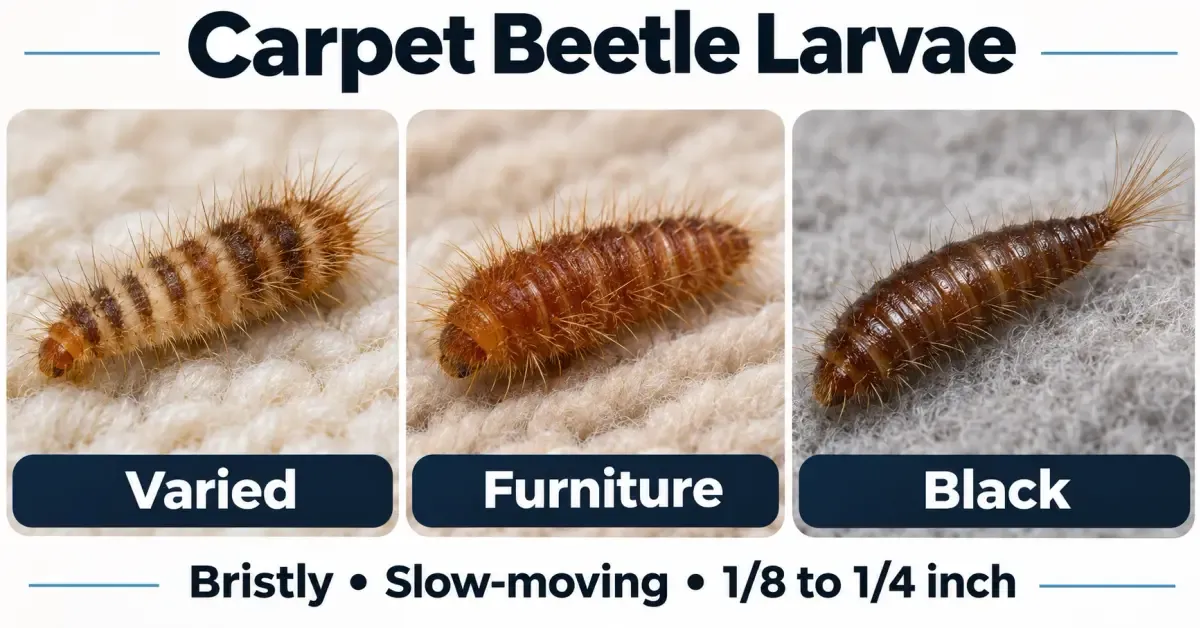
The varied carpet beetle larva is covered in dense, bristly hairs arranged in alternating light and dark brown bands, giving it a striped, fuzzy look. It's broader toward the rear than the front. The furniture carpet beetle larva starts out nearly white and darkens to a reddish or chestnut brown as it matures, and it's shaped the opposite way, broader at the front. The black carpet beetle larva looks the most distinct: shiny, smooth, and carrot-shaped, tapering toward a tail tuft of noticeably longer hairs, and generally growing larger than the other two. All three share the same basic habit. They move slowly, avoid light, and curl up tightly when disturbed or touched.
Size and Color
Most measure about 1/8 to 1/4 inch long, roughly the size of a grain of rice, though a newly hatched larva can be smaller than a millimeter. Black carpet beetle larvae grow larger than the other species, often reaching close to 1/2 inch by the time they're fully grown. Color depends on species and age: expect shades of tan, brown, reddish-brown, or near-black, frequently patterned with lighter and darker bands rather than a single solid color. Because color and size shift as a larva matures, a single photo rarely tells the whole story, and the bristly, hairy texture is usually the most reliable identifying feature.
Shed Skins and Pupal Casings: What That Empty Shell Is
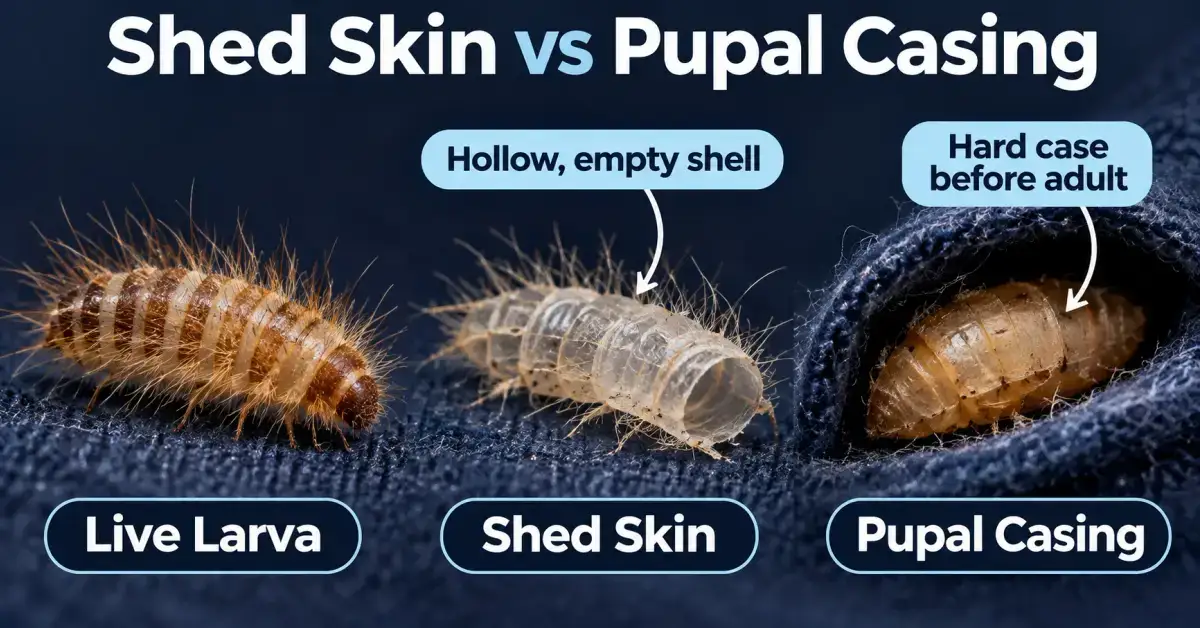
If you've found a hollow, hairy husk that looks like a larva but doesn't move, you're likely looking at a shed skin rather than a live pest. Larvae molt repeatedly as they grow, roughly five to twelve times depending on species and conditions, and each molt leaves behind an empty, translucent casing that can look startlingly like the real thing. One well-documented study of varied carpet beetles recorded sixteen separate larval instars before pupation, showing how widely the molt count can vary. Right before becoming an adult, a larva forms a hard, light brown pupal case in a hidden spot, where it stays for one to three weeks while it transforms.
Key Takeaway: Carpet beetle larvae vary by species in color and shape, but all are small, bristly, and slow-moving, typically 1/8 to 1/4 inch long. An empty, hollow shell is usually a shed skin or pupal casing, not a live threat.
Life Cycle of a Carpet Beetle Larva
Like all beetles, they go through complete metamorphosis: egg, larva, pupa, then adult. A female lays her eggs in batches near a food source, tucking them into cracks, fabric folds, or debris. Egg counts vary by species: a university extension study puts it at about 40 eggs for the varied carpet beetle, 60 for the furniture carpet beetle, and 90 for the black carpet beetle. Eggs typically hatch within one to five weeks depending on temperature.
The larval stage is by far the longest part of the cycle and the only one that causes damage. Duration again depends heavily on species: the same extension research found varied carpet beetle larvae feeding for 220 to 630 days, furniture carpet beetle larvae for just 70 to 94 days, and black carpet beetle larvae for 166 to 330 days. Once full grown, a larva pupates for roughly one to three weeks before emerging as an adult, which then lives only a few weeks, just long enough to mate and start the cycle again.
Key Takeaway: From egg to adult, the life cycle can take anywhere from several months to nearly two years, depending on the species. The larval stage lasts the longest by far and is the only one responsible for fabric damage.
Where Do Carpet Beetle Larvae Nest?
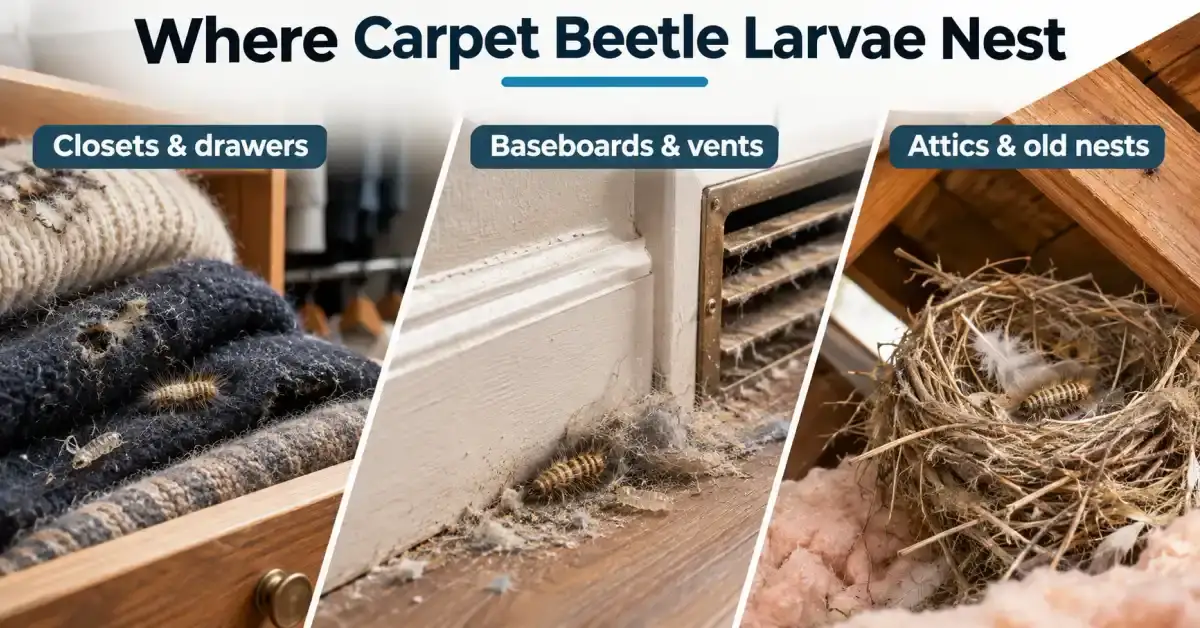
They rarely build an obvious nest the way some insects do. Instead, they settle wherever food, darkness, and shelter overlap, which is exactly why an infestation can be hard to pin down. The most common breeding grounds inside a home include closets, drawer backs, baseboards, air ducts and vents, under rugs and heavy furniture, and inside upholstery that hasn't been disturbed in a while.
A less obvious but genuinely important source sits outside the living space entirely. Bird nests, such as those built by sparrows, swifts, or pigeons, along with wasp nests, are natural habitats where the larvae develop on feathers, hair, and other debris. When these nests sit in an attic, chimney, eave, or wall void, larvae can breed there for a long time before ever wandering into a room, and a few will keep finding their way inside even after a visible infestation seems to be cleared. This is the main reason a home can have a repeat problem despite thorough indoor cleaning: the real source was never in the living space to begin with. Checking attics, eaves, and gutters for old nests is worth doing if they keep reappearing.
Carpet Beetle Larvae in the UK
They're just as common a household problem in the United Kingdom as in the United States, though the species mix differs slightly. The varied carpet beetle is the dominant species in UK homes too, long established and found throughout England and Wales. The two-spot carpet beetle is also found in the UK, especially in the southern half, while a third species, sometimes called the brown or vodka beetle, is a more recent and far less common arrival, reported mainly in and around London.
One notable difference: the black carpet beetle, common across the US, has not been confirmed as an established species in the UK. The Natural History Museum and English Heritage, which both publish pest-identification guidance for homes and historic collections, describe UK infestations in terms of the varied and two-spot species rather than the black carpet beetle. UK records show the larval stage can stretch up to three years in some cases, which lines up with the longer end of the ranges reported in the United States.
Carpet Beetle Larvae vs. Bed Bugs and Clothes Moths
They get confused with two other pests more than anything else. Here's how to tell them apart.
Larvae vs. Bed Bug Nymphs
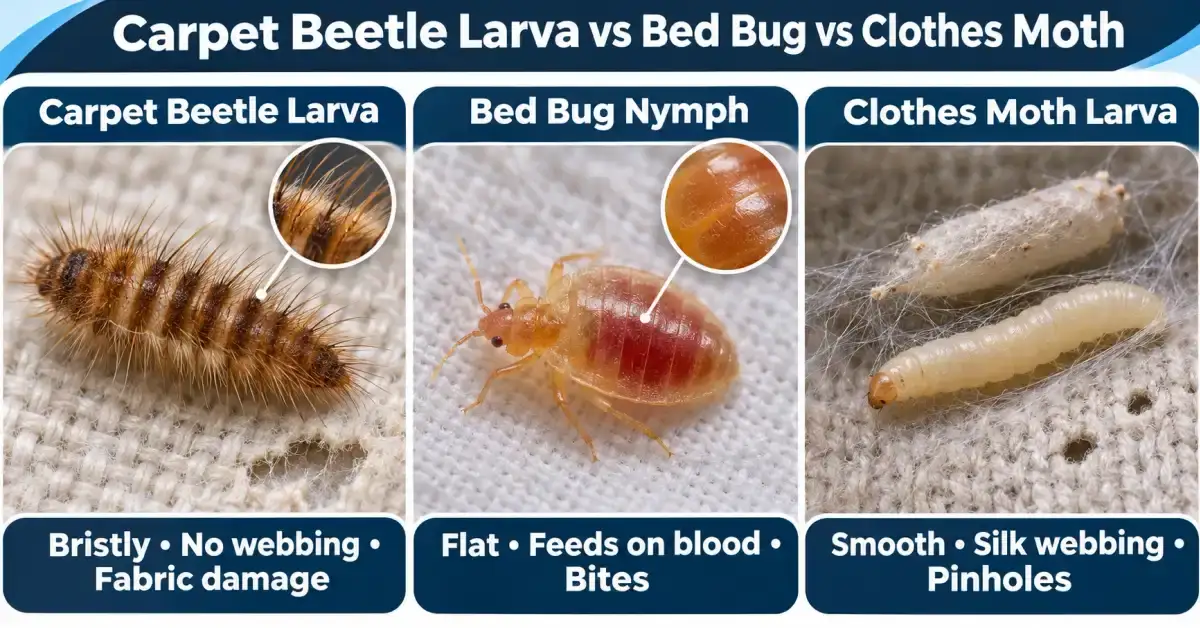
Bed bug nymphs and carpet beetle larvae both show up in bedrooms, but they look and behave nothing alike once you know what to check. Bed bug nymphs are flat, oval, and pale to reddish depending on how recently they fed, with a smooth, shiny body and no hair at all. Carpet beetle larvae are rounder, bristly, and covered in visible hairs, and they never develop the flattened, blood-fed look of a bed bug. The clearest difference is diet and evidence. Bed bugs feed on blood and leave true bite marks, usually in a line or cluster on exposed skin, along with dark fecal spotting on sheets. The larvae don't bite at all; instead, they leave shed skins and small holes in fabric, with no blood and no biting pattern anywhere on the body.
Larvae vs. Clothes Moth Larvae
Clothes moth larvae and carpet beetle larvae both eat natural fibers, which is why the damage gets mixed up constantly. The giveaway is webbing. Clothes moth larvae are smooth, cream-colored, and hairless, and they spin silk threads or small tube-like cases as they feed, leaving a webby residue behind. Carpet beetle larvae never spin silk or webbing of any kind. They're visibly hairy instead of smooth, and the damage they leave tends to concentrate in one larger area of a garment or carpet, while clothes moth damage usually looks like scattered pinholes spread across the surface.
Key Takeaway: Bed bugs are flat, feed on blood, and leave true bite marks in a line, while clothes moth larvae spin silk webbing that carpet beetle larvae never produce. Of the three, only carpet beetle larvae are visibly bristly and leave concentrated fabric damage with shed skins instead of webbing or bites.
Are Carpet Beetle Larvae Dangerous?
For the most part, they're a threat to belongings rather than to health. They don't spread disease, and the real-world risk is damage to clothing, rugs, and upholstery. The main source of worry is a skin reaction some people get from handling or brushing against the larvae's hairs.
Do They Bite?
Carpet beetle larvae do not bite. Neither the larvae nor the adults have mouthparts built to pierce skin, so there's no mechanism for an actual bite. What people experience instead is an allergic reaction to the larvae's barbed hairs, which can lodge in skin and cause an itchy rash that looks a lot like a cluster of bites. This reaction is documented in medical literature. A 2021 case cluster published in the CDC's Emerging Infectious Diseases journal described eleven patients across seven families in France who developed this exact rash after contact with the larvae. All of them recovered within days using ordinary antihistamines and topical treatment.
Are They Harmful to Pets?
They aren't considered directly harmful to dogs or cats. They don't bite pets and aren't known to spread disease to them. The same barbed hairs that irritate human skin can occasionally cause mild skin or stomach upset in a pet that rolls on or swallows larvae, though this is uncommon. Regular vacuuming of floors, closets, and pet bedding lowers the odds of a pet encountering them in the first place.
Key Takeaway: Carpet beetle larvae can't bite humans or pets because they lack the mouthparts to do it. The itchy rash some people get, known as carpet beetle dermatitis, comes from an allergic reaction to the hairs and has been documented in a verified 2021 CDC case study.
Signs You Have an Infestation
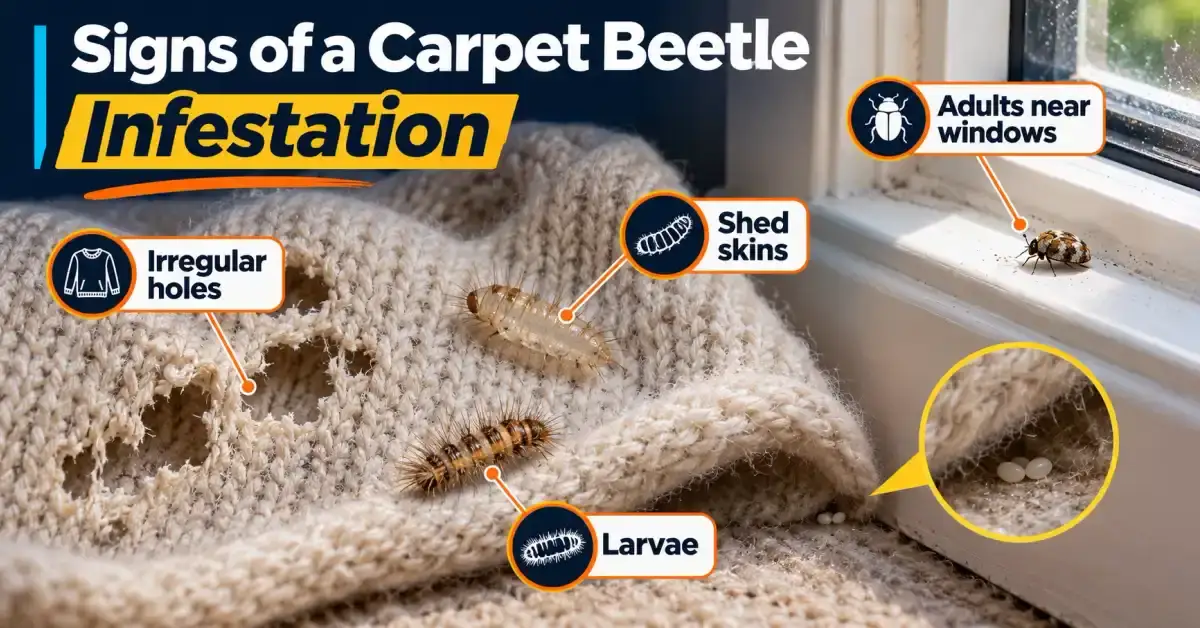
An infestation is usually easier to spot through its evidence than through the larvae themselves, since they avoid light and stay hidden. Watch for:
- Irregular holes concentrated in one area of a wool, fur, or silk item, rather than scattered across it
- Shed skins or pupal casings, which look like small, pale, hollow larvae left in closets, baseboards, or under furniture
- Tiny fecal pellets near damaged items, about the size of a grain of sand
- Live larvae crawling slowly along baseboards, window frames, or rug edges
- Dead adult beetles collecting near windowsills, which hints that larvae may be developing somewhere nearby
Finding more than one of these signs is a good reason to check closets, vents, and storage areas more closely.
How to Get Rid of Them
Getting rid of carpet beetle larvae starts with cleaning, not chemicals.
- Vacuum thoroughly and often, focusing on carpet edges, baseboards, closets, vents, and under furniture, then empty the canister or bag right away so eggs and larvae don't end up back in the room
- Launder infested clothing, linens, and other washable items in hot water, at least 120°F, or dry-clean anything that can't be washed
- Freeze delicate items that can't be washed in sealed bags for at least two weeks to kill all life stages
- Seal cracks and gaps around windows, doors, and vents where adult beetles might be getting in
- Store out-of-season wool, fur, and silk items in sealed, airtight containers instead of open shelves or cardboard boxes
- Check attics, eaves, and gutters for old bird or wasp nests, since these are a common hidden source
Insecticides are rarely necessary if these steps are done thoroughly. If larvae keep reappearing despite repeated cleaning, the source is likely in a wall void, attic, or old nest that needs a closer look, and a pest control professional can help locate it.
Carpet Beetle Larvae FAQs
Do carpet beetle larvae bite?
+
No. They lack the mouthparts needed to bite. The itchy rash some people get comes from an allergic reaction to the larvae's hairs, not an actual bite.
How long do carpet beetle larvae live?
+
The larval stage itself can last anywhere from about ten weeks to well over a year, depending on the species. Adding the egg, pupal, and adult stages, the full life cycle commonly runs from several months to close to two years.
Are carpet beetle larvae in the UK different from the US?
+
The species overlap but aren't identical. The varied carpet beetle is common in both countries, and the UK also sees the two-spot carpet beetle, while the black carpet beetle, common in the US, hasn't been confirmed as established in the UK.
How do you find the nest or source of an infestation?
+
Start indoors with closets, baseboards, vents, and rug edges, then check outdoors for bird or wasp nests in attics, eaves, or gutters, since these are a common and easily overlooked breeding source.
Are carpet beetle larvae harmful to pets?
+
Not directly. They don't bite pets or spread disease, though the hairs can occasionally cause mild irritation if a pet rolls on or swallows larvae.
Does finding carpet beetle larvae mean my house is dirty?
+
No. Adult beetles fly in from outside or arrive on cut flowers, secondhand furniture, or old nests regardless of how clean a home is.
Can carpet beetle larvae live in your bed or mattress?
+
It's uncommon compared to closets or rugs, but possible if bedding contains natural materials like down or wool and goes undisturbed for a long time.
Can carpet beetle larvae fly?
+
No. Only the adult beetles can fly. Larvae only crawl, and slowly at that.
Final Thoughts
Carpet beetle larvae can look alarming the first time you spot one, especially if you've mistaken a shed skin for a live pest or worried about a bite that never actually happened. In reality, they're a fabric problem more than a health problem, and most infestations clear up with thorough vacuuming, laundering, and checking a few hidden breeding spots like attics or old nests. Pay attention early, mainly to shed skins and small holes in natural-fiber items, and you can usually catch an infestation long before it spreads to anything irreplaceable.
Need a carpet cleaning company you can trust? We handle residential and commercial carpet cleaning, rug cleaning, upholstery cleaning, and pet stain and odor removal —our team is ready to help.

Michael Sanders
Michael Sanders is a home care and cleaning industry writer covering carpet maintenance, flooring care, and household cleaning practices across the United States. His work focuses on practical, research-backed guidance — from stain and odor removal to deep extraction methods and indoor allergen prevention. Michael collaborates with cleaning professionals to ensure accuracy, and his writing reflects a genuine interest in helping homeowners make informed decisions about caring for their homes.