

Blog · Buying Guide
How Long Does Carpet Last? Lifespan by Fiber and Signs
How long does carpet last is one of the most searched flooring questions homeowners ask, and the standard answer of 5 to 15 years is so wide it tells you almost nothing useful. That range covers cheap olefin in a busy hallway lasting 5 years and quality wool in a formal room lasting 25. The difference is predictable.
Published October 19, 202611 min read

This article gives fiber-specific lifespan numbers, the signs that tell you replacement is unavoidable, the replace versus clean decision framework, and the padding angle nobody else covers.
Carpet lifespan ranges from 5 years for budget fiber in high-traffic areas to 25 or more years for quality wool in low-traffic rooms. Fiber type, traffic level, padding quality, and maintenance frequency are the four variables that determine where your carpet lands in that range.
How Long Does Carpet Last by Fiber Type?
Fiber type is the single most predictive variable in carpet lifespan. The 5 to 15 year range collapses into specific numbers once fiber is known.
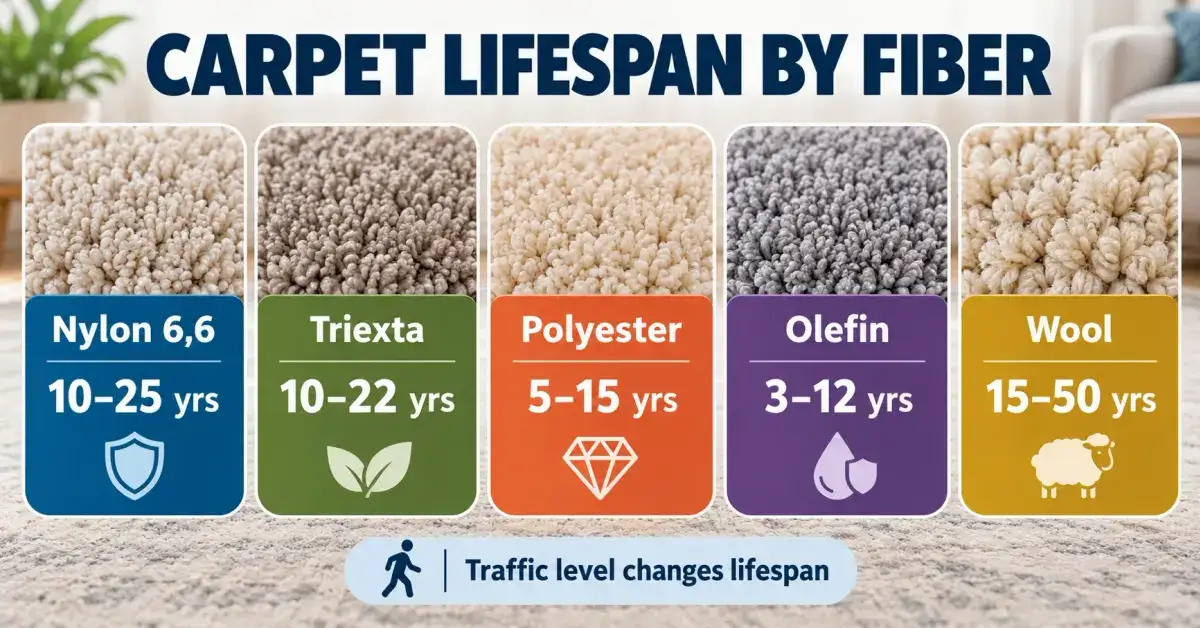
Carpet Lifespan by Fiber and Traffic Level
| Fiber | Low Traffic | Moderate Traffic | High Traffic |
|---|---|---|---|
| Nylon 6,6 | 20 to 25 years | 15 to 20 years | 10 to 15 years |
| Triexta (PTT) | 18 to 22 years | 15 to 18 years | 10 to 15 years |
| Polyester (PET) | 12 to 15 years | 10 to 12 years | 5 to 8 years |
| Olefin (Polypropylene) | 8 to 12 years | 5 to 8 years | 3 to 5 years |
| Wool | 25 to 50 years | 20 to 30 years | 15 to 20 years |
Two households can have the same size bedroom and replace carpet at completely different intervals based on fiber choice alone. A household that chose entry-level polyester in a master bedroom with two adults and a dog will likely replace it at the 8 to 10 year mark. The same household with quality nylon 6,6 in the same room, same traffic, same cleaning habits, would reasonably expect 18 to 20 years before replacement.
Wool outlasts every synthetic fiber at every traffic level but costs significantly more per square foot. For high-traffic installations where longevity matters most, nylon 6,6 delivers the best balance of lifespan and cost. For low-traffic bedrooms, triexta or polyester deliver adequate longevity at lower cost.
Carpet padding quality affects lifespan nearly as much as fiber choice. A quality fiber installed over inadequate padding wears out faster than a moderate fiber installed over proper dense padding, because the padding absorbs the subfloor stress that would otherwise transfer directly to fiber roots.
What Actually Shortens Carpet Life the Most?
Three factors shorten carpet life faster than any other variables, and none of them are obvious from the surface.
Embedded Grit Abrasion
Grit particles tracked in from outside work their way down through carpet pile to the fiber base. Every footstep after that grinds those particles against the fiber root where it anchors to the backing. This abrasion is invisible from above but cuts fiber integrity at its weakest point. By the time the carpet shows surface wear, the grit damage at the base may have been accumulating for years. The IICRC identifies infrequent vacuuming as the leading cause of premature carpet fiber failure for this exact reason.
Moisture and Humidity
Carpet in rooms where humidity consistently exceeds 50% faces accelerated breakdown from mold growth in the backing and padding. Mold degrades both the carpet fiber adhesive and the padding material, and the damage is irreversible once established. According to the EPA, mold growth in carpet and padding creates indoor air quality problems that surface cleaning cannot address, making replacement the only real solution once mold is established.
Inadequate Padding
Padding that is too thin, too soft, or the wrong density for the carpet type transfers subfloor movement directly to fiber roots with every step. This mechanical stress accelerates crushing and fiber base separation years before the carpet surface shows visible damage. A homeowner who replaced carpet twice in 8 years discovered on the second replacement that both failures started with inadequate padding compressing and failing early. The third installation with correct density padding is still performing at year 6.
What Are the Real Signs Carpet Needs to Be Replaced?
Most replacement sign lists identify symptoms. Understanding the mechanism behind each sign tells you whether the damage is recoverable or permanent.
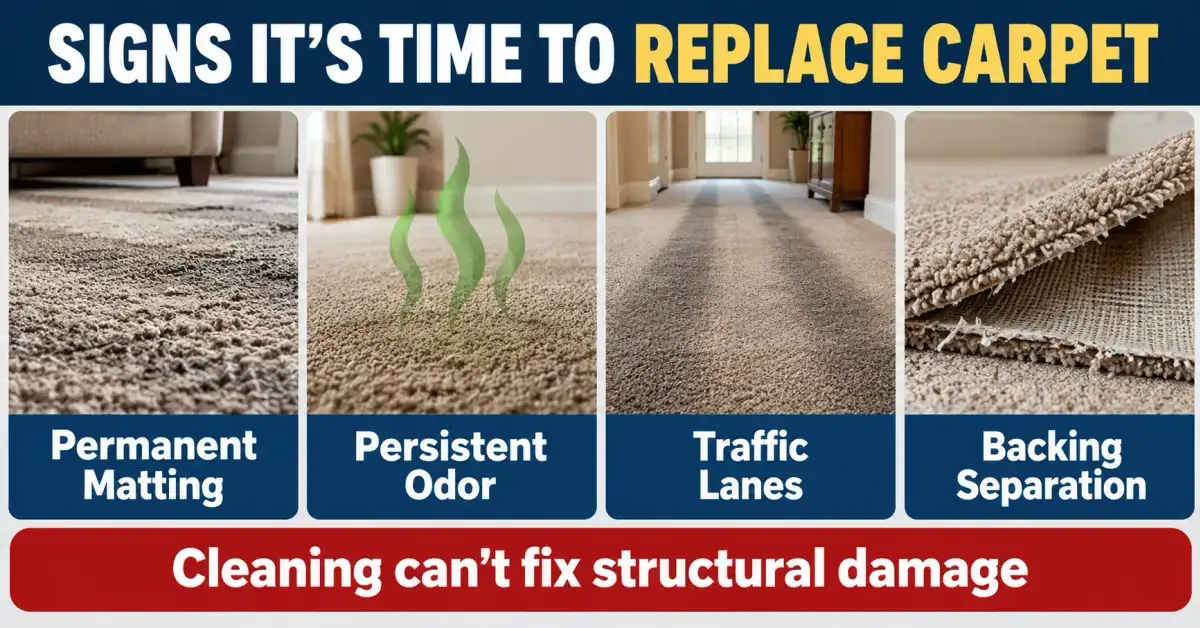
Matting That Does Not Recover
When carpet pile does not spring back after compression, the fiber twist has permanently unwound. Heat-set fiber holds its twist under traffic for years. When that twist releases permanently, no cleaning or grooming recovers it. Press your palm flat into the carpet, hold for 10 seconds, and release. If the pile stays flat, the fiber has reached the end of its structural integrity.
Persistent Odor After Professional Cleaning
Surface odor from spills responds to professional hot water extraction. Odor that returns within days of professional cleaning means contamination has penetrated to the backing or padding where extraction cannot reach. Pet urine, mold growth, and long-term moisture saturation all create this pattern. The odor source is no longer in the fiber, it is below it.
Visible Traffic Lanes With No Recovery
Permanent traffic lanes show where face weight has been mechanically depleted past the point of recovery. The fiber in these zones has lost so much material through abrasion and crushing that the original surface no longer exists. A professional cleaning may temporarily improve the appearance but the structural depletion is permanent.
Backing Separation or Delamination
When primary and secondary carpet backing separate, the carpet loses dimensional stability. It buckles, ripples, and shifts under foot traffic. Delamination is a structural failure with no repair solution that returns the carpet to full function.
When to replace carpet is a clear decision when any of these four conditions exist. Cleaning addresses soil and surface contamination. It does not address structural fiber failure, delamination, or sub-surface contamination.
When Should You Clean Carpet Instead of Replace It?
This is the decision most homeowners get wrong because they either replace prematurely or clean long after replacement is the only real solution.
Clean if the fiber is structurally intact and the issue is soil, surface staining, or odor from recent contamination. Professional hot water extraction reaches deep into the pile, removes embedded soil, and addresses odor from surface-level contamination effectively. Carpet that mats during cleaning and springs back when dry still has viable fiber. Carpet that shows uniform color improvement after cleaning still has useful life.
Replace if any of these conditions exist: permanent matting that does not recover, backing delamination, padding saturation from pet urine or water damage, mold in the backing or padding, or face weight depleted to the point where traffic lanes are structurally permanent. No cleaning method addresses structural fiber failure or sub-surface contamination that has reached the padding.
The practical test: if a professional cleaning delivers a meaningful improvement that lasts at least 6 months before the carpet looks poor again, the carpet has remaining life worth extending. If cleaning produces minimal improvement or the carpet returns to poor appearance within weeks, replacement is the right call regardless of the carpet's age.
Carpet cleaning every 12 to 18 months, according to IICRC standards, is the maintenance practice most likely to keep structurally sound carpet in the clean category rather than pushing it toward premature replacement.
How Long Does Carpet Padding Last and What Happens When It Fails?
Carpet padding lifespan is the most overlooked variable in carpet longevity and the least covered topic in any competitor content on this subject.
According to the World Floor Covering Association, proper padding under carpet extends carpet life by up to 50%, with quality padding typically lasting 25 years under normal residential use when correct density and thickness are matched to the carpet type. This means padding, when properly specified, outlasts the carpet above it. The problem is when padding is incorrectly specified or is low quality.
Low-density padding compresses permanently under foot traffic, usually within 3 to 5 years in moderate-traffic areas. Once padding loses its resilience, it no longer absorbs the subfloor stress of every footstep. That stress transfers directly to the fiber root with each step, accelerating crushing and matting above the surface level where you can see it.
How to test padding without pulling up carpet: press firmly into the carpet with your knee in a high-traffic area and then in a low-traffic area. If the high-traffic area feels noticeably harder with less give, the padding beneath it has compressed and is no longer providing meaningful cushioning or stress absorption.
Padding that has been saturated by pet urine or water damage cannot be restored by drying or cleaning. Saturated padding retains odor and moisture that feeds mold growth and re-contaminates the carpet above it regardless of how many times the surface is cleaned. In these cases, padding replacement is required alongside or instead of full carpet replacement depending on the extent of fiber damage above.
What Carpet Lifespan Data Tells You About Long-Term Home Maintenance
These facts place carpet replacement decisions in a practical real-world context.
The IICRC recommends professional cleaning every 12 to 18 months for moderate-traffic residential carpet, identifying this as the single most effective maintenance practice for extending carpet life within its natural fiber lifespan range.
According to IRS Publication 527, carpet in rental properties is classified as personal property with a standard 5-year depreciation schedule, reflecting its expected useful life under higher-use residential conditions. This figure is relevant for homeowners as well, indicating the IRS view of when carpet in active use has reached its economic end of life.
The Carpet and Rug Institute states that carpet can trap up to one pound of dirt per square yard before showing visible soiling. Carpet past its useful life loses this trapping ability as fiber integrity breaks down, allowing trapped particles to re-enter the air rather than remaining held at floor level.
The World Floor Covering Association reports that proper padding extends carpet life by up to 50%, making the padding specification at installation one of the highest-leverage decisions a homeowner makes for long-term carpet value.
The EPA notes that deteriorating carpet with compromised fiber integrity can contribute to indoor air quality problems, as damaged fiber releases trapped allergens including dust mite matter, pet dander, and mold spores back into the breathing zone rather than holding them at floor level.
Common Questions About Carpet Lifespan, Answered
How long does carpet last with pets?
+
With pets, expect to reduce the standard fiber lifespan by 20 to 30% without exceptional maintenance. Quality nylon or triexta with a moisture barrier pad and professional cleaning every 6 to 12 months can maintain carpet life close to the standard range. Polyester and olefin fiber with pets in high-traffic areas typically last 5 to 7 years before replacement becomes necessary.
How long does carpet last in high-traffic areas?
+
In genuinely high-traffic areas including hallways, stairs, and main living rooms, subtract 30 to 40% from standard fiber lifespan estimates. Quality nylon in a main hallway realistically lasts 10 to 12 years with good maintenance. The same fiber in a low-traffic guest bedroom lasts 20 years or more. Location matters as much as fiber type.
How can I make my carpet last longer?
+
Three practices extend carpet life more than anything else: vacuum high-traffic areas three or more times per week to remove grit before it reaches the fiber base, schedule professional hot water extraction every 12 months, and use entry mats at all exterior doors to reduce the volume of tracked-in grit. These three habits together can add 3 to 5 years to the lifespan of any carpet fiber.
How long does carpet last in a rental property?
+
The IRS depreciation schedule of 5 years reflects real-world rental carpet lifespan under tenant use. Quality nylon in a well-maintained rental can last 7 to 10 years. Budget fiber in a high-turnover rental often needs replacement every 3 to 5 years. Landlord-tenant disputes about carpet replacement timing are common because most carpet does not show obvious wear until well past the IRS depreciation window.
How long does Berber carpet last?
+
Nylon Berber in moderate traffic lasts 15 to 20 years due to its loop construction resisting crushing. Olefin Berber, which is more common in lower-price ranges, lasts 5 to 8 years in the same traffic conditions. The fiber type under the Berber construction matters more than the loop style itself. Always confirm fiber content before purchasing Berber specifically for longevity.
Does professional cleaning extend carpet life?
+
Yes, meaningfully. Professional hot water extraction removes embedded grit that causes fiber abrasion at the base, the leading cause of premature carpet failure according to the IICRC. Carpet cleaned professionally every 12 months consistently outlasts identical carpet cleaned only when visibly soiled. The extension is estimated at 3 to 5 years for quality fiber maintained with annual professional cleaning.
How long does carpet last in a bedroom vs a hallway?
+
The same carpet installed in a bedroom and a hallway simultaneously can reach end of life at completely different times. A bedroom with two adults sees moderate foot traffic concentrated in narrow paths from door to bed to closet. A hallway sees every person in the household multiple times daily in concentrated directional traffic. Expect hallway carpet to reach end of life 40 to 50% sooner than the same carpet in an adjacent bedroom.
How long does cheap carpet last?
+
Entry-level olefin or low-face-weight polyester in the $1 to $2 per square foot material range typically lasts 3 to 5 years in any room with regular daily use. In low-traffic guest bedrooms it may reach 7 to 8 years. Cheap carpet is appropriate for short-term rentals, staging purposes, or rooms used infrequently. It is not a cost-effective choice for any high-use area when total replacement cost over 15 years is calculated.
How long does polyester carpet last?
+
Quality polyester in a low-traffic bedroom lasts 12 to 15 years. In moderate-traffic living rooms, 8 to 10 years is realistic. In high-traffic hallways or under heavy daily use, polyester typically shows permanent matting and traffic lane failure at 5 to 7 years. Polyester's main weakness is low crush resistance, which accelerates in any location where foot traffic is concentrated or furniture weight is sustained.
How often should carpet be replaced in an average home?
+
For most USA homes with moderate traffic, quality mid-range nylon or triexta carpet should be evaluated for replacement between 10 and 15 years. Actual replacement timing depends on visible condition rather than a fixed schedule. A carpet at 12 years that passes the palm test and responds well to professional cleaning has remaining life worth extending. A carpet at 8 years with permanent matting and persistent odor is past its useful life regardless of age.
The detail most homeowners overlook entirely when thinking about how long does carpet last is the padding decision made at installation. Padding that fails early takes the carpet above it with it, and no maintenance practice can recover carpet that has been grinding against a compressed, failed pad for years. Choosing the correct density and thickness of padding for the specific fiber and traffic level at installation is the highest-leverage carpet longevity decision a homeowner makes, more impactful than fiber choice alone and more controllable than traffic level.
Need a carpet cleaning company you can trust? We handle residential and commercial carpet cleaning, rug cleaning, upholstery cleaning, and pet stain and odor removal —our team is ready to help.

Michael Sanders
Michael Sanders is a home care and cleaning industry writer covering carpet maintenance, flooring care, and household cleaning practices across the United States. His work focuses on practical, research-backed guidance — from stain and odor removal to deep extraction methods and indoor allergen prevention. Michael collaborates with cleaning professionals to ensure accuracy, and his writing reflects a genuine interest in helping homeowners make informed decisions about caring for their homes.