
Blog · Cleaning Methods
Encapsulation Carpet Cleaning: How It Works and Costs
Encapsulation carpet cleaning shows up on cleaning quotes and company websites as the modern, fast-drying option, and most homeowners have no idea what the word actually means. Is it real cleaning science or just marketing dressed up in a technical term? The companies selling it rarely explain it in plain language.
Published October 21, 202610 min read
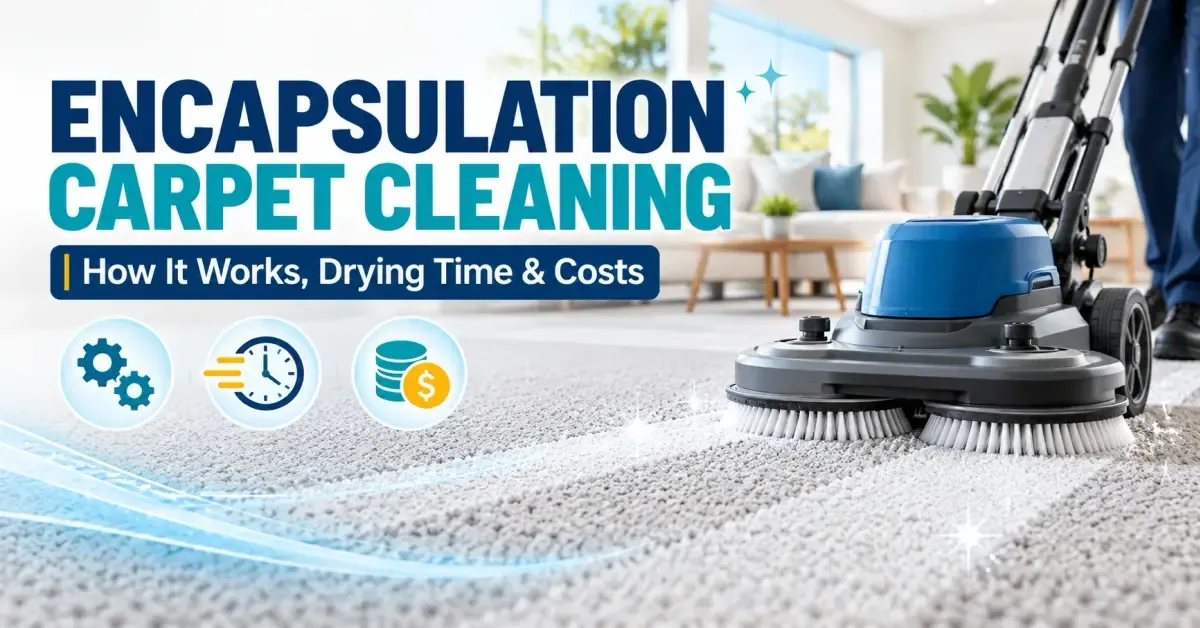
This article explains exactly what encapsulation cleaning is, how the crystallizing chemistry works, what the process looks like step by step, how it compares to steam cleaning, and what it should cost, so you can decide if it fits your carpet.
Encapsulation carpet cleaning applies a polymer-based solution that surrounds dirt particles and dries into brittle crystals. Those crystals release from carpet fibers and get removed by routine vacuuming. It uses up to 90 percent less water than steam cleaning, dries in under an hour, and works best as maintenance cleaning between deep cleans.
What Is Encapsulation Carpet Cleaning?
Encapsulation carpet cleaning is a very low moisture method that traps soil inside a crystallizing polymer instead of flushing it out with water. The trapped dirt gets vacuumed away after the solution dries, which takes 20 to 45 minutes in most conditions.
The industry calls this VLM cleaning, short for very low moisture. A technician applies the solution with a sprayer, works it into the fibers with a brush machine, and lets it dry. No rinse, no extraction, no hoses running to a truck outside.
The method grew up in commercial buildings, where offices and hotels needed carpet cleaned without shutting spaces down for hours. That origin explains most of its strengths and its limits, which matter when deciding whether it belongs in your home.
How Does the Crystallizing Polymer Actually Work?
The polymer in encapsulation solution surrounds each soil particle as a liquid, then hardens into a brittle crystal shell as it dries. The crystal cannot stick to carpet fiber, so it breaks loose and lifts out with normal vacuuming.
Think of it like dipping something sticky in wax. Oily soil normally clings to fibers and grabs more dirt over time. The polymer coats that oily particle completely, cutting off its ability to bond with anything. Once dry, the coated particle behaves like dry sand instead of sticky grime.
The removal keeps going after the cleaning day ends. Crystallized soil continues releasing through routine vacuuming over the following 24 to 48 hours, according to industry equipment documentation. Each vacuum pass pulls out more of it, which is why encapsulated carpet often looks better a week after cleaning than the day of.
Why the Crystallizing Carpet Cleaning Method Resists Resoiling
The crystallizing carpet cleaning method leaves no sticky residue behind, which is the exact opposite of what traditional shampooing does. Sticky detergent residue attracts new dirt with every footstep. Dry crystal residue attracts nothing.
This is why encapsulated carpet stays clean longer between sessions. There is nothing left in the fiber for fresh soil to grab onto. The polymer either leaves with the vacuum or sits inert until it does.
What Are the Steps in the Encapsulation Cleaning Process?
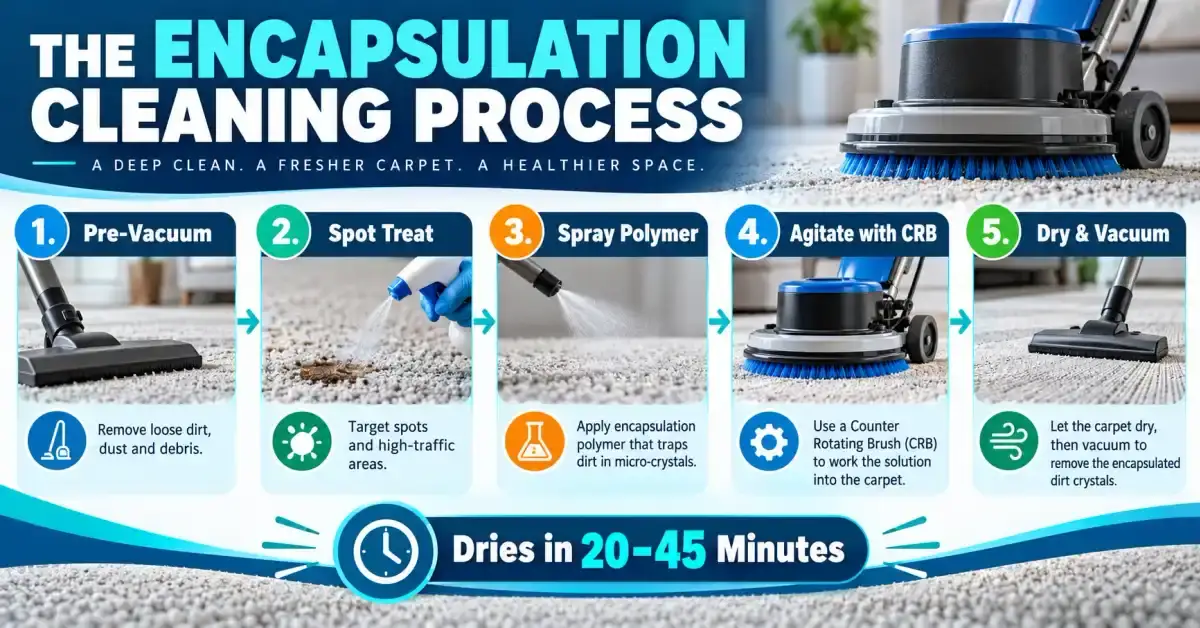
The encapsulation process runs in five steps: pre-vacuum, spot pre-treatment, solution application, machine agitation, and post-vacuuming after drying. The whole active cleaning takes under an hour for most rooms.
First comes a thorough vacuum pass, since encapsulation targets sticky and oily soil, not loose dry dirt. Visible spots get a pre-treatment next. Then the technician sprays the polymer solution evenly across the carpet.
Agitation is where the real work happens. A counter-rotating brush machine, often called a CRB, drives the solution down into the pile so polymers reach soil at the fiber level, not just the surface. Some technicians use a rotary pad machine instead, which works but reaches less deeply.
The carpet then dries for 20 to 45 minutes while the polymer crystallizes. A final vacuum, either the same day or during normal routine vacuuming afterward, removes the crystals and the soil locked inside them.
Encapsulation vs Steam Cleaning: Which One Does Your Carpet Need?
Encapsulation wins on speed, drying time, and cost per visit, while steam cleaning wins on deep soil removal and warranty compliance. The right choice depends on how dirty the carpet is below the surface, not just how it looks on top.
Here is the honest comparison:
Encapsulation vs Steam Cleaning
| Factor | Encapsulation | Steam Cleaning |
|---|---|---|
| Soil removal depth | Surface and mid-fiber soil, excellent appearance improvement | Full pile depth, flushes contamination from the backing |
| Drying time | Under 1 hour | 2 to 24 hours depending on equipment |
| Water used | Up to 80 to 90 percent less than extraction | High volume, injected and extracted |
| Warranty compliance | Does not satisfy manufacturer requirements alone | The method most warranties specifically require |
| Best role | Interim maintenance between deep cleans | Periodic restorative deep cleaning |
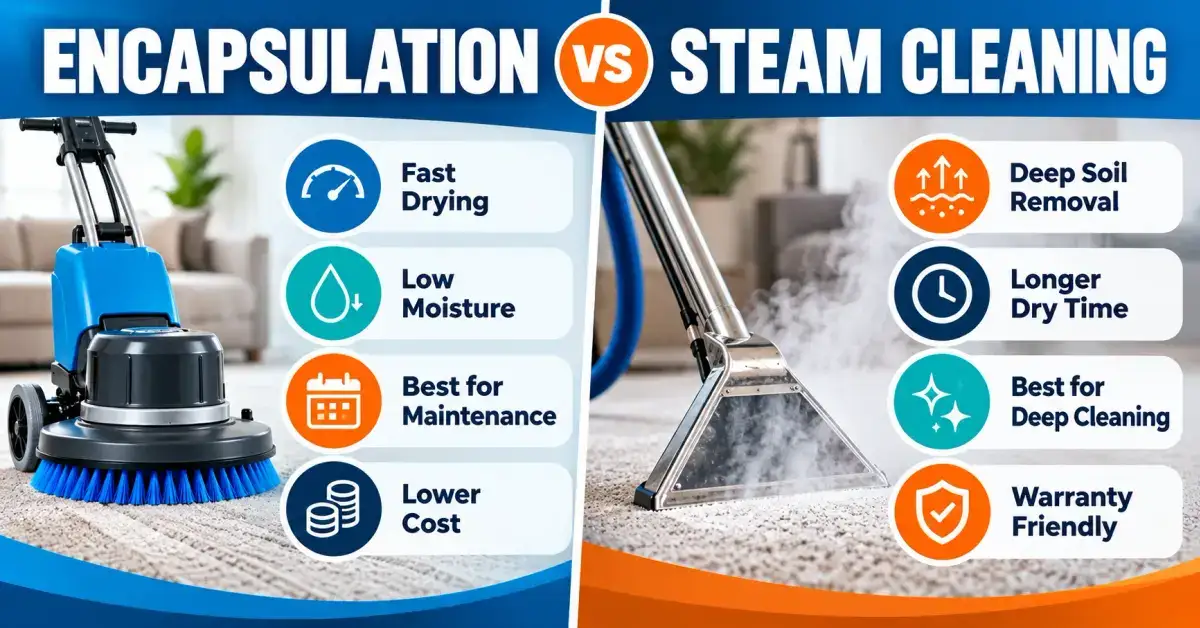
A carpet that looks dull and gets steady daily traffic responds beautifully to encapsulation. A carpet with pet accidents, deep odor, or years of embedded grit needs the flushing action only hot water extraction provides. Many well-maintained homes and businesses use both: encapsulation quarterly, extraction annually.
Is Encapsulation Cleaning for Homes, or Just Commercial Buildings?
Encapsulation works fine in homes, but it earns its reputation in commercial buildings because that is the environment it was designed for. Offices, hotels, and stores cannot close a floor for half a day while carpet dries, so a method with a one-hour return to service solved a real business problem.
In a house, the fast drying matters less but still helps. A family can clean the living room in the morning and use it by lunch. Homes in humid climates also benefit, since less moisture means less mold risk in carpet that dries slowly.
The catch is warranty coverage. Major manufacturers including Shaw and Mohawk require professional hot water extraction every 12 to 18 months to keep warranties valid. Encapsulation between those extractions is smart maintenance, but a homeowner who uses encapsulation exclusively for three years, then files a wear claim, will likely find the warranty voided. Keep extraction in the rotation and keep the receipts.
How Much Does Encapsulation Carpet Cleaning Cost?
Encapsulation typically costs 10 to 30 cents per square foot professionally, roughly half the price of hot water extraction in most markets. The lower price reflects faster job times and simpler equipment, not lower-quality results for what the method is designed to do.
The smarter way to think about cost is across a full year. A homeowner paying for one deep extraction annually plus two encapsulation visits often spends about the same as two extractions, while the carpet looks consistently clean year-round instead of cycling between freshly cleaned and visibly soiled.
Picture a household with a high-traffic hallway that starts looking gray about four months after every deep clean. Adding a low-cost encapsulation visit at that four-month mark keeps the hallway presentable without paying extraction prices twice a year. That maintenance-layer role is exactly where the method delivers the best value for the money.
What Encapsulation Cleaning Data Shows About Carpet Maintenance
Industry and standards data explains why encapsulation earned a permanent place in professional cleaning rather than fading as a trend. These numbers show what the method genuinely delivers.
Encapsulation uses up to 80 to 90 percent less water than hot water extraction, according to industry cleaning equipment data, which nearly eliminates the mold and overwetting risks tied to moisture left in carpet. Cleaned areas return to service in under an hour, versus 6 to 24 hours for traditional extraction. The polymer solution dries and crystallizes within 20 to 45 minutes, and soil removal continues through routine vacuuming for 24 to 48 hours afterward. The IICRC S100 standard recognizes low moisture methods like encapsulation as legitimate professional cleaning, while specifying performance outcomes rather than requiring any single method. Manufacturers including Shaw and Mohawk still require hot water extraction every 12 to 18 months for warranty coverage, which positions encapsulation officially as interim maintenance rather than the required deep clean.
Common Questions About Encapsulation Cleaning, Answered
How long does carpet take to dry after encapsulation cleaning?
+
Carpet dries in 20 to 45 minutes after encapsulation cleaning in normal conditions. Most rooms are ready for foot traffic within an hour, which is the fastest turnaround of any professional wet method.
Why does carpet sometimes feel stiff or crunchy after encapsulation cleaning?
+
A slightly crisp feel means dried polymer crystals are still in the fibers waiting to be vacuumed out. One or two normal vacuum passes removes them and restores the regular texture.
Does encapsulation cleaning remove pet stains and odors?
+
Encapsulation handles light surface pet soil reasonably well but cannot reach urine that has soaked into the backing or pad. Deep pet contamination needs enzyme treatment and hot water extraction.
Is encapsulation cleaning safe for kids and pets?
+
Yes, most encapsulation solutions are low-VOC and safe once dry, which happens within the hour. Ask for products carrying the CRI Seal of Approval for independently tested options.
Can you do encapsulation cleaning yourself at home?
+
DIY encapsulation is possible with retail polymer solutions and a brush machine rental, but results depend heavily on even application and proper agitation. Professional CRB equipment outperforms consumer tools significantly.
How often should encapsulation cleaning be done?
+
Every 3 to 6 months works well for busy homes, and monthly for commercial spaces with constant traffic. Pair it with hot water extraction every 12 to 18 months for warranty compliance.
Does regular vacuuming remove the leftover polymer crystals?
+
Yes, routine vacuuming removes the crystals along with the soil trapped inside them. Two to three normal vacuum sessions after cleaning typically clears everything out.
What machines are used for encapsulation cleaning?
+
Counter-rotating brush machines are the standard because they agitate solution deep into the pile. Rotary machines with pads and cylindrical brush units also work for lighter jobs.
Can encapsulation cleaning fix wicking and recurring spots?
+
Yes, encapsulation is one of the best fixes for wicking, where stains reappear after wet cleaning. The polymer locks the rising residue in place so it vacuums out instead of resurfacing.
Does encapsulation cleaning work on all carpet types?
+
Encapsulation works on most synthetic residential and commercial carpet. Delicate natural fibers like wool need a compatible solution and gentler agitation, so confirm with the technician first.
The most useful way to think about encapsulation carpet cleaning is as the maintenance layer in a two-layer system, not as a rival to deep cleaning. Homeowners who treat it as a cheap replacement for extraction end up disappointed and out of warranty. Those who slot it between annual deep cleans get carpet that looks consistently clean all year at a lower total cost than extraction alone could deliver.
Need a carpet cleaning company you can trust? We handle residential and commercial carpet cleaning, rug cleaning, upholstery cleaning, and pet stain and odor removal —our team is ready to help.

Michael Sanders
Michael Sanders is a home care and cleaning industry writer covering carpet maintenance, flooring care, and household cleaning practices across the United States. His work focuses on practical, research-backed guidance — from stain and odor removal to deep extraction methods and indoor allergen prevention. Michael collaborates with cleaning professionals to ensure accuracy, and his writing reflects a genuine interest in helping homeowners make informed decisions about caring for their homes.